
In this chapter
This chapter describes the people UAE dental clinics serve: their oral health, how often they see a dentist, what holds them back and how they choose a provider. The evidence shows a large unmet need held back by cost and insurance: in a 2019 survey of UAE residents, 55% had not received dental care when they needed it and 62% cited affordability, while modelled WHO data put untreated caries in children aged 1 to 9 at 50.8% (Arabian Business; World Health Organization). Most of the behavioural evidence is old, small or from neighbouring Gulf states, and this chapter says so wherever it applies.
In brief
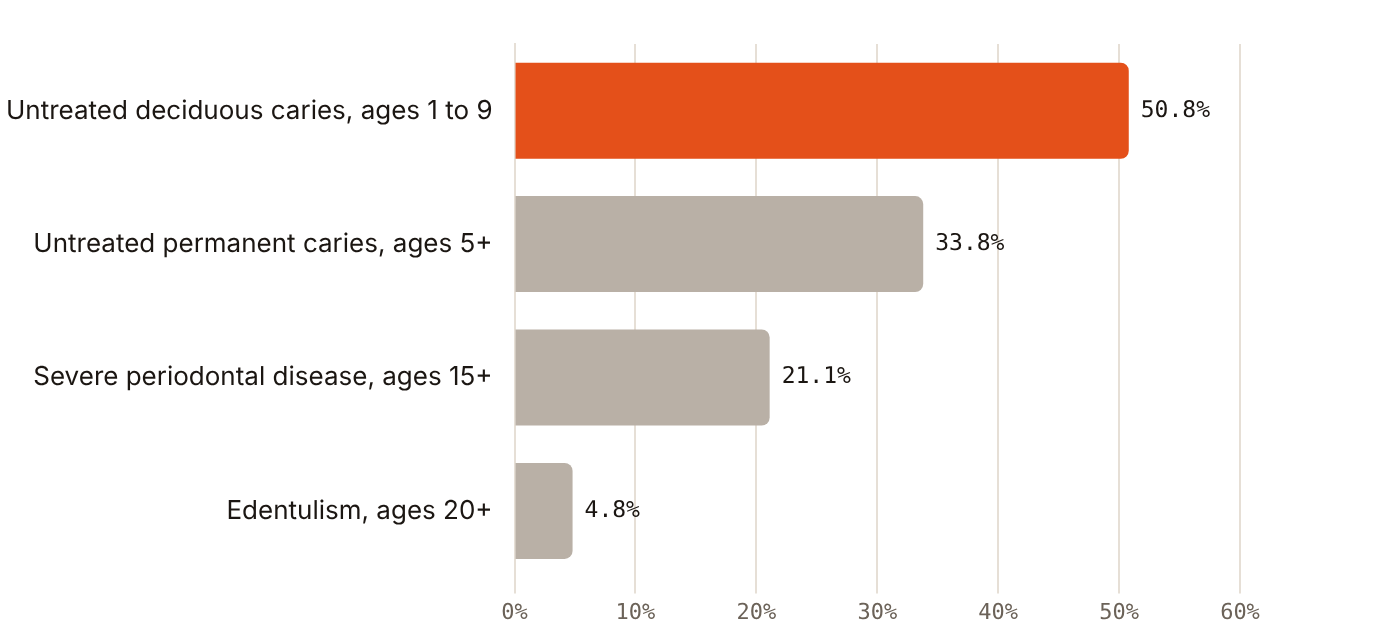
WHO modelled 2019 UAE prevalence at 50.8% untreated deciduous caries (ages 1 to 9), 33.8% untreated permanent caries (ages 5 and over), 21.1% severe periodontal disease (15 and over) and 4.8% edentulism (20 and over) (World Health Organization).
Of 131,451 public-school screening records in Dubai and the northern emirates (2015/16 to 2019/20), 80,061 recorded caries (Alfalasi et al., peer-reviewed study).
Across 29 UAE studies of children, caries prevalence ranged from 22% to 99.4%, and about two-thirds of Al Ain preschoolers seen at a paediatric dental department had never visited a dentist (Al Anouti et al., Frontiers in Oral Health; Al Anouti et al.).
In a 2013 survey, about one in five UAE residents visited the dentist regularly and almost 50% went only when in pain; in 2019, 53% had visited in the past 12 months (Dental Tribune ME; Dental Tribune Middle East).
72.3% of 206 adult oral-surgery patients in Dubai reported moderate or high dental anxiety; 22.4% of children at a UAE dental hospital self-reported severe anxiety (Alansaari et al., IJERPH 20; AlGharebi, Al-Halabi, Kowash et al., European Archives of Paediatric Dentistry 22:29-40, 2021).
Only one third of UAE respondents had dental cover in their insurance in 2019, and 85% said they would consult a dentist if insurance covered it (Arabian Business; Gulf News).
35% of UAE respondents regularly use online reviews when choosing healthcare, against 23% across 17 markets (YouGov, Jan 2024).
Women are 33% of the population in both Abu Dhabi (2024) and Sharjah (2025 census), and a minority of every major UAE social ad audience, from 25.8% on Facebook to 38.0% on Snapchat (SCAD; Khaleej Times).
No UAE study of why residents choose a particular dentist was found; the nearest evidence is from Bahrain, Saudi Arabia and the US.
Demand is broader than cosmetic dentistry
The resident dental market includes prevention, family visits, urgent care, restoration, orthodontics and complex rehabilitation. These involve different decisions. Someone looking for a nearby children's dentist may put a reassuring visit and convenient access first; someone comparing full-arch options may need several discussions about suitability, materials, recovery, cost and ongoing care. Each layer of evidence in this chapter answers a different question, and none of them alone measures paid demand.
| Demand layer | What it establishes | What it does not establish |
|---|---|---|
| Population | Potential resident catchment | Number needing or choosing paid dental treatment |
| Historical disease burden | Public-health context | Current private-clinic demand or annual patient volume |
| Search and review activity | Expressed information or service interest | Clinical eligibility or willingness to pay |
| Attended assessment | A real clinical interaction | Acceptance of the proposed plan |
| Paid care and collections | Commercial outcome for that cohort | Permanent retention or future lifetime value |
ONS reading Plan services around the range of oral-health needs, and use current local enquiries and clinician capacity to decide where to spend the advertising budget. Never infer an individual's condition, income or treatment suitability from population statistics, and never target or message people as though a population prevalence figure describes them personally.
Who the residents are
Population counts are the starting point for planning a clinic's catchment. The latest official figures held are 4,580,000 residents in Dubai at the end of 2025, 4,135,985 in Abu Dhabi emirate in 2024, up 7.5%, and 2,135,888 in Sharjah at the 2025 census (WAM reporting Digital Dubai; DGE and SCAD). No population figure for Ajman, Umm Al Quwain, Ras Al Khaimah or Fujairah is held in the research notes.
| 4.58m Dubai residents End 2025. WAM reporting Digital Dubai | 4,135,985 Abu Dhabi emirate residents 2024. DGE and SCAD | 2,135,888 Sharjah residents 2025 census. Sharjah Government Media Bureau / Sharjah24 |
|---|---|---|
| 33% Female share of population Abu Dhabi 2024 and Sharjah 2025. SCAD; Khaleej Times |
Sex, age and nationality
Both emirates with a published split show the same imbalance. Abu Dhabi's 2024 population was about 2.77m men (67%) and 1.37m women (33%) (SCAD). Sharjah's 2025 census also records 67% men and 33% women, but among Emiratis the split is even, at 116,128 men and 118,213 women (Khaleej Times). Emiratis were 234,431 people, 11% of Sharjah's population (Khaleej Times, 2025). No equivalent nationality split for Dubai or Abu Dhabi residents is held in the notes.
The population is concentrated in working ages. In Abu Dhabi, about 84% of residents are aged 15 to 64 and the median age is 33; residents aged 25 to 44 make up 54% (SCAD, 2024; DGE and SCAD, 2024). That last figure describes the population; it is not a dental demand segment. Within the emirate, the Abu Dhabi Region holds about 2.8m people (68%), Al Ain Region nearly 1m (24%) and Al Dhafra 325,735 (8%) (SCAD, 2024). In Sharjah, the city accounts for 1,899,202 of the 2,135,888 residents, with Khorfakkan at 61,936, Kalba at 59,401 and Al Dhaid at 39,295 (Khaleej Times, 2025).
For marketersA two-to-one male majority shapes the resident market, but the patient for family dentistry, children's care and many cosmetic treatments is often a woman. Sharjah's even Emirati sex split and the female skew of health tourists (58% in Dubai in 2023) suggest that population totals understate the decision-making role of women in some segments; clinics should check their own patient records before assuming either way (Khaleej Times, 2025; Dubai Media Office).
Births and school-age children
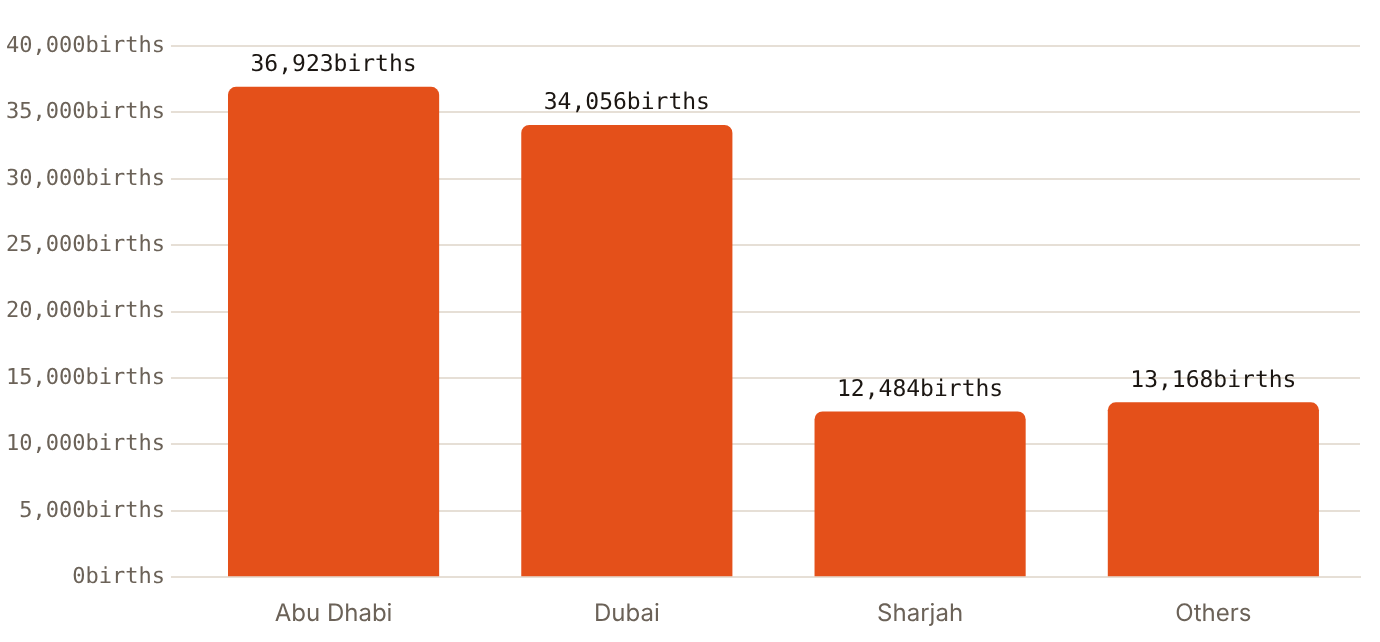
Births define the future paediatric caseload. The latest UAE-wide breakdown by emirate is for 2022, from federal data reproduced by the Gulf Labour Markets and Migration programme (GLMM / FCSC).
| Emirate | Live births | Emirati | Non-Emirati | Year | Source |
|---|---|---|---|---|---|
| Abu Dhabi | 36,923 | 16,303 | 20,620 | 2022 | GLMM reproduction of FCSC/MOHAP data [Official] |
| Dubai | 34,056 | 7,041 | 27,015 | 2022 | GLMM / FCSC [Official] |
| Dubai (DHA Yearbook Tables 3 and 4) | 34,354 | 7,072 | 27,282 | 2024 | DHA [Official] |
| Sharjah | 12,484 | 2,843 | 9,641 | 2022 | GLMM / FCSC [Official] |
| Others: Ajman 6,275; RAK 2,951; Fujairah 2,661; UAQ 1,281 | 13,168 (ONS sum) | Not summed | Not summed | 2022 | GLMM / FCSC [Official] |
| UAE | 96,631 | 30,889 | 65,742 | 2022 | GLMM / FCSC [Official] |
The Dubai 2024 figure needs a caveat. The DHA yearbook's text and Table 2 give 37,834 live births for 2024, but its Tables 3 and 4 show 37,834 as the 2022 value and 34,354 for 2024 (DHA). The federal figure for Dubai in 2022 is 34,056 (GLMM / FCSC). This book uses 34,354 for 2024, from the yearbook tables, and 34,056 for 2022, from federal data (DHA; GLMM / FCSC). A press headline for Abu Dhabi Emirati births in 2024 could not be confirmed and is not used.
Abu Dhabi and Dubai accounted for most of the UAE's 96,631 births in 2022
Live births by emirate, 2022, federal data; Others = Ajman, RAK, Fujairah and UAQ combined (ONS sum)
View chart data
| Label | Live births (births) |
|---|---|
| Abu Dhabi | 36923 |
| Dubai | 34056 |
| Sharjah | 12484 |
| Others | 13168 |
School enrolment provides another indicator of potential family demand. Dubai's private schools started the 2026-27 year with 406,563 students, up 4.6% from about 388,731 in June 2026 (Gulf News). Seven new private schools and 17 early childhood centres opened in the year, and 51 new private institutions over two years (Gulf News). Emirates Health Services oversees 312 government schools and 333 school clinics, whose services include oral and dental health (EHS, 2025). In Abu Dhabi, dental tests have been part of student screening for Grades 1, 5 and 9, with 361 schools taking part in recent years as of 2022 (Dubai Eye 103.8). No school-age population count for Abu Dhabi was found.
Oral health of adults
The only recent national estimates are WHO's modelled figures for 2019, published in its 2022 country profile. They measure different age groups and cannot be added together.
WHO models half of UAE children aged 1 to 9 with untreated decay in milk teeth
Modelled prevalence, UAE, 2019, %; each bar has a different age group and denominator, so bars cannot be summed
View chart data
| Label | Prevalence (%) |
|---|---|
| Untreated deciduous caries, ages 1 to 9 | 50.8 |
| Untreated permanent caries, ages 5+ | 33.8 |
| Severe periodontal disease, ages 15+ | 21.1 |
| Edentulism, ages 20+ | 4.8 |
An Abu Dhabi data set for Emirati nationals gives an older, observed picture. Among adult Thiqa cardholders in 2017, the Department of Health recorded more than 85,000 cases of periodontal disease (27 per 100 individuals) and 134,110 caries cases (48 per 100) (Gulf News; Gulf News, citing DoH). Thiqa covers Emirati nationals, so these rates describe one population group in one emirate, not all residents.
A 2019 YouGov survey for Align Technology found that 71% of respondents had had a problem with their teeth or gums in the past year (Arabian Business). The article reporting it attributes the 71% to respondents "in the region" rather than specifically to the UAE, and the survey was commissioned by an aligner manufacturer, so the figure is shown here only as context (Arabian Business). The same survey found that 55% of UAE respondents had occasionally felt self-conscious because of poor oral health in the past year (Dental Tribune Middle East, 2019).
Oral health of children
Children's oral health is better documented than adults', mainly through academic studies. The evidence consistently shows high caries levels and very low treatment of decay in young children.
| Measure | Value | Population and period | Source |
|---|---|---|---|
| Caries, children under 18 | 44 per 100 (described as an increase); gum disease 10 per 100 | Thiqa children, Abu Dhabi, 2017 | Gulf News, citing DoH [Official] |
| Screening records with caries | 80,061 of 131,451 records | Public schools, Dubai and northern emirates, 2015/16 to 2019/20; records may not be unique children | Alfalasi et al., peer-reviewed study [Industry] |
| Child caries prevalence range | 22% to 99.4% | 29 studies, 43,916 participants, systematic review (2021) | Al Anouti et al., Frontiers in Oral Health [Industry] |
| Caries severity (dmft, primary teeth) | 0.75 (Abu Dhabi nurseries) to 10.9 (Al Ain) | Abu Dhabi studies in the review | Al Anouti et al. [Industry] |
| Caries severity (DMFT, permanent teeth) | 1.48 to 3.19 | Sharjah studies in the review | Al Anouti et al. [Industry] |
| Never visited a dentist; care index | about two-thirds; 6.4% | Preschoolers at an Al Ain paediatric dentistry department (clinic sample) | Al Anouti et al. [Industry] |
| Care index despite mean dmft 3.07 | 3.8% | RAK preschool study | Al Anouti et al. [Industry] |
| Deep bite | 40.8% | 458 Emirati children aged 3 to 6, RAK (2021) | Padmanabhan, Madan, Shahid, Dental Journal [Industry] |
| Dental decay at age 5; 12-year-olds with caries | 83%; 54% | First national MOH survey, reported 2006, survey year not stated (old) | Khaleej Times [Official] |
The range across studies is wide because samples differ: the lowest figure, 22%, comes from Sharjah public day care centres and the highest, 99.4%, from an Al Ain paediatric department (Al Anouti et al., Frontiers in Oral Health). A clinic sample will always show more disease than a community sample. The care index figures matter most for marketing: a care index of 6.4% in Al Ain and 3.8% in RAK means only a small fraction of decayed primary teeth in those samples had been treated (Al Anouti et al.). In the 2006 national survey, 52% of five-year-olds with decay had four or more decayed teeth (Khaleej Times).
The RAK occlusion study also recorded physiologic spacing in both arches in 44.5% of children and primate space in both arches in 46% (Padmanabhan, Madan, Shahid, Dental Journal, 2021). These are precursors of later orthodontic need, but no UAE study of malocclusion prevalence or orthodontic treatment need in older children was found.
Referral pathways are part of the picture. In a 2020 survey of 185 paediatricians in the UAE, 51.4% identified the appropriate age for a child's first dental visit, 47.6% believed brushing should start only after the primary molars erupt, and 66.5% would prescribe antibiotics for local dental sepsis without fever (Aburahima, Hussein, Kowash, Alsalami, Al Halabi, Hindawi, DOI 10.1155/2020/7930564). Parents also want to be present: 78% of 240 parents in a UAE study chose to stay with their child during treatment (Odeh et al., Int J Dent 2024).
ONS reading The child evidence points to a gap between need and attendance in early childhood, not to a lack of interest from parents. Low care indices and paediatricians' uncertainty about the first visit suggest that parent education on when to start, delivered through schools, nurseries and paediatric clinics, is likely to find receptive audiences. Messages must be addressed to parents and guardians, should explain what a first visit involves, and must not use fear of decay or shame about a child's teeth to drive bookings.
How often residents see a dentist
Attendance data for UAE adults are sparse and old. A 2013 survey for the Wrigley Extra Oral Healthcare Programme found that about one in five UAE residents visited the dentist regularly, almost 50% went only when in pain, and about 20% went once a year (Dental Tribune ME). In the 2019 YouGov survey for Align, 53% of UAE respondents had visited a dentist in the past 12 months; the top reasons were cleaning and polishing (44%) and general check-ups (31%) (Dental Tribune Middle East). The two surveys used different questions and samples, so the change between them cannot be read as a trend.
Among secondary school students in Sharjah, past-year dental visits varied by nationality group: 53.8% among students of other nationalities, 50.7% among other Arabs, 49.5% among UAE nationals and 25.2% among Indian students (Al Anouti et al.). The low figure for Indian students is a single-study finding, but it suggests that access and habit differ between communities as well as between emirates.
Missed appointments are another reason enquiries may not lead to care. The only UAE study found, published in 2011 and based on two private clinics, reported an average missed-appointment rate of 22.5%, with fear of pain and emergencies the most cited reasons (Ismail AI, Saeed MH, Al-Silwadi FM, J Int Dental and Medical Research 4). As a non-UAE comparison, 36% of US consumers had not visited a dentist in two years in a 2024 American Dental Association survey, with cost the top barrier.
Dental anxiety
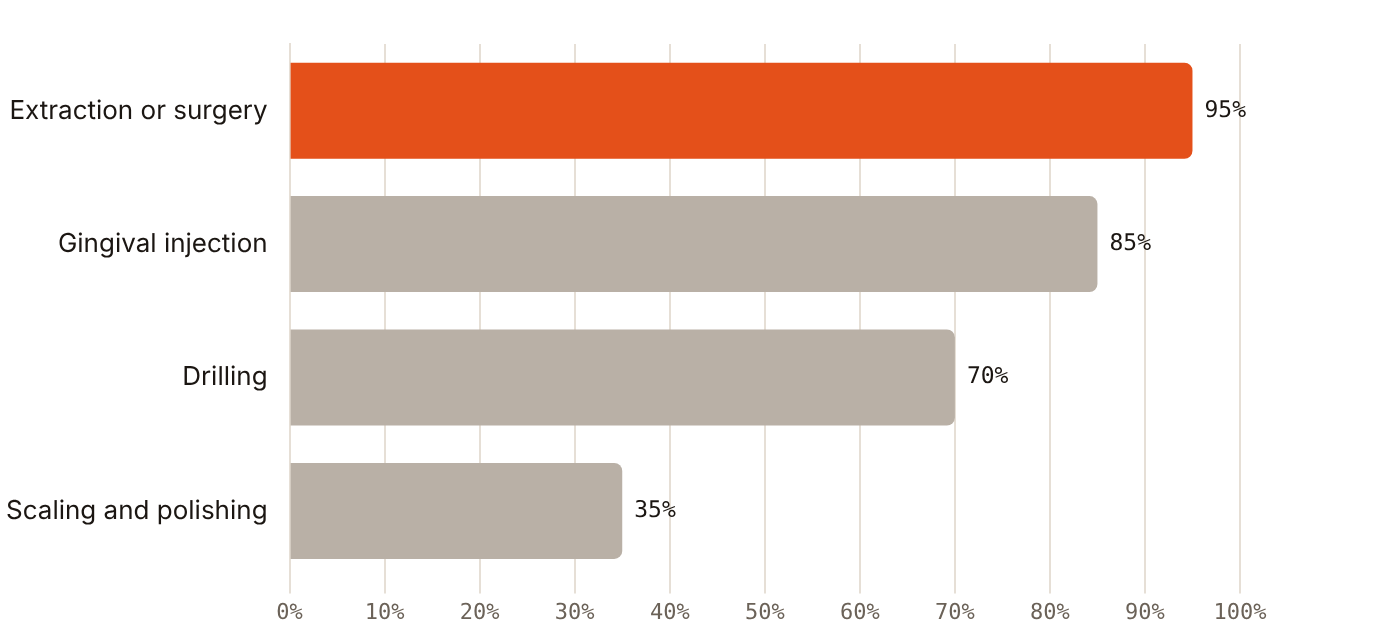
Anxiety shapes both attendance and the marketing message. In a 2023 study of 206 adult oral-surgery patients at Dubai Dental Clinics, 72.3% reported moderate or high dental anxiety (Alansaari et al., IJERPH 20). Extraction or surgery provoked the most anxiety (95%), followed by gingival injection (85%) and drilling (70%); scaling and polishing provoked the least (35%) (Alansaari et al.). Patients preferred "tell-show-do" (70%) and communication strategies (65%) to reduce anxiety (Alansaari et al.).
95% of anxious oral-surgery patients in Dubai found extraction or surgery anxiety-provoking
Share of patients rating each procedure anxiety-provoking, adult oral-surgery patients, Dubai Dental Clinics, n=206, 2023, %
View chart data
| Label | Anxiety-provoking (%) |
|---|---|
| Extraction or surgery | 95 |
| Gingival injection | 85 |
| Drilling | 70 |
| Scaling and polishing | 35 |
Among children, a study of 156 parent and child pairs at a UAE postgraduate dental hospital found severe dental anxiety self-reported by 22.4% of children and reported by 33.3% of parents on their child's behalf, with 9% of children dentally uncooperative (AlGharebi, Al-Halabi, Kowash et al., European Archives of Paediatric Dentistry 22:29-40, 2021). Extractions caused the most anxiety, then injections and fillings, and children and parents agreed in 68.6% of cases (AlGharebi, Al-Halabi, Kowash et al., European Archives of Paediatric Dentistry 22:29-40, 2021). A Ras Al Khaimah study of 138 adults (November 2024 to April 2025) examined anxiety and oral-health-related quality of life but reported no prevalence figure (Hashim et al., Healthcare 14).
For marketersThe procedure ranking matters for content. People fear extraction and injections far more than cleaning (Alansaari et al.). Explaining each step and introducing the team addresses that anxiety directly; patients in the Dubai study preferred explanation and communication over other approaches (Alansaari et al.). DHA's social media standard, in force since October 2022, bans absolute phrases such as "has no side effects" and "immediate results" (see chapter 18) (Khaleej Times, 2026).
Cost and insurance as demand drivers
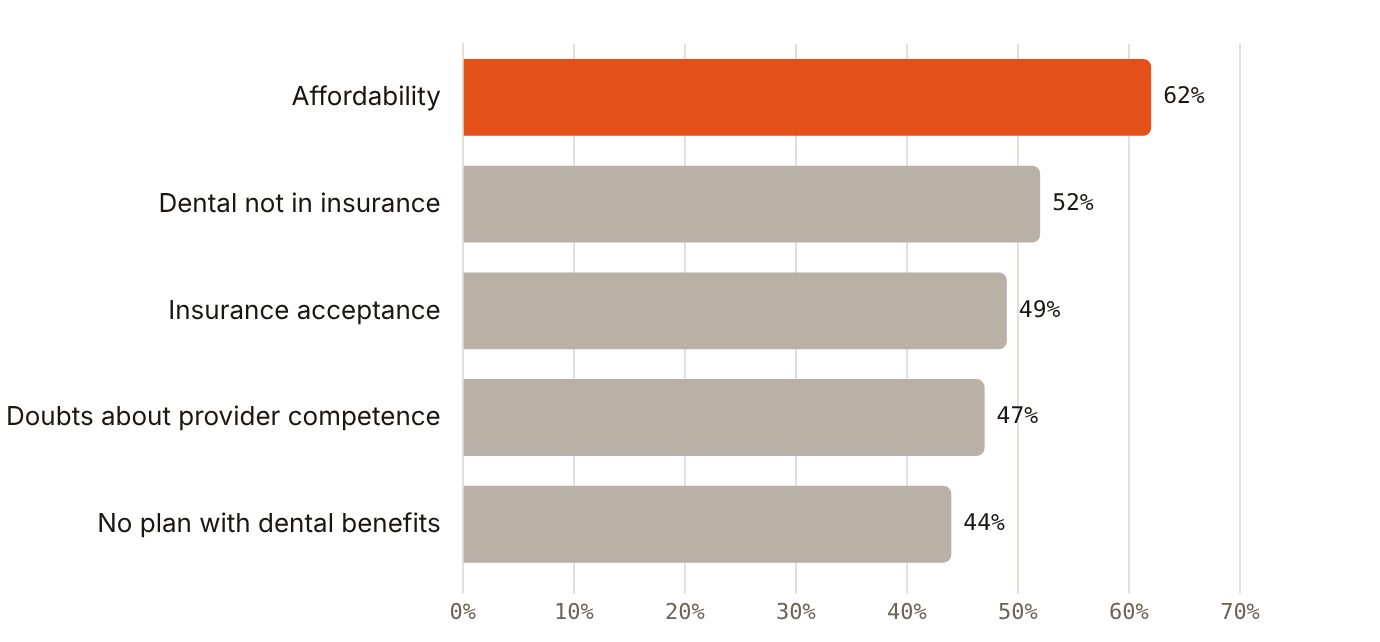
Cost is the barrier residents name most often. In the 2019 YouGov survey for Align, 55% of UAE respondents had not received dental care when needed in the past 12 months; 62% cited affordability and 52% said dental care was not in their insurance (Arabian Business). Other barriers were insurance acceptance (49%), doubts about provider competence (47%) and having no plan with dental benefits (44%). Only one third had dental cover in their insurance; of those, 47% were covered for AED 3,000 or less a year and 20% for up to AED 5,000 (Arabian Business).
The same survey suggests that cover changes behaviour: 85% said they would consult a dentist if insurance covered it, and 89% said dental consultations should be in basic insurance; 80% of respondents were expatriates (Gulf News). The survey is old and was commissioned by a manufacturer with an interest in the result, but it is the only UAE-wide evidence on insurance and attendance found.
Current insurance terms confirm the gap. Dubai's mandatory basic plan generally covers dental emergencies such as acute pain, infection or injury, while braces are often excluded or only partly covered (Gulf News). An insurer executive quoted in October 2026 put typical dental limits on add-on or higher-tier plans at AED 1,500 to 3,500 a year with about 20% co-payment (Gulf News). In Abu Dhabi, a regulator statement reported in 2018 said companies tend to give employees basic plans that exclude oral health, while 569,000 Emiratis had dental access through Thiqa according to 2010 records (Gulf News). Public dentistry in the federal network is free for UAE citizens and GCC nationals with a valid health card. Chapter 14 sets out the plan terms in full.
62% of UAE residents surveyed in 2019 named affordability as a barrier to dental care
Barriers to dental care cited by UAE respondents, YouGov for Align Technology, fieldwork Jul to Aug 2019 (n=509 UAE), %; manufacturer-commissioned, old
View chart data
| Label | Respondents citing (%) |
|---|---|
| Affordability | 62 |
| Dental not in insurance | 52 |
| Insurance acceptance | 49 |
| Doubts about provider competence | 47 |
| No plan with dental benefits | 44 |
ONS reading Insurance status splits the resident market into two different buyers. Insured patients with a dental limit behave like routine-care buyers who want to know whether their card is accepted and what the co-payment is. Uninsured or emergency-only patients behave like self-pay buyers who compare prices and look for instalments. Booking pages should answer the first group's question (accepted insurers, how approval works) and the second group's question (published starting prices with their basis, payment options) separately.
How residents choose a dentist
No UAE study of the reasons residents choose a particular dentist was found. The table below gathers the nearest evidence, with its geography in every row, because a US or Saudi figure must never be read as a UAE figure.
| Finding | Value | Geography and period | Source |
|---|---|---|---|
| Would choose based on dentist qualifications; friends and family; facility's social media | 45.7%; 38.5%; 14.8% | Bahrain, 249 patients, 2021 to 2022 | Sivaramakrishnan G et al., Healthcare Informatics Research 29 [Industry] |
| Instagram used when searching for a dental clinic, women vs men | 15.6% vs 1.2% (abstract gives 10% vs 3%) | Riyadh, Saudi Arabia, 442 patients, 2019 | Alkadhi et al., Journal of Clinical and Diagnostic Research 14 [Industry] |
| Visited or highly considered a dentist for aesthetic treatment because of social media | 26.0% | Saudi Arabia, 515 adults, 2022 | Alhuzili et al., The Open Dentistry Journal vol. 16 [Industry] |
| Social media as main source on "Hollywood smile"; dentist as source | 56.4%; 3.9% | Saudi Arabia, 4,104 respondents, 2022 | Alsurayyi MA et al., The Open Dentistry Journal 16 [Industry] |
| Decision factors: quality of treatment; cost; location; waiting times | 90%; 59%; 46%; 27% | US, 1,099 adults, Oct 2023 | Dentaly.org [Industry] |
| Choose a dentist through friends or family referrals | 47% | US, ADA survey, Mar 2024 | Becker's Dental Review reporting ADA [Industry] |
| Reviews affect choice of dentist | 59% | US, ADA survey, Mar 2024 | Becker's Dental Review reporting ADA 2024 Communications Trend Report [Industry] |
The Saudi studies add detail on aesthetic demand. In the 2022 study of 515 adults, aesthetic dentistry content was seen most on Snapchat (45.8%) and Instagram (44.5%), 62.5% preferred to receive dental health information through social media, and 42.7% were satisfied with their smile. In the 2022 "Hollywood smile" study, 40% of those who had the treatment did so although their dentist had not recommended it (Alsurayyi MA et al., The Open Dentistry Journal 16). In the US, 6% of consumers trust health information from people they follow on social media, against 63% who trust their doctor (Becker's Dental Review reporting ADA, 2024).
Reviews, search and social media
The UAE evidence on reviews is stronger than the evidence on choice. A YouGov study published in January 2024 found that 35% of UAE respondents regularly use online reviews by other consumers when choosing healthcare services, against 23% across 17 markets, 19% in the US and 10% in the UK. A separate YouGov question from December 2021 found that 27% of UAE respondents read or check a provider's ratings or reviews before using a healthcare service, against 18% globally. The two questions measure different behaviour and should not be read as a trend.
Reviews on directories are uniformly high. One directory reports that 88.3% of UAE dental clinics it lists are rated 4.5 or higher (Zavis, 2026). A Doctify search for dentistry around Al Rigga in Dubai returned 691 clinics with 27,949 verified reviews averaging 4.86, and its clear-aligner search returned 54 practices with 8,062 reviews averaging 4.90. When almost every listed clinic is rated 4.5 or above, the rating itself stops differentiating; the number, recency and content of reviews become more important (Zavis, 2026). In the US, 74% of consumers look for reviews written in the last three months (BrightLocal, 2026).
The UAE is almost entirely online: 11.3 million internet users and 99.0% penetration at the end of 2025, with 12.5 million social media user identities (DataReportal, end 2025). Google holds a 93.47% share of UAE search (StatCounter Global Stats, 2026). On one healthcare directory's Google Search Console data, Arabic-language searches were 15.6% of impressions across all specialties in September and October 2026; this is one directory's data, not UAE search behaviour (Zavis). Use of AI for health is high: 59% of UAE respondents in a 2026 Edelman study use AI to manage their health, against a 35% global average, while 89% trust their doctor (Khaleej Times).
Messaging preferences favour WhatsApp. In a 2024 YouGov survey for Zbooni of 1,000 UAE residents across all sectors, 65% had used WhatsApp to enquire about a product or service in the past year, against 55% for call centres and 48% for email, and 87% preferred a real person to a chatbot or AI (Communicate). In Google's Year in Search 2025 for the UAE, "Dr. Joy Dental Clinics" ranked seventh in Google's 2025 UAE trending list for "gadgets, toys, and luxe experiences", the only dental brand reported (Gulf News). Trending measures rising interest, not volume.
Social audiences by gender
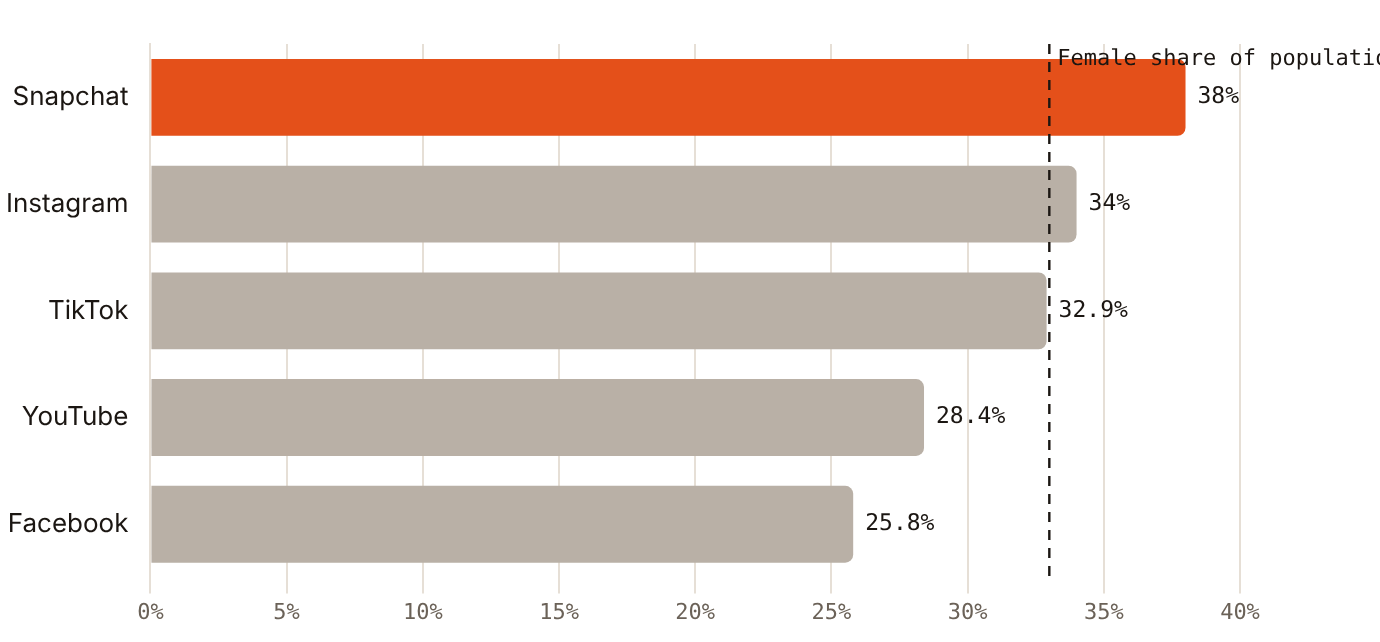
Social advertising audiences in the UAE are majority male on every platform, mirroring the population. In late 2025, Facebook reached 9.70m people, YouTube 8.37m, Instagram 8.05m and Snapchat 5.13m, and TikTok reported 12.5m adults (DataReportal). The female share of each ad audience was 38.0% on Snapchat, 34.0% on Instagram, 32.9% on TikTok, 28.4% on YouTube and 25.8% on Facebook (DataReportal, late 2025).
Women are at most 38.0% of any major UAE social ad audience
Female share of adult advertising audience by platform, UAE, late 2025, %
View chart data
| Label | Female share (%) |
|---|---|
| Snapchat | 38.0 |
| 34.0 | |
| TikTok | 32.9 |
| YouTube | 28.4 |
| 25.8 |
Content on aesthetic dentistry is heavily patient-driven. A peer-reviewed study of 150 Arabic Instagram posts on smile alteration, collected in February 2024 by Saudi-based authors, found that 49.3% were posted by patients, 32.7% by dentists and 18.0% by dental groups; 69.3% had a marketing theme and 84.0% contained non-factual claims (AlSheikh RN et al., Clinical, Cosmetic and Investigational Dentistry 17:135-146). Photos made up 51.3% of posts and reels 30.0%, mean likes per post were 1,666, and patients' posts drew the highest mean likes, 2,768 (AlSheikh RN et al., CCIDE, 2024). The audience is Arabic-speaking and Gulf-wide, not specifically UAE.
ONS reading The UAE combines high review reliance (35% for healthcare against 23% across 17 markets) with near-universal high ratings on directories. Clinics that want reviews to work for them should focus on steady, recent, detailed reviews within platform rules, and on replying to criticism calmly, rather than chasing a star average that every competitor already has. On social media, patient-generated content draws the most engagement, which makes consent, accuracy and the DHA's before-and-after rules central to any content plan, not an afterthought.
Gaps in the evidence
No public data. No current UAE survey of adult dental attendance, reasons for choosing a dentist, or the influence of reviews and social media on dental choice (candidate UAE articles on PMC and the MBRU repository were behind bot checks); no current caries or periodontal prevalence by emirate beyond the 2015/16 to 2019/20 school records; no UAE study of malocclusion or orthodontic treatment need in older children; no dental anxiety prevalence for Sharjah or the northern emirates beyond the RAK study design; no nationality split of Dubai or Abu Dhabi residents in the notes; no population for Ajman, Umm Al Quwain, Ras Al Khaimah or Fujairah; no confirmed Abu Dhabi births for 2024. A future edition should commission a UAE resident survey covering attendance, insurance status, decision factors and channel use, split by emirate, sex and nationality group.
Sources & credits
Aburahima, Hussein, Kowash, Alsalami, Al Halabi, Hindawi, DOI 10.1155/2020/7930564, "Assessment of Paediatricians' Oral Health Knowledge, Behaviour, and Attitude in the United Arab Emirates", 2020. https://oalib-perpustakaan.upi.edu/Record/doaj_082d023c05a3485ca857b5e67e693d8d/Description
Al Anouti et al., Frontiers in Oral Health, "Oral Health of Children and Adolescents in the UAE: A Systematic Review", 29 Sep 2021. https://www.frontiersin.org/journals/oral-health/articles/10.3389/froh.2021.744328/pdf
Alansaari et al., 2023. https://ideas.repec.org/a/gam/jijerp/v20y2023i12p6118-d1170040.html
Alfalasi et al., peer-reviewed study, "Dental caries in Dubai and Northern Emirates public schoolchildren", 2026 paper; academic years 2015/16 to 2019/20. https://pmc.ncbi.nlm.nih.gov/articles/PMC13109432/
AlGharebi, Al-Halabi, Kowash et al., European Archives of Paediatric Dentistry 22:29-40, "Children's dental anxiety (self and proxy reported", 2021. https://link.springer.com/article/10.1007%2Fs40368-020-00517-x
Alhuzili et al., The Open Dentistry Journal vol. 16, "The Impact of Social Media Posts Concerning Esthetic Dentistry on Self-Esteem and Satisfaction Among Adults in Saudi Arabia", 2022. https://opendentistryjournal.com/VOLUME/16/ELOCATOR/e187421062202141/PDF
Alkadhi et al., Journal of Clinical and Diagnostic Research 14, "01", Jan 2020. https://jcdr.net/ReadXMLFile.aspx?id=13466
AlSheikh RN et al., Clinical, Cosmetic and Investigational Dentistry 17:135-146, "Instagram and Aesthetic Dentistry: Arabic posts related to dental smile", 19 Feb 2025. https://www.dovepress.com/instagram-and-aesthetic-dentistry-a-study-of-content-and-engagement-am-peer-reviewed-fulltext-article-CCIDE
Alsurayyi MA et al., The Open Dentistry Journal 16, "Hollywood Smile knowledge and perceptions in Saudi Arabia", 14 Mar 2022. https://opendentistryjournal.com/VOLUME/16/ELOCATOR/e187421062111261/
Arabian Business, 5 Feb 2020. https://www.arabianbusiness.com/gcc/uae/439379-majority-in-uae-say-dental-should-be-mandatory-in-health-insurance
Becker's Dental Review reporting ADA, 16 Oct 2024. https://www.beckersdental.com/uncategorized/10-dental-patient-trends-to-know
BrightLocal, "Local Consumer Review Survey 2026", 11 Feb 2026. https://www.brightlocal.com/research/consumer-review-survey/
Communicate, "85 Percent of UAE Residents Want Businesses to Use WhatsApp", 12 Feb 2024. https://communicateonline.me/?p=1277
DataReportal, "Digital 2026: UAE", 5 Nov 2025. https://datareportal.com/reports/digital-2026-united-arab-emirates
Dental Tribune ME, "Only one in five UAE residents visit dentist regularly", 23 Oct 2013. https://me.dental-tribune.com/news/only-one-in-five-uae-residents-visit-dentist-regularly/
Dental Tribune Middle East, "YouGov / Align Technology UAE survey result: dental care should be mandatory within health insurance", 5 Feb 2020. https://me.dental-tribune.com/news/yougov-align-technology-uae-survey-result-dental-care-should-be-mandatory-within-health-insurance/
Dentaly.org, Oct 2023. https://www.dentaly.org/us/research/dentist-reviews-online/
DGE and SCAD, "Abu Dhabi population update", 2024. https://www.dge.gov.ae/en/news/2025-scad-population-update
DHA, "Dubai Health Statistical Yearbook 2024", Dec 2025. https://www.dha.gov.ae/uploads/122025/Dubai Health Statistical Yearbook_202420251248281.pdf
Doctify, "Clear Aligners practices, Al Rigga", Live page, fetched 27 Oct 2026. https://www.doctify.com/en-ae/find/clear-aligners/al-rigga/practices
Dubai Eye 103.8, "Abu Dhabi continues medical screening programme for students", 19 Oct 2022. https://dubaieye1038.com/news/local/abu-dhabi-continues-medical-screening-programme-for-students
Dubai Media Office, "same", 19 Aug 2024. https://www.mediaoffice.ae/en/news/2024/august/19-08/dubai-welcomes-more-than-691k
EHS, "Emirates Health Services provides student screenings and vaccinations through school clinics", 27 Aug 2025. https://www.ehs.gov.ae/en/media-center/news/emirates-health-services-provides-student-screenings-and-vaccinations-through-school-clinics
Emirates Health Services, "General Dentistry service page", accessed Oct 2026. https://www.ehs.gov.ae/en/services/services-directory/general-dentistry
GLMM reproduction of FCSC/MOHAP data, Accessed Oct 2026. https://gulfmigration.grc.net/uae-number-of-births-by-nationality-emirati-non-emirati-and-gender-of-child-and-emirate-2022/?print=pdf
Gulf News, "KHDA: Dubai schools to add 18,000 affordable seats as student numbers climb to 406,563", 1 Oct 2026. https://gulfnews.com/uae/khda-dubai-schools-to-add-18000-affordable-seats-as-student-numbers-climb-to-406563-1.500694714
Gulf News, "Many companies in Abu Dhabi exclude dental care insurance plans", 15 Sep 2018 (figures older). https://gulfnews.com/uae/health/many-companies-in-abu-dhabi-exclude-dental-care-insurance-plans-1.728569
Gulf News, "Should dental care be part of basic health insurance?", 8 Feb 2020. https://gulfnews.com/amp/story/uae%2Fhealth%2Fshould-dental-care-be-part-of-basic-health-insurance-1.69488099
Gulf News, "UAE Google Trends 2025: From cricket to Dubai Chocolate, what everyone googled", Upd. 6 Dec 2025. https://gulfnews.com/amp/story/uae%2Fuae-google-trends-2025-from-cricket-to-dubai-chocolate-what-everyone-googled-1.500370922
Gulf News, 22 Oct 2026. https://gulfnews.com/uae/health/dental-care-in-the-uae-what-families-need-to-know-about-costs-and-insurance-1.500718751
Gulf News, citing DoH, 27 Jun 2019. https://gulfnews.com/uae/new-oral-health-policy-announced-in-abu-dhabi-1.64830168
Hashim et al., Healthcare 14, "2", 15 Jan 2026. https://www.mdpi.com/2227-9032/14/2/219
Ismail AI, Saeed MH, Al-Silwadi FM, J Int Dental and Medical Research 4, "3", 2011. https://research.ajman.ac.ae/en/publications/missed-dental-appointments-in-the-united-arab-emirates/
Khaleej Times, "ChatGPT before doctor? Over half of UAE residents use AI for health decisions", 10 Jun 2026. https://www.khaleejtimes.com/lifestyle/health/ai-use-uae-residents-healthcare-advice
Khaleej Times, "Dental decay on the rise among kids in UAE", 3 Feb 2006. https://khaleejtimes.com/article/dental-decay-on-the-rise-among-kids-in-uae
Khaleej Times, "No side effects: Dubai authority lists words clinics cannot use in ads", 1 Sep 2026. https://www.khaleejtimes.com/uae/dubai-health-authority-claims-words-cannot-be-used-in-doctor-clinic-social-media-ads
Khaleej Times, 24 Jun 2026. https://www.khaleejtimes.com/uae/sharjah-population-jumps-51-in-10-years-to-reach-213-million-census-shows
Odeh et al., Int J Dent 2024, "Understanding Parental Emotions: Children's Dental Visits...", 2024. https://research.ajman.ac.ae/en/publications/understanding-parental-emotions-childrens-dental-visits-and-the-s/
Padmanabhan, Madan, Shahid, Dental Journal, "Majalah Kedokteran Gigi", 2021. https://e-journal.unair.ac.id/MKG/article/download/26587/14472
SCAD, "Abu Dhabi population in 2024 grows 7.5% to reach 4.14m", 30 Jun 2025. https://scad.gov.ae/w/abu-dhabi-population-in-2024-grows-7-5-to-reach-4-14m
Sharjah Government Media Bureau / Sharjah24, "Sharjah Census 2025", 2025 census; released June 2026. https://cm.sharjah24.ae/en/Articles/2026/06/24/aa11
Sivaramakrishnan G et al., Healthcare Informatics Research 29, "1", 31 Jan 2023. https://synapse.koreamed.org/articles/1516081982
StatCounter Global Stats, "Search Engine Market Share United Arab Emirates", Sep 2026 data, checked 27 Oct 2026. https://gs.statcounter.com/search-engine-market-share/all/united-arab-emirates
WAM reporting Digital Dubai, "Dubai resident population at end 2025", End 2025. https://www.wam.ae/en/article/c1hd5qo-dubai-population-tops-4580-million-end-2025
World Health Organization, "Oral Health Country Profile: United Arab Emirates", 2022 profile; 2019 burden and spending estimates. https://cdn.who.int/media/docs/default-source/country-profiles/oral-health/oral-health-united-arab-emirates-2022.pdf?download=true&sfvrsn=aea86e12_7
YouGov Business, "Global: where consumers are most likely to read their reviews", c. 2022 (date not shown). https://business.yougov.com/content/40766-global-where-consumers-are-most-likely-read-their-
YouGov, "Should healthcare services concern themselves with online reviews?", 15 Jan 2024. https://yougov.com/articles/48379-should-healthcare-services-concern-themselves-with-online-reviews
Zavis, "cross-links on UAE Patient Demand Monitor; source articles not fetched", 19 Oct 2026. https://www.zavis.ai/intelligence/uae-patient-demand-monitor-october-2026
PUT THE INSIGHT TO WORK
Your market.
Your next move.
Explore how ONS approaches dental clinic marketing.
Explore our expertise ↗