
In this chapter
This chapter answers three questions for a UAE business: can it buy ChatGPT Ads, how large and receptive is the UAE audience, and how should it plan by emirate, language and customer type. The UAE is listed as "Available" for self-service Ads Manager in OpenAI's 89-country list read on 28 October 2026, alongside all five other GCC states. The UAE has the highest measured generative AI use in the world, 73.3% of the working-age population in Q2 2026, and ChatGPT holds 80.99% of UAE AI chatbot share, but OpenAI publishes no UAE audience figure for the Free and Go users who can actually see ads.
In brief
- OpenAI's Ads Manager availability page, read on 28 October 2026, lists 89 countries, all "Available", including the UAE, Saudi Arabia, Qatar, Kuwait, Bahrain and Oman.
- The listing confirms self-service access for a legal entity in the UAE; it does not approve any category or guarantee delivery in a target market (OpenAI; OpenAI Help Center).
- The UAE was not on the list in early September 2026 and appeared between 6 and 17 September, according to third-party reads; OpenAI has not published the date (Origami; Digital Applied).
- Microsoft measured UAE generative AI use at 73.3% of people aged 15 to 64 in Q2 2026, ahead of Singapore at 64.3%, against a global 18.8%, up from 70.1% in Q1 2026.
- ChatGPT had 80.99% of UAE AI chatbot share in September 2026, and chatgpt.com was the third most visited site in the UAE with 27.73M visits (StatCounter; Semrush).
- Search remains far larger: Google had 93.47% of UAE search engine share in September 2026 (StatCounter).
- Reports of free ChatGPT Plus for all UAE residents were not confirmed by OpenAI or UAE authorities; this matters because Plus users do not see ads.
- UAE consumer protection rules require advertising and website information to be in Arabic as a minimum, according to Pinsent Masons.
- No emirate-level ChatGPT audience, price or performance data has been published; location controls must be checked in each account (OpenAI; OpenAI Help).
UAE availability: what the 89-country list says
OpenAI's help-centre article "Ads Manager Availability" was read in a browser by ONS on 28 October 2026. It listed 89 countries, all marked "Available", including "United Arab Emirates", Saudi Arabia, Qatar, Kuwait, Bahrain and Oman (OpenAI Help Center). The page carried an "Updated" stamp of 14 hours before it was read (OpenAI Help Center). The same article in the ru-ru locale listed the other Middle East and North Africa markets: Egypt, Jordan, Lebanon, Iraq, Morocco, Algeria, Tunisia, Israel and Turkey, together with Pakistan and India (OpenAI Help, 2026). OpenAI's 21 October 2026 announcement of the expansion to 89 countries named 14 Latin American markets and others such as Nigeria, South Africa, Serbia, Ukraine, Cambodia, Bangladesh and Pakistan, but no Middle East country.
Readers who check the page themselves should note the date read. The help-centre page read on 28 October 2026 listed 89 countries, all "Available", including the UAE. Any citation of UAE availability should name the date read.
The page states what the listing means: to use self-service Ads Manager, the advertiser's legal entity must be in a listed country (OpenAI Help Center). The ONS draft verified this as "Legal-entity availability; not category approval" (OpenAI). OpenAI's onboarding page adds that "A registered or licensed business is not automatically eligible for every advertising category or market" and that an ad "can pass review and still be ineligible to serve in its selected countries". Availability is therefore the first of several gates, not the last.
The GCC picture
All six GCC states are listed as available for self-service (OpenAI Help Center). Billing differs. The minimum daily budget table includes AED 65, SAR 50 and QAR 60, but has no row for the Kuwaiti dinar, Bahraini dinar or Omani rial (OpenAI Help, 2026). OpenAI does not state whether advertisers in those three countries bill in USD, whose minimum is USD 25.
| Country | Ads Manager status, 28 Oct 2026 | Minimum daily budget in local currency | Listing history from third parties | Source |
|---|---|---|---|---|
| United Arab Emirates | Available | AED 65 | Absent 3 and 6 Sep; present in 17 Sep archive copy | OpenAI Help Center; OpenAI Help; Digital Applied [Platform] |
| Saudi Arabia | Available | SAR 50 | Absent 3 and 6 Sep; listed by 24 Sep | OpenAI Help Center; OpenAI Help; Origami [Platform] |
| Qatar | Available | QAR 60 | Listed on 6 Sep | OpenAI Help Center; OpenAI Help; Origami [Platform] |
| Kuwait | Available | No KWD row | Listed on 6 Sep | OpenAI Help Center; OpenAI Help; Origami [Platform] |
| Bahrain | Available | No BHD row | Listed on 6 Sep | OpenAI Help Center; OpenAI Help; Origami [Platform] |
| Oman | Available | No OMR row | Listed on 6 Sep | OpenAI Help Center; OpenAI Help; Origami [Platform] |
When the UAE was added
OpenAI has not published the date the UAE joined the list, and the sources that bound it are mostly agency reads graded Estimate. OpenAI's own post dated self-serve opening for "the Middle East and North Africa" to 31 August 2026, without naming countries. A Thrad press release on ExchangeWire, dated 2 September 2026, said ChatGPT Ads opened across MENA "today"; that is the day Thrad's clients went live, and OpenAI's 31 August is the opening date. Digital Applied found the UAE, Saudi Arabia, Israel and Turkey absent from a 3 September read of the help page and present in an Internet Archive copy of 17 September 2026. Origami, a Saudi agency, reported on 6 September that Saudi Arabia and the UAE "are not listed", while Bahrain, Kuwait, Qatar, Oman, Jordan, Egypt, Morocco, Tunisia, Algeria, Iraq and Lebanon were.
Al Bayan reported on 16 September 2026 that OpenAI was expanding with self-serve in MENA and named the UAE, Saudi Arabia, Qatar, Egypt, Kuwait, Morocco, Turkey, Jordan and Bahrain, with a statement from Dave Dugan, VP Global Advertising Solutions. The same report said Mark Bambury had been appointed Head of OpenAI EMEA, Ads, including MENA, based in Dublin (Al Bayan). PPC Land saw 63 countries on the help page on 24 September, of which 15 MENA markets, including the UAE, had no public activation date. The best-supported reading is that the MENA region opened on 31 August and the UAE appeared on the list between 6 and 17 September 2026; the sources do not give an exact day.
Al Bayan also reported OpenAI figures given at the MENA briefing: about 20% of ChatGPT conversations globally show clear commercial intent, and over the previous six weeks average cost per purchase fell about 60% and average CPM about 20%. These are global figures reported by press from an OpenAI briefing, not UAE measurements.
For UAE marketers: A UAE-registered business can open a self-service account today. A Saudi, Qatari or Kuwaiti sister company can too, but each entity bills in its own currency where one exists, and a Kuwaiti, Bahraini or Omani entity should confirm its billing currency at set-up because the table has no row for it (OpenAI Help Center; OpenAI Help, 2026).
How widely the UAE uses AI
The UAE leads Microsoft's measure of generative AI diffusion: 73.3% in Q2 2026, ahead of Singapore at 64.3%, against a global 18.8%. For the earlier trend, Microsoft's AI Diffusion Report for Q1 2026 puts UAE use at 59.4% of the working-age population in H1 2025, 64.0% in H2 2025 and 70.1% in Q1 2026, against global figures of 15.1%, 16.3% and 17.8%. The Q1 figure was up 6.1 points in the quarter (Microsoft, Q1 2026). Microsoft's method measures the share of people aged 15 to 64 who used a generative AI product in the period, using aggregated anonymised Microsoft telemetry adjusted for device share, internet penetration and population. It is Microsoft's own modelled estimate of use of any generative AI product, not a ChatGPT figure.
Share of people aged 15 to 64 using a generative AI product, %, UAE vs global, H1 2025 to Q2 2026 (Microsoft modelled telemetry)

Source: Microsoft, AI Diffusion Report 2026 Q1, May 2026; Microsoft On the Issues, 21 Sep 2026
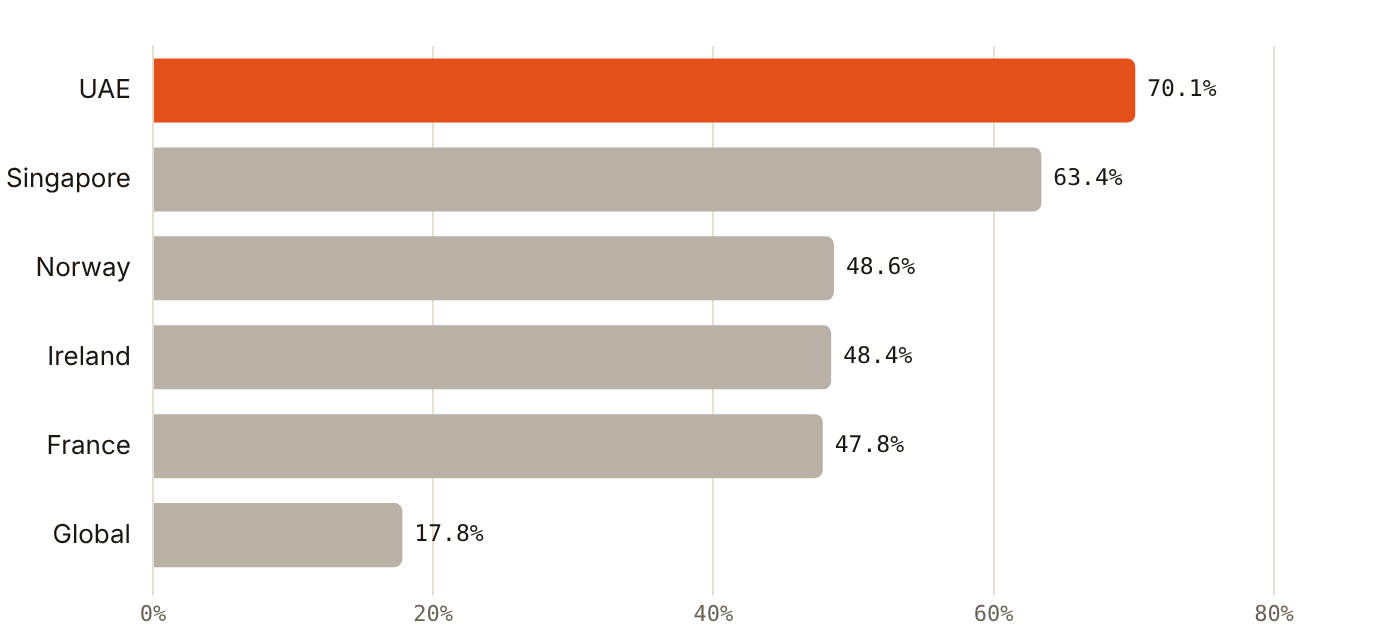
Microsoft's Q2 2026 post (June 2026 reference month) gives the UAE at 73.3%, Singapore at 64.3% and the global figure at 18.8%, and says the UAE and Singapore top the leaderboard without giving a numeric rank. In Q1 2026 the next countries after the UAE were Singapore at 63.4%, Norway at 48.6%, Ireland at 48.4% and France at 47.8% (Microsoft).
Share of people aged 15 to 64 using a generative AI product, %, top five countries and global, Q1 2026
Source: Microsoft, AI Diffusion Report 2026 Q1, May 2026
Survey measures give even higher figures because they ask about any use. KPMG Lower Gulf, reporting the KPMG and University of Melbourne global study, found 97% of UAE respondents used AI for work, study or personal purposes. The global study covers more than 48,000 people in 47 countries; the UAE sample size is not stated (KPMG). Deloitte's Digital Consumer Trends 2025 found 58% of respondents had used generative AI tools such as ChatGPT or Gemini and 55% of users used them weekly or daily, but this sample of 2,000 people aged 18 to 50 combines the UAE and Saudi Arabia. OpenAI's own Signals report ranks countries by per-capita consumer ChatGPT usage but gives no UAE value in its text.
ChatGPT's position in the UAE
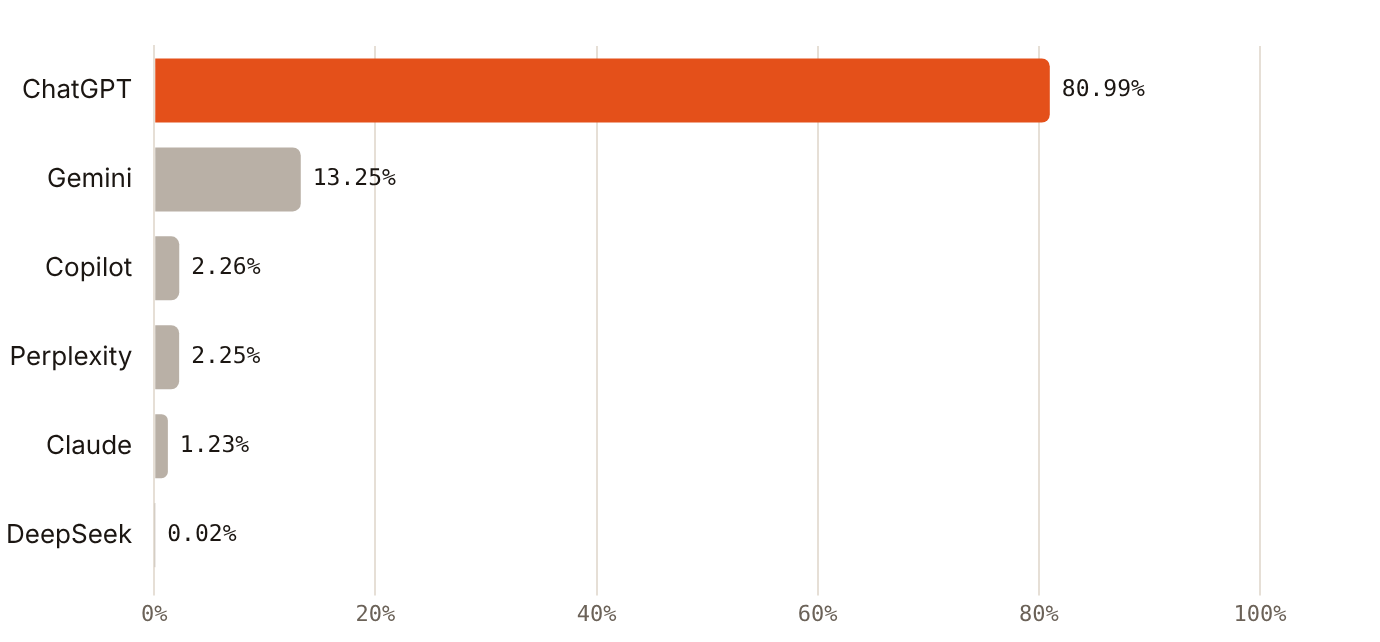
Among AI chatbots, ChatGPT dominates UAE referral traffic. StatCounter's September 2026 figures give ChatGPT 80.99%, Gemini 13.25%, Copilot 2.26%, Perplexity 2.25%, Claude 1.23% and DeepSeek 0.02% of UAE AI chatbot share. StatCounter measures page views and referrals from its tracked sites, not users.
AI chatbot market share by page views and referrals, %, UAE, all platforms, Sep 2026
Source: StatCounter, AI chatbot market share UAE, Sep 2026
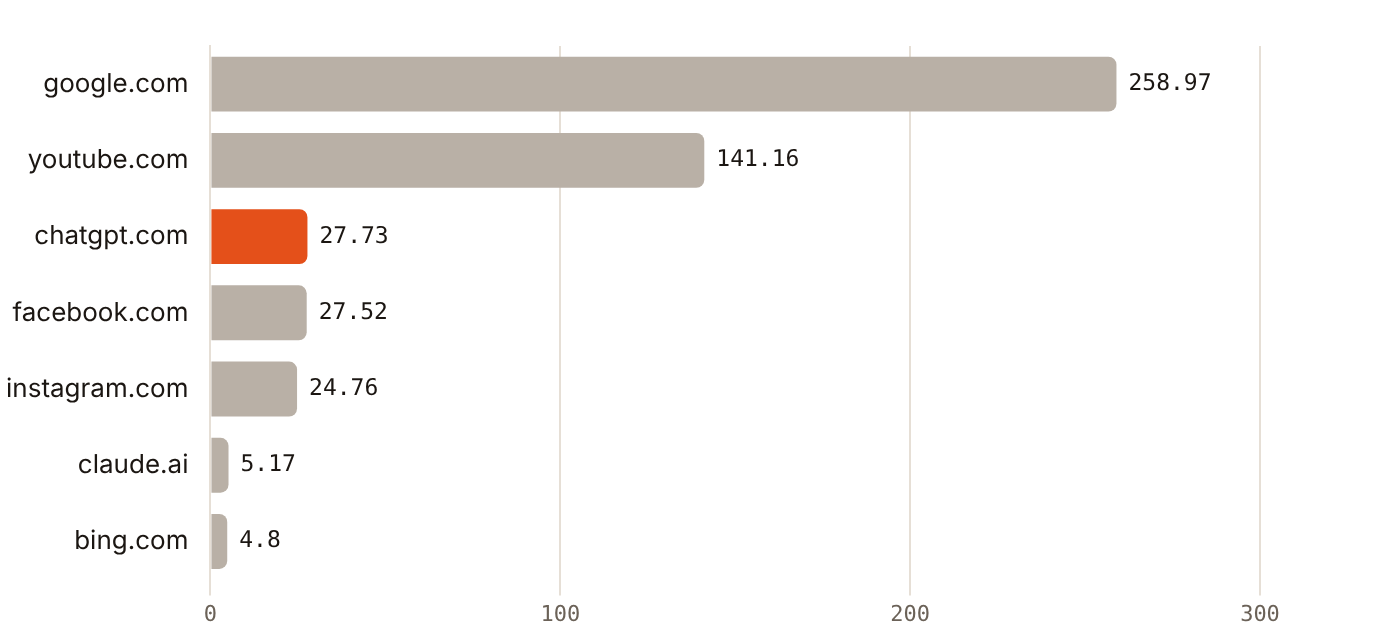
By site visits, chatgpt.com was the third most visited website in the UAE in September 2026 with 27.73M visits, behind google.com with 258.97M and youtube.com with 141.16M, and ahead of facebook.com with 27.52M and instagram.com with 24.76M. claude.ai ranked 17th with 5.17M visits and bing.com 18th with 4.8M (Semrush).
Monthly visits, millions, UAE, Sep 2026 (Semrush)
Source: Semrush, Top websites UAE, Sep 2026
Search is still much larger. Google had 93.47% of UAE search engine share in September 2026, followed by Bing at 3.96%, Yandex at 1.8%, Yahoo at 0.37%, DuckDuckGo at 0.24% and Ecosia at 0.04% (StatCounter). In StatCounter's Google versus ChatGPT view, Google had 99.57% and ChatGPT 0.43% across all platforms, and 99.94% against 0.06% on mobile. That view compares referral traffic, so it does not measure how many people use ChatGPT. The different measures should not be combined.
| Measure | UAE value | What it measures | Period | Source |
|---|---|---|---|---|
| Generative AI diffusion | 70.1% | Modelled share of people 15 to 64 using any gen AI product | Q1 2026 | Microsoft [Platform] |
| Generative AI diffusion | 73.3% | As above (latest) | Q2 2026 | Microsoft On the Issues [Platform] |
| Self-reported AI use | 97% | Survey respondents using AI for work, study or personal purposes | 2025 | KPMG Lower Gulf [Industry] |
| Gen AI tool use (UAE and KSA combined) | 58% | Survey, ages 18 to 50, n=2,000 | 2025 | Deloitte Middle East [Industry] |
| ChatGPT share of AI chatbots | 80.99% | Page views and referrals | Sep 2026 | StatCounter [Industry] |
| chatgpt.com monthly visits | 27.73M | Site visits, rank 3 | Sep 2026 | Semrush [Industry] |
| Google search engine share | 93.47% | Search referrals | Sep 2026 | StatCounter [Industry] |
| ChatGPT vs Google share | 0.43% | Referral share, all platforms | Sep 2026 | StatCounter [Industry] |
ONS reading The UAE is an unusually AI-literate market, and ChatGPT is the assistant most of that use flows through. That makes ChatGPT Ads more relevant in the UAE than the platform's global averages would suggest. It does not make ChatGPT a replacement for search: Google still carries most discovery traffic, and a UAE plan should treat ChatGPT Ads as an addition to a working search and social programme, not a substitute for it.
Who in the UAE can see an ad
Only users on the Free and Go plans can see ads. Plus, Pro, Business, Enterprise and Edu are ad-free, and no ads are shown to users who say, or are predicted to be, under 18 (OpenAI). ChatGPT Go is "available everywhere ChatGPT is available", at USD 8 a month in the US (OpenAI). No official AED price for Go has been found; tbreak estimated "approximately Dhs 29" in January 2026, as its own estimate. tbreak also reported that local AED pricing had not been announced for ChatGPT Pro.
One claim affects the size of the UAE ad audience directly. In May 2025 OpenAI announced Stargate UAE as the first partnership under OpenAI for Countries and said "the UAE will become the first country in the world to enable ChatGPT nationwide". The National then reported, from one unnamed source, that the UAE and OpenAI were "in talks" on free ChatGPT Plus for all residents and that "a final deal has not been reached" (The National). Gulf News reported that the free Plus claim "is not confirmed by OpenAI or UAE authorities" and that the announcement "mentions nationwide access, not free personal subscriptions" (Gulf News; Gulf News, Justin Varghese). People Matters Middle East and Benzinga reached the same conclusion. An agency blog dated 3 September 2026 stated that MENA users get free Plus through Stargate, with no source (Platformance). This book does not treat UAE residents as having free Plus. If they did, they would not see ads, because Plus is ad-free (OpenAI).
The physical infrastructure is also not yet running. OpenAI described a 1GW Stargate UAE cluster in Abu Dhabi with 200MW expected to go live in 2026. Epoch AI recorded it as "still under construction" with 0 MW online as of 22 July 2026, projecting the first 200MW by 1 December 2026.
The UAE population and digital base
| 11.4M Population UAE, Oct 2025. DataReportal/Kepios, Simon Kemp | 99.0% Internet penetration (11.3M users) UAE, late 2025. DataReportal | 31.6 Median age UAE, Oct 2025. DataReportal/Kepios, Simon Kemp |
|---|---|---|
| 63.7% Male share of population UAE, Oct 2025. DataReportal/Kepios, Simon Kemp |
DataReportal's Digital 2026 report for the UAE gives a population of 11.4M in October 2025, a median age of 31.6, a population that is 63.7% male and 88.3% urban, 11.3M internet users and 12.5M social media user identities, equal to 110% of the population and possibly not unique. Cellular connections stood at 23.0M, or 202% of the population, with a median mobile download speed of 614.42 Mbps (DataReportal). Ad reach on established platforms gives a sense of scale against which ChatGPT will be judged: Facebook 9.70M, YouTube 8.37M, Instagram 8.05M, TikTok 12.5M (18 and over), Snapchat 5.13M and LinkedIn 10.0M members (DataReportal, late 2025). DataReportal gives no AI assistant or search share figures.
Custom audiences in ChatGPT Ads need at least 25,000 matched users for inclusion (OpenAI Help). In a population of 11.4M, many UAE customer lists will fall below that threshold; smaller lists can still be used for exclusions (DataReportal/Kepios, Simon Kemp; OpenAI Help).
Attitudes to AI and to AI-made content
UAE residents trust AI answers more than most, but want AI content to be identifiable. KPMG Lower Gulf found that 65% of UAE respondents are willing to rely on information provided by an AI system, and 84% would be more willing to trust AI if assured of trustworthy use. 86% agree that news and social media companies must ensure people can detect AI-generated content, and 73% are cautious about online content because it may be AI-generated. 89% report experiencing AI benefits, against 83% globally.
| Finding | UAE value | Survey and period | Source |
|---|---|---|---|
| Willing to rely on information from an AI system | 65% | KPMG Lower Gulf, 2025 | KPMG Lower Gulf [Industry] |
| Want platforms to make AI content detectable | 86% | KPMG Lower Gulf, 2025 | KPMG Lower Gulf [Industry] |
| Say current regulation is sufficient for safe AI (global 43%) | 68% | KPMG Lower Gulf, 2025 | KPMG Lower Gulf [Industry] |
| Agree laws should prevent AI-generated misinformation | 88% | KPMG global study, UAE page, May 2025 | KPMG [Industry] |
| Say content should state it was made with generative AI | 76% | YouGov, n=1,000, Dec 2024 to Jan 2025 | YouGov [Industry] |
| Comfortable with AI-made brand marketing content | 25% to 27% | YouGov, n=1,000 | YouGov [Industry] |
| Want brands and creators to disclose AI use | 73% | Advertising Business Group, n=1,500, Q4 2025 | Communicate Online [Industry] |
| Say a human influencer's AI use decreases trust | 51% | Advertising Business Group, Q4 2025 | Communicate Online [Industry] |
| Encounter false information more often than a year ago | 48% | Deloitte, 2025 | Deloitte Middle East [Industry] |
YouGov's UAE sample found 25% to 27% comfortable with AI-made brand marketing content across formats, 5% to 7% uncomfortable and 26% to 30% neutral. 33% trust AI-generated news more than human news and 32% less. The Advertising Business Group survey found 87% aware of AI or virtual influencers and 53% strongly preferring human influencers (Communicate Online, Q4 2025). No survey has asked UAE consumers specifically about ads inside AI chatbots.
AI and shopping behaviour
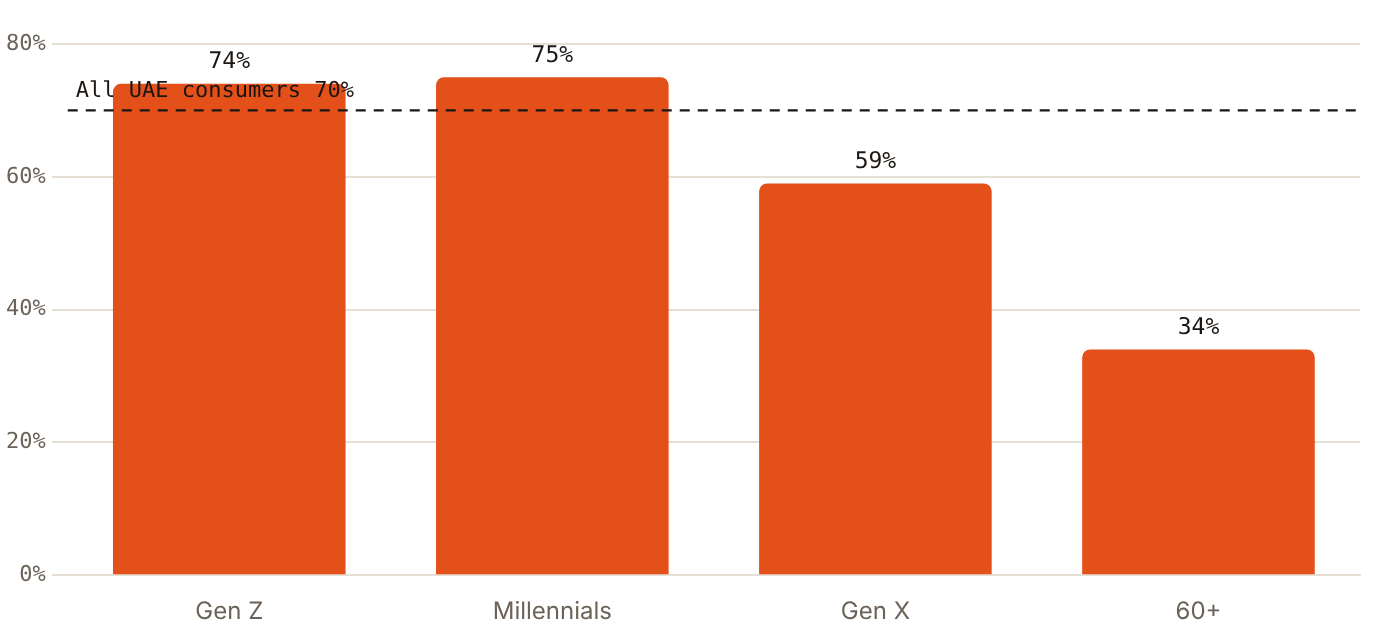
Several vendor studies report high use of AI for shopping in the UAE. Khaleej Times, citing the Adyen Retail Report 2025, reported that 70% of UAE consumers use AI to shop, with use at 74% for Gen Z, 75% for Millennials, 59% for Gen X and 34% for those aged 60 and over. The same report said 41% of UAE retailers would invest in AI for sales and marketing in 2025 (Khaleej Times citing Adyen). Visa's study, with fieldwork in January and February 2026, found 85% of UAE respondents had used AI tools to assist shopping, 32% would trust AI agents to complete checkout and 60% discover new brands online. Checkout.com reported 79% comfortable with AI completing a purchase, but its method is not stated.
Share of UAE consumers using AI to shop, %, by generation, 2025 (Adyen Retail Report via Khaleej Times)
Source: Khaleej Times citing Adyen Retail Report 2025, 19 May 2025
Edelman found that nearly six in ten UAE respondents use AI to manage their health. That interest does not translate into an advertising opportunity on ChatGPT for UAE health providers: OpenAI's policy states that ads for health services outside the US are generally prohibited, and its eligibility table marks hospitals, cosmetic procedures, diagnostics and telehealth as "Not allowed" outside the US. Mental and personal health conversations are also excluded from ad placement (OpenAI). Business adoption is lower than consumer use: PwC found 45% of UAE CEOs use AI for demand generation (PwC Middle East, 2025).
Languages
Language is a legal requirement as well as a service promise. Pinsent Masons, summarising the UAE consumer protection regime, states that advertising, website information, contracts and invoices must be in Arabic as a minimum, with a maximum penalty of AED 2,000,000 and/or two years' imprisonment. This is a law firm's summary, not a legal opinion for any specific campaign.
Arabic AI search is established on Google. AI Overviews became broadly available to all users in MENA and globally in Arabic from 20 May 2025, and AI Mode rolled out in Modern Standard Arabic from October 2025. OpenAI publishes Arabic-language pages, including the Arabic version of its ChatGPT Go announcement. ONS could not read OpenAI's ChatGPT supported-languages page, so this chapter does not state how Arabic conversations are handled for ad matching. Reuters reported on 16 September 2026 that OpenAI was adding opt-in headline adaptation and translation into the user's language for advertisers, but did not say which markets would get it.
English and Arabic content should reflect the languages in which the business can genuinely provide support. Additional language versions should follow customer evidence and operational capacity. Translate price conditions and eligibility details as carefully as headlines; a translated advert pointing to a landing page in another language introduces avoidable uncertainty. Do not infer ethnicity or nationality from an interface language. Report language performance only where the platform or the business's own lawful records support it, and where a small sample cannot sustain separate language comparisons, keep the result combined and mark the breakdown unavailable.
Planning by emirate
No emirate-level ChatGPT audience, price or performance figure has been published. Location targeting depends on the account and campaign type: campaigns other than new product-feed campaigns can target regions, cities, markets and postcodes where available, while new product-feed campaigns are country-level only (OpenAI Help; OpenAI). Whether Dubai, Abu Dhabi or Sharjah can be selected in a particular account must be checked during set-up. Context hints are relevance signals, not delivery controls, and cannot enforce geography (OpenAI).
For planning, ONS treats Dubai, Abu Dhabi and Sharjah as separate commercial areas and groups Ajman, Ras Al Khaimah, Fujairah and Umm Al Quwain as "Others". This is a reporting convention, not a claim that these markets share demand, prices or customer behaviour. No ChatGPT audience or CPC estimate is assigned to any emirate.
| Planning market | Information to collect | Useful landing-page treatment | Source |
|---|---|---|---|
| Dubai | Actual branches, travel constraints and service coverage | State location and realistic delivery area | ONS planning convention |
| Abu Dhabi | City versus wider emirate coverage and on-site availability | Explain where appointments or services take place | ONS planning convention |
| Sharjah | Campus or branch access, timing and customer travel needs | Publish map, hours and access details | ONS planning convention |
| Others (Ajman, Ras Al Khaimah, Fujairah, Umm Al Quwain) | Which of the four emirates are genuinely served | Name covered emirates rather than implying universal coverage | ONS planning convention |
A UAE-wide campaign can produce enquiries outside a provider's catchment. Qualification and clear location information reduce wasted sales effort, but they cannot turn a broad campaign into verified emirate-only targeting after the event. Health advertising rules also differ by emirate: the Dubai Health Authority issued social media standards for medical advertising on 17 August 2026, and Abu Dhabi's Department of Health requires facilities to log ad materials on its systems. Chapter 06 covers sector rules.
Planning by customer type
The UAE sectors that matter most to ONS clients are large, but much of the official data is for Dubai only. The table matches each customer type with its scale data and the current ChatGPT Ads position. Category eligibility comes from OpenAI's policy v1.6 of 10 September 2026 and the eligibility table read on 28 October 2026.
| Customer type | Scale data | ChatGPT Ads position for UAE advertisers | Source |
|---|---|---|---|
| Visitors and hotel guests | Travel and tourism AED 257.3bn, 13% of GDP, 2024; 216,248 rooms in 1,246 hotels; hotel revenue AED 44.4bn Jan to Nov 2025 (TradeArabia citing WAM) | Travel and experiences among primary test verticals | TradeArabia citing WAM; OpenAI [Official] |
| Parents choosing schools | 406,563 students in Dubai private schools, 2026-27 | Education among primary test verticals; under-18s excluded, so target adult decision-makers | Gulf News citing KHDA; OpenAI [Official] |
| Online shoppers | UAE ecommerce AED 42.2bn in 2025 (Euromonitor, not official) | Lifestyle and household goods among primary test verticals; product feeds country-level only | EZDubai with Euromonitor; OpenAI; OpenAI Help [Industry] |
| Property buyers and investors | Dubai real estate transactions AED 917bn in 2025, over 270,000 transactions | Individual housing rentals or sales listings prohibited; links to listing platforms allowed if no specific listing is referenced | Government of Dubai Media Office; OpenAI [Official] |
| Patients | About 5,800 licensed health facilities in Dubai, 2025 | Health services outside the US generally prohibited; hospitals, cosmetic procedures, diagnostics Not allowed | Government of Dubai Media Office citing DHA; OpenAI; OpenAI Help Center [Official] |
| Business buyers | 45% of UAE CEOs use AI for demand generation | Digital products and local services among primary test verticals | PwC Middle East; OpenAI [Industry] |
| Nightlife customers | No scale data in notes | Alcohol and tobacco disallowed by OpenAI; UAE law bans direct or indirect promotion of alcohol, tobacco and smoking | OpenAI; UAE Legislation portal [Platform] |
For nightlife, ONS's rule is that alcohol and shisha cannot be promoted in Dubai, and no shisha may appear in any ad image or video. OpenAI disallows ads that "promote or facilitate the sale, use, or consumption of alcohol or tobacco", and applies its standards to copy, images, video and landing pages.
Separate the business location from the customer's location
A Dubai provider may sell online training nationally, serve local customers in person or recruit international students. Those are different acquisition plans. Self-service access depends on where the legal entity is, and some new accounts can serve only in their home country until identity verification is approved and required home-country spend is reached (OpenAI Help Center; OpenAI Help). Determine where the customer can receive the service and where the advertiser is permitted to deliver ads, and do not substitute the office address for the target-market definition.
For physical services, ask for the customer's preferred branch or emirate at an appropriate point in the enquiry. For remote offers, prioritise time zone, language, schedule and delivery suitability. Avoid requiring a long form before the visitor has enough information to know whether the offer fits.
Consent and data rules that shape audience planning
OpenAI targets ads using the current conversation and, depending on country and user settings, broader ChatGPT context. It has published US and EU or UK personalisation settings but not the UAE setting (Crypto Briefing via Gizmodo). On the advertiser side, the UAE Personal Data Protection Law has been in force since 2 January 2022 and requires consent to be "clear, specific, and unambiguous", but excludes DIFC, ADGM and other free zones with their own data laws (Primerus / Reina Consulting). Morgan Lewis reported in June 2026 that its implementing regulations "have still not been issued"; no later issuance was found by 28 October 2026. In the DIFC, prior opt-in consent is listed for online behavioural advertising, social media targeting and ad personalisation, though there are no specific cookie rules (Baker McKenzie). A business uploading customer lists or installing the ChatGPT Ads pixel should confirm which regime applies to it. Chapter 10 covers measurement.
Build a useful local evidence base
Capture enquiry emirate, service requested, customer type, qualification outcome, response time and eventual sale. Review geographic performance at a level where there is enough data to act. An isolated sale in one emirate does not establish that market as the strongest opportunity. ONS's own two early UAE client tests are reported in Chapter 11; they are a small sample with no dates, spend or revenue published, and are not a basis for emirate or sector benchmarks.
ONS reading For the first pilot, ONS recommends concentrating on the provider's best-supported service area and offer, in English and Arabic where the business can serve in both, and expanding only after evidence of fulfilment quality and acceptable acquisition economics. That gives a more reliable basis for growth than allocating spend by assumed population shares, especially when no platform publishes emirate-level data.
ONS outlook The UAE's high AI adoption, ChatGPT's dominant share of chatbot traffic and the presence of an OpenAI EMEA advertising lead covering MENA suggest the UAE could become one of the more active ChatGPT Ads markets in the region. That is a view, not a forecast. Whether it happens depends on factors OpenAI has not published, including the UAE's ad-eligible user base, its personalisation setting and whether US-only formats are extended. ONS will update this chapter when OpenAI publishes UAE-specific information.
Gaps in the evidence
No public data. OpenAI has not published UAE ChatGPT user numbers, the share of UAE users on Free and Go plans, an official AED price for Go, the exact date the UAE joined the Ads Manager list, or the ad-personalisation setting for UAE users. No independent UAE, GCC or MENA CPM, CPC, CTR or conversion data exists; the Similarweb panel covers nine markets, none in the Middle East. No emirate-level AI usage data was found. No survey covers UAE attitudes to ads inside AI chatbots. OpenAI's supported-languages page could not be read. The full 89-country list is not reproduced in the notes. A future edition should record the full list by locale and date, and seek UAE plan-mix and Arabic ad-matching statements from OpenAI.
Sources for this chapter
- Al Bayan, "OpenAI expands ChatGPT ads to MENA", 2026-09-16. https://www.albayan.ae/economy/1552481
- Baker McKenzie, "DIFC: cookies, online tracking and direct marketing", reviewed 23 Dec 2024. https://resourcehub.bakermckenzie.com/en/resources/global-data-and-cyber-handbook/emea/dubai-international-financial-center/topics/cookies-online-tracking-and-direct-marketing
- Benzinga, "Fact check: no, ChatGPT Plus isn't free for all UAE residents", May 2025. https://feeds2.benzinga.com/news/global/25/05/45612410/fact-check-no-openais-chatgpt-plus-isnt-free-for-all-uae-residents
- Communicate Online, "Eleni Kitra, Advertising Business Group", 2 Feb 2026. https://communicateonline.me/news/ai-influencers-trust-and-the-future-of-advertising-what-uae-consumers-are-telling-our-industry/
- Crypto Briefing via Gizmodo, "OpenAI updates privacy policy for ad personalization", 2026-08-16. https://cryptobriefing.com/openai-privacy-policy-chatgpt-ad-personalization/
- DataReportal/Kepios, Simon Kemp, "Digital 2026: The UAE", 5 Nov 2025. https://datareportal.com/reports/digital-2026-united-arab-emirates
- Deloitte Middle East, "Digital Consumer Trends 2025 press release", 1 Sep 2025. https://www.deloitte.com/middle-east/en/about/press-room/deloitte-digital-consumer-trends-2025-report-reveals-ai-adoption-surge-social-commerce-boom-and-changing-digital-behaviors-in-the-uaeand-ksa
- Department of Health Abu Dhabi, 23 Feb 2023 (older). https://doh.gov.ae/-/media/Feature/Resources/Circulars/26--2023.ashx
- Digital Applied, "Where ChatGPT ads are sold: every market and date", 2026-09-01, mod 2026-10-22. https://www.digitalapplied.com/blog/where-chatgpt-ads-are-sold-every-market-and-date
- Dubai Health Authority, 17 Aug 2026. https://www.dha.gov.ae/en/circulars/details/CIR-2026-00000144
- Edelman, "2026 Trust Barometer Special Report: Health", 2026. https://www.edelman.com/ae/trust/2026/trust-barometer/special-report-health
- Epoch AI, "OpenAI Stargate UAE", upd 22 Jul 2026. https://epoch.ai/data/ai-data-centers/directory/openai-stargate-uae
- ExchangeWire, "Thrad's advertisers in MENA go live on ChatGPT as ads open across the region", 2026-09-02. https://exchangewire.com/blog/2026/09/02/thrads-advertisers-in-the-middle-east-north-africa-go-live-on-chatgpt-as-ads-open-across-the-region
- EZDubai with Euromonitor, "Zawya press release", 28 Sep 2026. https://www.zawya.com/en/press-release/research-studies/ezdubai-logistics-hub-uae-e-commerce-market-size-reaches-aed-42.2bln-in-2025-1286875
- Google MENA Blog, "Bringing AI Overviews to MENA, and in Arabic globally", 20 May 2025. https://blog.google/intl/en-mena/product-updates/explore-get-answers/bringing-ai-overviews-to-mena-and-in-arabic-globally/
- Google MENA Blog, "Introducing AI Mode in Arabic", 8 Oct 2025. https://blog.google/intl/en-mena/product-updates/explore-get-answers/introducing-ai-mode-in-arabic/
- Government of Dubai Media Office citing DHA, 18 Feb 2026. https://www.mediaoffice.ae/en/news/2026/february/18-02/dubais-healthcare-ecosystem-posts-record-growth-in-2025
- Government of Dubai Media Office, 12 Jan 2026. https://www.mediaoffice.ae/en/news/2026/january/12-01/dubais-real-estate-market-records-new-historic-milestone
- Gulf News citing KHDA, 1 Oct 2026. https://gulfnews.com/uae/khda-dubai-schools-to-add-18000-affordable-seats-as-student-numbers-climb-to-406563-1.500694714
- Gulf News, "Is ChatGPT Plus free in the UAE?", 27 May 2025. https://gulfnews.com/business/markets/is-openai-giving-chatgpt-for-free-to-all-uae-residents-know-whats-true-1.500141497
- Khaleej Times citing Adyen Retail Report 2025, 19 May 2025. https://www.khaleejtimes.com/business/70-of-uae-consumers-use-ai-to-shop-a-44-increase-on-2024-numbers?amp=1
- KPMG Lower Gulf, "97 percent of UAE residents now use AI", 9 Oct 2025. https://kpmg.com/ae/en/media/press-releases/2025/10/97-percent-of-uae-residents-now-use-ai.html
- KPMG, "Trust, attitudes and use of AI: a global study 2025, UAE page", May 2025 (from URL). https://kpmg.com/ae/en/home/insights/2025/05/trust-attitudes-and-use-of-artificial-intelligence.html
- MENA Startup Digest citing Checkout.com, 13 Jun 2026. https://menastartupdigest.com/?p=41933
- Microsoft On the Issues, "The continued state of global AI diffusion in 2026", 21 Sep 2026. https://blogs.microsoft.com/on-the-issues/2026/09/21/the-continued-state-of-global-ai-diffusion-in-2026/
- Microsoft, "AI Diffusion Report 2026 Q1", May 2026. https://www.microsoft.com/en-us/research/wp-content/uploads/2026/05/Microsoft-AI-Diffusion-Report-2026-Q1.pdf
- Morgan Lewis, "UAE establishes Federal Authority for AI and Data", 15 Jun 2026. https://www.morganlewis.com/pubs/2026/06/uae-establishes-federal-authority-for-artificial-intelligence-and-data
- OpenAI Help Center, "Ads Manager Availability", Updated 27 to 28 Oct 2026 ("14 hours ago" when read 28 Oct 2026). https://help.openai.com/en/articles/20001245-ads-manager-availability
- OpenAI Help Center, "Troubleshooting Common Onboarding and Policy Issues, Ads Policy Eligibility Table", Updated about 26 Oct 2026 ("2 days ago" when read 28 Oct 2026). https://help.openai.com/en/articles/20001534-troubleshooting-common-onboarding-and-policy-issues
- OpenAI Help, "Ads Manager Availability, ru-ru locale, "Updated: 3 days ago"", undated, read 28 Oct 2026. https://help.openai.com/ru-ru/articles/20001245-ads-manager-availability
- OpenAI, "Ad policies", 10 Sep 2026; read 28 Oct 2026. https://openai.com/policies/ad-policies/
- OpenAI, "Introducing ChatGPT Go, Arabic page", 16 Jan 2026. https://openai.com/ar/index/introducing-chatgpt-go/
- OpenAI, "Introducing Stargate UAE", May 2025. https://openai.com/index/introducing-stargate-uae
- OpenAI, "Signals 2026Q1 update", 11 May 2026. https://openai.com/ar/signals/research/2026q1-update/
- OpenAI, "Writing context hints for ChatGPT Ads", checked 2026-10-28. https://help.openai.com/en/articles/20001521-writing-context-hints-for-chatgpt-ads
- Origami, "Your ad inside a ChatGPT answer", 2026-09-06. https://origami.sa/en/blog/chatgpt-ads-manager-saudi-advertisers/
- People Matters Middle East, 29 May 2025, upd 5 Jun 2025. https://me.peoplemattersglobal.com/news/technology/is-everyone-in-the-uae-getting-free-access-to-chatgpt-plus-heres-what-the-official-deal-says-45767
- Pinsent Masons, 6 Oct 2023. https://www.pinsentmasons.com/out-law/analysis/uae-consumer-protection-regime-revamped
- Platformance, "ChatGPT Ads in the MENA Region", 3 Sep 2026. https://www.platformance.io/post/chatgpt-ads-have-reached-the-mena
- PPC Land, "OpenAI gains 7 Asian markets for ChatGPT ads, passing 60 countries", 2026-09-24. https://ppc.land/openai-gains-7-asian-markets-for-chatgpt-ads-passing-60-countries/
- Primerus / Reina Consulting, "UAE Data Privacy Law", Mar 2026 (from URL). https://www.primerus.com/sites/default/files/2026-03/UAE%20Data%20Privacy%20Law.pdf
- PwC Middle East, "29th CEO Survey UAE findings", 28 Jan 2026. https://www.pwc.com/m1/en/ceo-survey/29th-ceo-survey-middle-east-findings-2026/29th-ceo-survey-uae-findings-2026.html
- Reuters via Zawya, "OpenAI tests advertiser-sponsored agents", 2026-09-16. https://www.zawya.com/en/business/ai-shaping-digital-future/openai-tests-advertiser-sponsored-agents-expands-ai-tools-for-chatgpt-ads-806532
- Semrush, "Top websites UAE", Sep 2026 data. https://www.semrush.com/trending-websites/ae/all
- StatCounter, "Search engine market share UAE", Sep 2026 data. https://gs.statcounter.com/search-engine-market-share/all/united-arab-emirates
- tbreak, "ChatGPT Pro USD 100 tier", undated, read 28 Oct 2026. https://tbreak.com/chatgpt-pro-100-tier-uae-pricing
- tbreak, "OpenAI just added ads to ChatGPT", 17 Jan 2026. https://tbreak.com/chatgpt-ads-openai-go-subscription-tier/
- The National, "OpenAI and UAE in talks for free ChatGPT Plus for all, Cody Combs", 27 May 2025. https://www.thenationalnews.com/future/technology/2025/05/27/chatgpt-plus-uae-openai-deal/
- TradeArabia citing WAM, 24 Jan 2026. https://www.tradearabia.com/News/388265/UAE-s-hotel-revenues-surge-8.8pc-to-%2412bn-in-2025/TTN
- TradeArabia citing WAM, late 2025. https://www.tradearabia.com/News/331592/UAE-tourism-sector-adds-%2470bn-to-GDP-sets-visitor-records-in-2025
- UAE Legislation portal, "Cabinet Resolution 68 of 2024", 10 Jun 2024. https://www.uaelegislation.gov.ae/en/legislations/2547/download
- Visa, "Visa study: 85% in UAE use AI to shop", 9 Jun 2026. https://www.visa.com/en-ae/newsroom/ai-shopping-fraud-study-uae
- YouGov, "MENA AI in Media Report", May 2025. https://commercial.yougov.com/rs/464-VHH-988/images/YouGov-MENA-AI-In-Media-Report-May-2025.pdf
PUT THE INSIGHT TO WORK
Your market.
Your next move.
Explore how ONS approaches ChatGPT Ads, campaign readiness and measurement for UAE businesses.
Explore our expertise ↗