
In this chapter
This chapter explains how AI assistants build an answer, where they find their sources, where and how ads are placed beside those answers, and what the click-through research says about the traffic that results. The headline finding is that answers and ads are run as separate systems: OpenAI states that "Ads do not influence the answers ChatGPT gives you" and that advertisers never receive chats, while independent US studies show that AI summaries reduce clicks to websites, with Pew recording 8% of visits clicking a traditional result when an AI summary appeared against 15% without one. No equivalent study exists for the UAE.
In brief
- ChatGPT search rewrites a question into one or more targeted queries, sometimes uses partner search providers, and states "There is no way to guarantee top placement" (OpenAI Help Center). Google's AI features may use "query fan-out" across subtopics.
- Questions in Google AI Mode are nearly three times longer than traditional searches, according to Google.
- ChatGPT ads appear below the response, carry the advertiser's name and favicon, and are selected by a relevance-weighted second-price auction (OpenAI Help). Targeting uses the current conversation and, depending on country and settings, broader ChatGPT context (OpenAI).
- Advertisers never receive chats, chat history, memories, name, email, precise location or IP address, only aggregated views and clicks (OpenAI Help). No ads appear to users under 18, in Temporary Chats, or in mental and personal health conversations (OpenAI; OpenAI Help).
- Separate measurements put sponsored placements in about a quarter of eligible ChatGPT responses: 26% of responses to Free and Go users (Similarweb, recorded 17 August 2026, geography not stated) and 25.94% of 50,006 commercial prompts (SE Ranking, US, July 2026) (PPC Land; Search Engine Journal).
- ChatGPT ad CTR from 30 March to 16 September 2026 was 0.73% in the US and 0.74% in the UK, with no Middle East data published (PPC Land).
- On Google, Ahrefs found AI Overviews correlate with a 58% lower CTR for the top-ranking page; Seer found organic CTR down 61% and paid CTR down from 19.70% to 6.34% on AI Overview queries, while brands cited in the overview did better than uncited brands.
- UAE media law requires ads to be "clearly identified, distinct, and separate" from other content, and 65% of UAE respondents say they are willing to rely on information from an AI system (UAE Legislation portal; KPMG Lower Gulf).
Explain the customer journey in ordinary language
A person may begin with a problem, add constraints and compare alternatives over several exchanges. For example, an adult learner could ask about changing careers, then compare certification routes, study schedules and local providers. A business buyer could begin with a workflow problem and only later request software options. These examples illustrate possible journeys; they are not observed ONS conversation data.
Platform data support the general pattern. Google says AI Mode users ask questions nearly three times longer than traditional search queries; its MENA blog put it as "two or three times the length of traditional search queries" when AI Mode launched in Arabic. The two statements are close but not identical. OpenAI says about one in five show commercial intent: Al Bayan relayed it as about 20% of ChatGPT conversations globally, while TNW quoted OpenAI's Colin Fleming as 20% of one billion weekly users. Most conversations are therefore not shopping conversations, and an ad system has to decide when not to show anything.
Conversation depth affects advertising too. Similarweb data read from a chart show worldwide CTR highest at the first turn of a conversation, approximately 0.66%, falling to approximately 0.36% to 0.48% at turns 5 to 21 (30 March to 30 August 2026) (PPC Land). Similarweb reports that about a third of ChatGPT ad impressions occur in the first response of a session.
The useful planning unit is the decision the customer is trying to make. Identify what the buyer needs to know, which claims the business can support and what action would sensibly follow. This produces more useful creative than repeating a list of commercial keywords without context, and it fits a platform that offers no keyword targeting, only context hints (The Decoder, 2026; OpenAI).
How an assistant builds an answer and chooses sources
Assistants answer in two broad ways. They can answer from what the underlying model learned in training, or they can search the web at the moment of the question and summarise what they retrieve. Retrieval is what gives a business website a chance to be cited, and it follows rules each platform publishes.
ChatGPT search
ChatGPT search is available to Free, Plus, Team, Edu and Enterprise users, including logged-out Free users, and searches automatically when a question "might benefit from information on the web" (OpenAI Help Center). It rewrites the user's question into one or more targeted queries, "sometimes partners with other search providers", and ranks results on "a number of factors"; OpenAI states "There is no way to guarantee top placement". "Any public website can appear in ChatGPT search", provided it does not block OAI-SearchBot. A page disallowed by robots.txt may still appear as a link and title where there are "signals the page is relevant to a user's query" (OpenAI Help Center). ChatGPT adds utm_source=chatgpt.com to referral links automatically, which makes organic ChatGPT traffic visible in analytics (OpenAI Help Center).
Google AI Overviews and AI Mode
Google's AI features may use a "query fan-out" technique, running multiple related searches across subtopics and data sources. A supporting link must be "indexed and eligible to be shown in Google Search with a snippet", and "There are no additional technical requirements". Google states "You don't need to create new machine readable files, AI text files, or markup to appear in these features"; the controls are the existing nosnippet, data-nosnippet, max-snippet and noindex, and AI feature clicks are reported in Search Console under the "Web" search type. Google-Extended controls the use of content to train Gemini models and "does not control Search features"; Google said in January 2026 it is "exploring updates" to let sites opt out of Search generative AI features, with no launch date. A Google analyst was reported as saying Google "doesn't support LLMs.txt and isn't planning to" (Search Engine Land).
Perplexity
PerplexityBot is "designed to surface and link websites in search results on Perplexity" and "is not used to crawl content for AI foundation models". Its user-triggered fetcher "generally ignores robots.txt rules" because a user requested the fetch (Perplexity Docs).
| Crawler or agent | Platform | Purpose | Control | Source |
|---|---|---|---|---|
| OAI-SearchBot | OpenAI | Surfaces sites in ChatGPT search | Allow in robots.txt to be included; changes take effect in about 24 hours | OpenAI Help Center; OpenAI [Platform] |
| GPTBot | OpenAI | Training | Disallow to exclude content from training | OpenAI Help Center; OpenAI [Platform] |
| ChatGPT-User | OpenAI | User-initiated visits; not automatic crawling | "robots.txt rules may not apply" | OpenAI [Platform] |
| OAI-AdsBot | OpenAI | Checks landing pages submitted as ChatGPT ads; not used for training | Must not be blocked for ads to run | OpenAI; OpenAI Help [Platform] |
| Googlebot (Search) | Indexing for Search, including AI Overviews and AI Mode | nosnippet, data-nosnippet, max-snippet, noindex | Google Search Central [Platform] | |
| Google-Extended | Use of content to train Gemini models | Does not control Search features | Google [Platform] | |
| PerplexityBot | Perplexity | Surfaces and links sites in Perplexity results; not for foundation-model training | Perplexity recommends allowing it | Perplexity Docs [Platform] |
| Perplexity-User | Perplexity | User-requested fetches | "generally ignores robots.txt rules"; changes up to 24 hours | Perplexity Docs [Platform] |
Which sources get cited
Citation data are early and mostly from the US. Similarweb reports that ChatGPT's citation presence on US prompts rose from about 1.6% in June 2025 to about 6.8% in May 2026; Travel and Hospitality prompts carry a citation about 23% of the time and Professional Services under 4% (citation rates, not ad rates) (Similarweb, 2026). Pew found Wikipedia, YouTube and Reddit together made up 15% of sources cited in Google AI summaries and 17% in standard results, in US data from March 2025 (Pew Research Center). BrightEdge reports that 34% of AI citations come from sources brands can influence through PR and nearly 10% from social platforms. None of these figures covers Arabic content or UAE queries.
What it means for marketersThe same robots.txt file can block an ad from running and a site from being cited. A UAE business preparing for ChatGPT Ads should check that OAI-AdsBot and OAI-SearchBot are not blocked, and should treat GPTBot, the training crawler, as a separate decision (OpenAI Help; OpenAI).
Keep the answer system and ad system distinct
OpenAI describes ads as separate from ChatGPT responses. Its first published principle reads: "Ads do not influence the answers ChatGPT gives you" (OpenAI). Its head of monetisation said ads "do not influence the core organic model" (Axios). Advertisers cannot shape or rank those responses through ad spend. The advertising system uses relevance signals that include conversational context and advertiser material; additional personalisation depends on the user's settings. Advertisers do not receive private conversations (OpenAI).
Where the ad appears and what it contains
The ChatGPT ad unit sits below the response and shows the advertiser's name, favicon, title, description, landing page and image (OpenAI Help). Adobe Advertising's ChatGPT ad settings give hard limits of 50 characters for the title and 100 for the description; about 16 and 32 characters is what typically displays. OpenAI's sponsored agents test, run with select US advertisers from 16 September 2026, lets a user who clicks an ad open a labelled conversation with a business-sponsored agent that is separate from ChatGPT's own answers (Reuters via Zawya, Anzar Mehraj). OpenAI has also tested placing several advertisers in one sponsored placement (MarTech, Constantine von Hoffman, 2026).
How the ad is chosen
Eligible ads are chosen through "a relevance-weighted, second-price auction", with bids set at ad-group level (OpenAI Help). Objectives are Views (billed per thousand impressions), Clicks (per click) and Conversions (optimised CPC or CPM); "you don't pay per conversion" (OpenAI Help; OpenAI). OpenAI states that "OpenAI's ads system controls all delivery decisions". Advertisers supply context hints, which are relevance signals rather than delivery controls and which cannot enforce geography or exclusions (OpenAI). There is no keyword targeting; The Information reported in April 2026 that advertisers receive broad topic tags (The Decoder).
What context the ad system uses
OpenAI says targeting uses the current conversation and, depending on country and user settings, broader ChatGPT context. TechCrunch reported at the US launch that ads were matched on conversation topic, past chats and previous ad interactions. With personalisation turned off, only the current thread is used (OpenAI Help). Personalisation rules vary by region: in the US it is on by default with an opt-out, while the EU and UK require opt-in consent, and at the European launch on 24 August 2026 personalisation based on conversation context, general location and device was withheld (Crypto Briefing via Gizmodo; TechWyse, DJ Kennedy). OpenAI advises against custom audiences for the EEA and Switzerland until personalisation is available. No source states which personalisation default applies to UAE users (see Gaps).
Privacy controls and exclusions
OpenAI's privacy commitments for ads are among the most specific published by any platform. "We keep your conversations with ChatGPT private from advertisers, and we never sell your data to advertisers". Advertisers never receive chats, chat history, memories, name, email, precise location or IP address, and receive only aggregated views and clicks (OpenAI Help). Ads data are deleted from servers within up to 30 days (OpenAI Help). Brand-safety vendors DoubleVerify and IAS are piloting suitability controls that assess safeguards without access to conversations (Adweek, Trishla Ostwal, 2026).
Users have choices. OpenAI says it will "always offer a way to not see ads in ChatGPT", and Free plan users can choose an ad-free option with "lower usage limits and reduced feature access". Paid plans from Plus upwards are ad-free (OpenAI). No ads are shown where a user says, or OpenAI predicts, they are under 18; logged-out users see ads "designed to be suitable for all ages"; and Temporary Chats carry no ads.
Some conversations are excluded entirely. OpenAI's ad policy v1.6, updated 10 September 2026, places no ads on conversations in sensitive categories, including regulated goods such as gambling or tobacco, or on "vulnerable user-model interactions": emotionally reliant contexts, "Mental and personal health conversations" and sensitive user journeys. The policy's April 2026 change means medical, legal and financial advice contexts are no longer categorically blocked from ad placement, but that concerns where ads may appear, not which advertisers may buy them (OpenAI). Outside the US, ads for health services are generally prohibited (OpenAI).
How the other platforms separate ads from answers
Google's new AI Mode formats, Conversational Discovery ads and Highlighted Answers, include "an independent AI explainer" and stay labelled "Sponsored". Ads within AI Overviews are text and Shopping ads, drawn from existing campaigns, and are excluded from sensitive categories (Google Ads Help). Business Agent for Leads, announced for "coming months", would place a brand chat agent inside the ad in place of a static lead form (Google). Direct Offers place exclusive offers in AI Mode responses as a pilot (Google; Google, Jan 2026). Perplexity's ads were sponsored follow-up questions (PPC Land, 2024). Amazon's Rufus ads are sponsored prompts billed per click (Shopifreaks, 2026). Meta's approach does not place ads inside Meta AI at all; it uses Meta AI conversations as a targeting signal for ads elsewhere, excluding sensitive topics.
| Platform | Where the ad sits | Separation from answer | Signals used | User and privacy controls | Source |
|---|---|---|---|---|---|
| ChatGPT | Unit below the response; sponsored agent after click (US test) | "Ads do not influence the answers"; labelled sponsored agent separate from answers | Current conversation; broader context depending on country and settings; context hints | Ad-free option; no ads under 18 or in Temporary Chats; chats never shared; data deleted within up to 30 days | OpenAI Help; OpenAI; Reuters via Zawya, Anzar Mehraj [Platform] |
| Google AI Overviews | Above, below or within the overview | Within-overview ads excluded for sensitive categories; no segmented reporting | Existing Search, Shopping and Performance Max signals | Standard Google ad controls | Google Ads Help [Platform] |
| Google AI Mode | In-response formats in test | "Independent AI explainer"; labelled "Sponsored" | Broad match, AI Max, Performance Max, Shopping | No AI Mode opt-out for advertisers | Google; Adthena [Platform] [Industry] |
| Microsoft Copilot | Ads in Copilot responses; Showroom ads on purchase intent | Not described in sources reviewed | Purchase intent expressed in conversation | Not described in sources reviewed | Microsoft Advertising [Platform] |
| Perplexity | Sponsored follow-up questions | Programme winding down over trust concerns | Not described | Not described | PPC Land; Campaign [Industry] |
| Meta AI | No ads inside Meta AI; signals feed ads on Meta apps | Not applicable | Meta AI interactions; sensitive topics excluded | No opt-out per Reuters; UK, EU, South Korea excluded | Meta Newsroom; Reuters via TradingView; Nasdaq [Platform] [Industry] |
| Amazon Rufus | Sponsored prompts in the assistant | Not described | Shopping context | Prompt-level reporting for advertisers | Modern Retail; Shopifreaks [Industry] |
This has a practical consequence: a campaign brief should describe the offer accurately, without claiming access to a user's private questions. ONS should never sell a service as monitoring individual ChatGPT conversations, because no such access exists (OpenAI Help). The landing page must earn the enquiry by answering the customer's next question clearly.
How often ads appear, and how relevant they are
Independent measurements of ChatGPT ad load come from panels and prompt tests, mostly in the US. They agree on the order of magnitude, an ad in roughly one in four or five responses or questions, but use different populations and methods (PPC Land; Search Engine Journal).
| Study | Finding | Population and period | Source |
|---|---|---|---|
| Similarweb | Sponsored placements in 26% of responses to Free and Go users; CTR 0.50% | Recorded 17 Aug 2026; geography not stated | PPC Land [Industry] |
| Similarweb (AI Search Stats) | About 26% of ChatGPT responses contain an ad; about a third of ad impressions in the first response of a session | Population not stated; data to May 2026 | Similarweb [Industry] |
| SE Ranking | 25.94% of 50,006 commercial prompts returned an ad; healthcare niche 28.69% vs 2.64% on Google AI Mode; 14.35% of ad impressions no closer to the prompt than random | US, collected 23 Jul 2026; AI Mode figure from a separate SE Ranking report (30 Jun), not like for like | Search Engine Journal [Industry] |
| Wired | About 1 in 5 questions in a new thread triggered an ad; travel most frequent; ads sometimes promoted a competitor of a brand named in the question | US mobile, 500 questions, c. Mar 2026 | Search Engine Land, Anu Adegbola [Industry] |
| Similarweb and Graphite | Share of ad-eligible users who saw at least one ad: UK 45.7%, US 43.4%, Brazil 34.9%, Mexico 27.8% | Nine markets, Sep 2026 | PPC Land [Industry] |
| Sensor Tower | Ads per user per hour on the US mobile app up 163% in August vs April 2026 | US mobile | PPC Land on Sensor Tower [Industry] |
The SE Ranking result on relevance is the most useful for planning: 14.35% of ad impressions were no closer to the prompt than a random ad would be (Search Engine Journal). Together with Wired's observation that an ad could promote a competitor of a brand the user had named, it shows that relevance matching is imperfect and that a business may appear beside, or be displaced by, a competitor in its own brand conversations (Search Engine Land, Anu Adegbola, 2026). OpenAI is testing exclusion targeting, meaning contexts an advertiser wants to avoid, with a small group of advertisers, but the exclusion categories have not been published (eMarketer).
Click-through: what the studies show
Two questions matter for a business: whether AI answers reduce clicks to websites in general, and how often people click the ads placed beside them. All the studies below are from the US or global panels, and all are correlational.
Clicks from AI summaries in Google
Pew Research Center tracked the browsing of 900 US adults in March 2025. Users clicked a traditional search result in 8% of visits where an AI summary appeared, against 15% where none appeared, and clicked a link inside the summary in 1% of visits. 18% of the 68,879 unique searches produced an AI summary, and users ended their browsing session on 26% of visits with a summary against 16% without (Pew Research Center, 2025).
Share of Google search visits with a click, %, US, 900 adults, March 2025
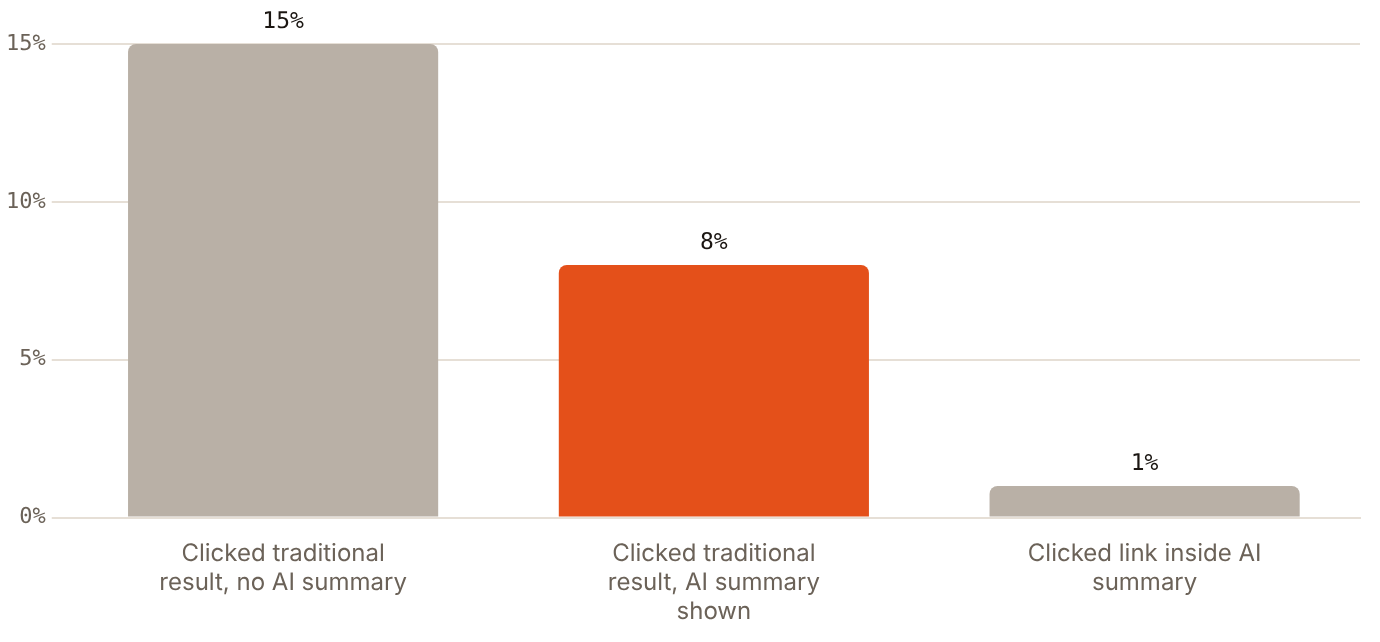
Source: Pew Research Center, 22 Jul 2025
Ahrefs, analysing desktop Search Console data for 300,000 keywords, found that the presence of an AI Overview "correlates with a 58% lower average clickthrough rate" for the top-ranking page, with position 1 CTR on AI Overview keywords falling from 0.073 in December 2023 to 0.016 in December 2025. Its earlier April 2025 study had found a 34.5% reduction; in the 2026 update, reductions for positions 2 to 10 ranged from 50.8% at position 2 to 19.4% at position 10 (Ahrefs).
Click-through rate for the top-ranking page on keywords showing an AI Overview, %, desktop, global Search Console sample of 300,000 keywords (0.073 and 0.016 expressed as %)

Source: Ahrefs, Update: AI Overviews Reduce Clicks by 58%, 4 Feb 2026
Seer Interactive's study of 3,119 informational queries across 42 client organisations, mainly in the US, is the only one that separates paid and organic clicks and checks whether a brand was cited in the overview. In Q3 2025, organic CTR was 1.45% with no AI Overview, 0.52% where an overview appeared and the brand was not cited, and 0.70% where it was cited. Paid CTR was 13.88% with no overview, 4.14% when not cited and 7.89% when cited (Seer Interactive, 2024). From June 2024 to September 2025, organic CTR on AI Overview queries fell 61% and paid CTR fell from 19.70% to 6.34% (the source gives the decline as both 65% and 68%); on queries without an overview, organic fell 41% and paid 32% (Seer Interactive). Cited brands saw about 35% higher organic and about 91% higher paid CTR than uncited brands, though Seer states "We cannot definitively prove that citation causes higher CTRs" and the source contains internal inconsistencies.
Organic and paid click-through rate by AI Overview presence and citation, %, Q3 2025, 3,119 informational queries, 42 organisations, mainly US
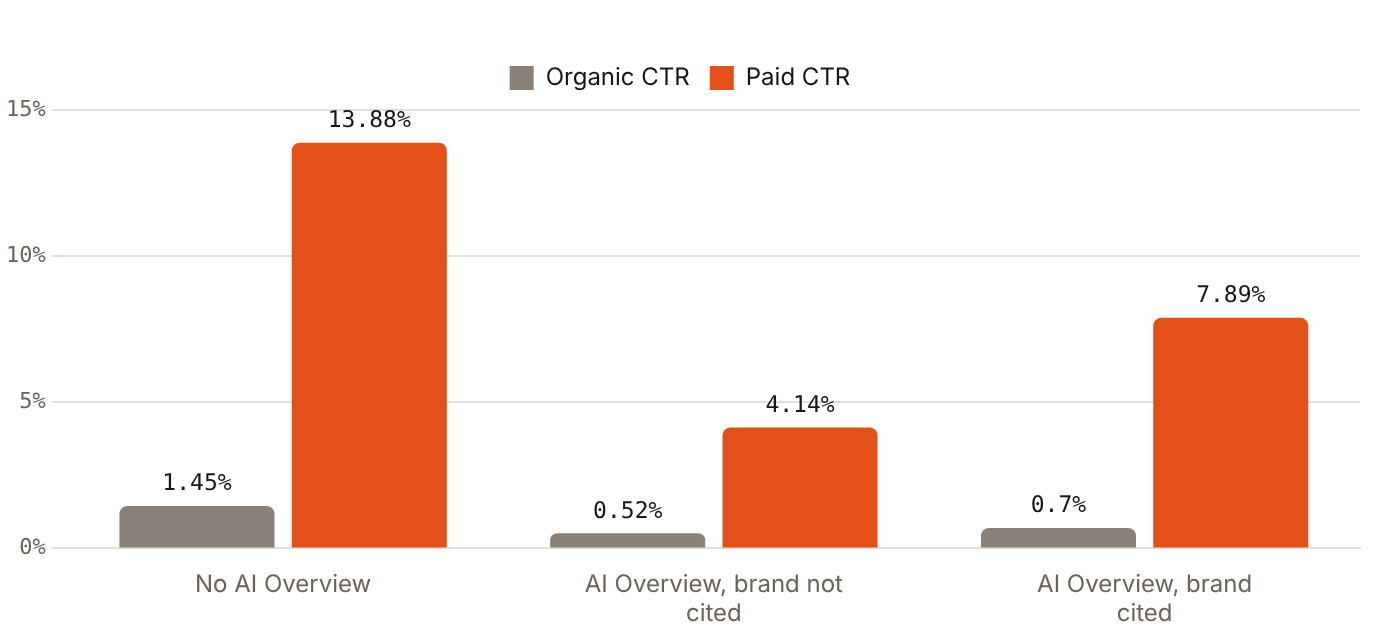
Source: Seer Interactive, AIO Impact on Google CTR: September 2025 Update, 4 Nov 2025
Wider traffic data point the same way. Organic search referral traffic to US sites fell from over 2.3 billion visits in July 2024 to 1.8 billion in June 2025, and Semrush measured the AI Overview share of US desktop queries rising from 6.49% in January 2025 to 20.22% in April 2025 (Digiday). BrightEdge reported search impressions up "over 49%" and click-throughs down nearly 30% in the year from May 2024, with AI Overviews in "over 11% of Google queries", without describing its method. Zero-click news searches rose from 56% to nearly 69% between May 2024 and May 2025 (Digiday).
AI assistants send some traffic back, but not much yet. ChatGPT sent 396.8 million referral visits to 1,000 tracked sites in June 2025, 81.7% of the AI referral traffic those sites received (Digiday). BrightEdge puts AI platforms at "less than 1% of referral traffic" across its clients from January to August 2025.
| Study | Headline finding | Geography, period, sample | Source |
|---|---|---|---|
| Pew Research Center | 8% vs 15% click rate with vs without AI summary; 1% click inside summary | US; Mar 2025; 900 adults, 68,879 searches | Pew Research Center [Industry] |
| Ahrefs | 58% lower top-result CTR when AI Overview present | Global desktop; Dec 2023 to Dec 2025; 300,000 keywords | Ahrefs [Industry] |
| Seer Interactive | Organic CTR down 61%, paid from 19.70% to 6.34% on AI Overview queries; cited brands higher CTR | Mainly US; Jun 2024 to Sep 2025; 3,119 queries | Seer Interactive [Industry] |
| BrightEdge | Impressions up over 49%, click-throughs down nearly 30%; AI under 1% of referrals | Client data; 2024 to 2025; method not described | BrightEdge via GlobeNewswire; BrightEdge [Industry] |
| Similarweb via Digiday | Zero-click news searches 56% to nearly 69%; ChatGPT 81.7% of AI referrals to tracked sites | Global/US; May 2024 to Jun 2025 | Digiday [Industry] |
| Similarweb and Graphite | ChatGPT ad CTR 0.73% US, 0.74% UK, 1.91% Brazil (about one month of data); worldwide CTR up approximately 112% | Nine markets; 30 Mar to 16 Sep 2026; 95,000+ US ads | PPC Land [Industry] |
Clicks on ChatGPT ads
The largest dataset on ChatGPT ad clicks is the Similarweb and Graphite panel, which covers nine markets from 30 March to 16 September 2026. All-time CTR ranged from 0.60% in New Zealand to 1.91% in Brazil, with the US at 0.73%; Brazil and Mexico rest on about one month of data (PPC Land). Similarweb reports worldwide CTR up approximately 112% over 30 March to 14 September 2026, without stating which weeks are compared (PPC Land). No Middle East market is in the panel (PPC Land).
All-time ad click-through rate by market, %, 30 March to 16 September 2026 (Similarweb and Graphite panel). Brazil and Mexico rest on about one month of data
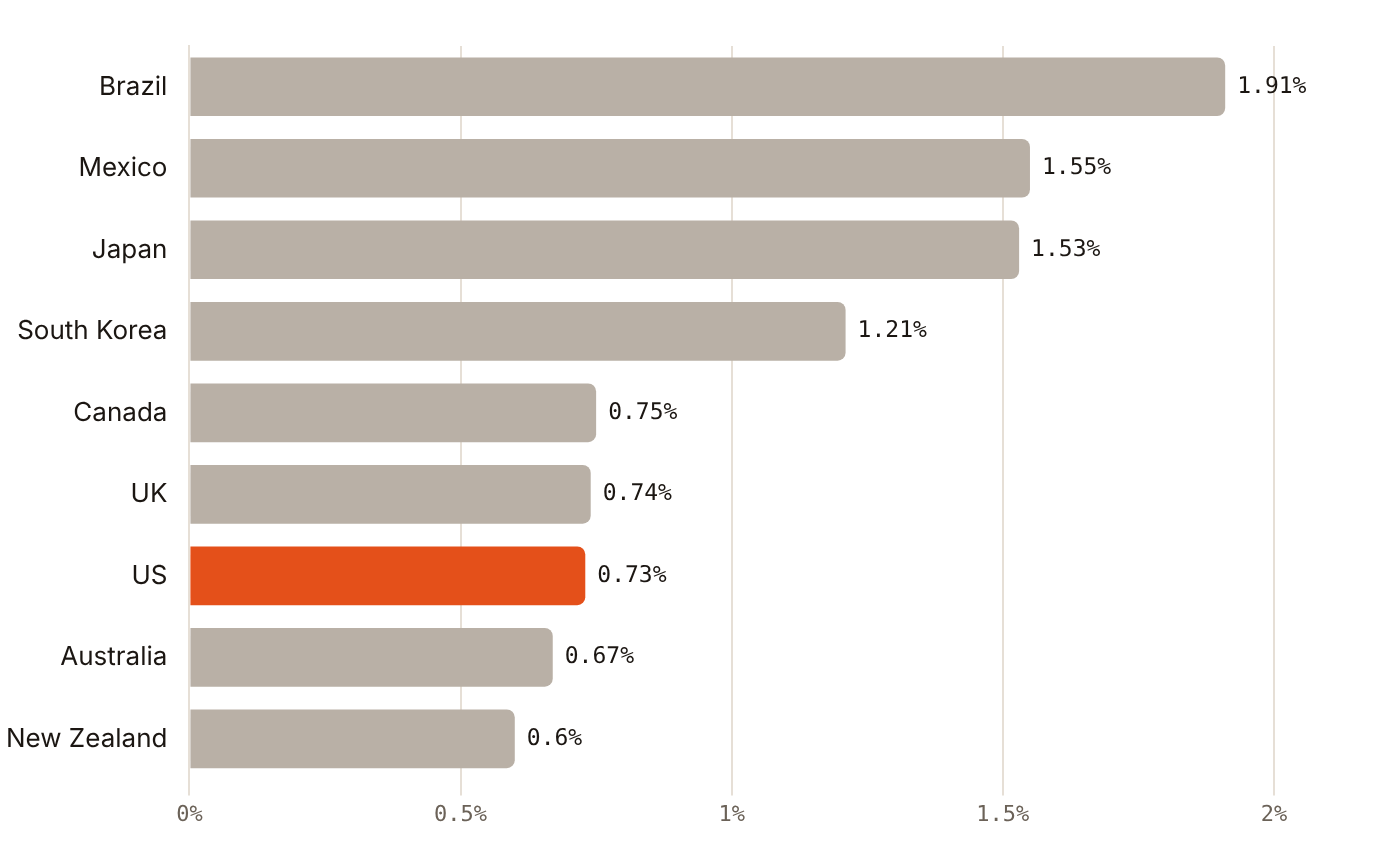
Source: PPC Land on Similarweb and Graphite, 4 Oct 2026
Advertiser-reported results are scattered and come from North America. One brand tracked by Adthena saw 0.91% CTR against a 6.4% Google search benchmark in the same sector, and agency executives quoted by MediaPost reported CTR of about 0.6% (Trending Topics, Jakob Steinschaden). Common Thread Collective self-reported 0.94% CTR on USD 9,620 of spend, a single-advertiser anecdote rather than a benchmark (Search Engine Journal). On the vendor side, Criteo reports CTR about three times comparable formats, and Microsoft claims Copilot ads achieve "73% higher click-through rates" than its own search ads, on Microsoft first-party data. Neither vendor claim is independently audited.
The only UAE observations available are ONS's own two anonymised client tests, which have no published dates, spend or revenue. Recalculated from published impressions and clicks, Test A recorded 196 clicks from 4,797 impressions (196 / 4,797 = 4.09%), Test B 451 clicks from 20,663 impressions (451 / 20,663 = 2.18%), and the two combined 647 clicks from 25,460 impressions (647 / 25,460 = 2.54%). These are two selected tests, not a benchmark, and they cannot be compared with the panel figures above, which measure different populations over different periods. Chapter 11 discusses them in full.
ONS reading The click research points one way: when an AI answer sits at the top of a page, fewer people click anything, organic or paid, and being cited in the answer is associated with keeping more of the clicks that remain. For ChatGPT ads, panel CTRs below 1% in the US and UK mean an advertiser should expect to pay for attention in an environment where the answer itself satisfies many users. The commercial test is not the CTR, which varies widely by market, but the quality of the enquiries that do arrive.
What this means for UAE businesses
The mechanisms above apply in the UAE, but the evidence about their effects does not yet. AI Overviews are available to all users in the UAE and in Arabic, and AI Mode has supported Arabic since October 2025, so the answer format that the US studies examined is already in front of UAE searchers (Google Search Help; Google MENA Blog). Whether it changes UAE click behaviour by the same amount is unknown. No UAE or GCC study of AI referral traffic or AI Overview click impact was found (see Gaps).
UAE users appear receptive to AI answers. In KPMG's 2025 survey, 97% of UAE respondents used AI for work, study or personal purposes and 65% were willing to rely on information provided by an AI system. They also want transparency: 86% agree companies must ensure people can detect AI-generated content, and in YouGov's UAE sample of 1,000, 76% said it is important that content states it was made with generative AI. No survey of UAE attitudes to ads inside AI chatbots was found.
UAE law already requires the separation that OpenAI describes. Article 33(6) of Cabinet Resolution No. 68 of 2024 requires that "Advertisements shall be clearly identified, distinct, and separate from other editorial and media content" (UAE Legislation portal); Article 33(2) bars "incorrect or misleading claims"; and Article 33(9) bans direct or indirect promotion of alcohol, tobacco and smoking (UAE Legislation portal). Ads for real estate, health services, financial services, education and food require approval from the relevant authority (UAE Legislation portal). The resolution does not name channels or mention AI (UAE Legislation portal). Health advertising needs regulator approval in any channel: the MOHAP health advertisement licence covers "multiple media channels and electronic platforms in the country".
Privacy rules for ad personalisation are less settled. The UAE PDPL has been in force since 2 January 2022, but its implementing regulations "have still not been issued" as of June 2026, with no later issuance found by 28 October 2026 (Morgan Lewis; Primerus / Reina Consulting). In the DIFC, prior opt-in consent is listed for online behavioural advertising and ad personalisation (Baker McKenzie). OpenAI has not published which ChatGPT ad personalisation default applies in the UAE (Crypto Briefing via Gizmodo).
ONS reading ONS treats the UAE media law separation and approval rules as applying to ads shown inside AI assistants to UAE users, because Article 33 is written for any published advertisement. This is a planning assumption, not a legal opinion. A UAE health, real estate, finance, education or food advertiser should hold the relevant authority approval before any AI assistant campaign, in addition to meeting the platform's own policy, which outside the US generally prohibits health services and prohibits legal services.
Map the information needed at each stage
Because an assistant answers the question first and the ad sits below it, the ad and landing page must add something the answer did not (OpenAI Help). The table below is an ONS planning aid for building context hints, ad copy and landing pages around the stage of the decision.
| Customer stage | Example question | Useful business content | Sensible next action | Source |
|---|---|---|---|---|
| Understanding | Which study route suits my schedule? | Course format and entry requirements | Review programme details | ONS planning example [ONS] |
| Comparing | What is included and what costs extra? | Fees, inclusions and alternatives | Request a relevant quotation | ONS planning example [ONS] |
| Validating | Is this provider suitable for my situation? | Credentials, examples and limitations | Speak to an adviser | ONS planning example [ONS] |
| Acting | Can I start next month? | Current availability and clear terms | Apply, book or purchase | ONS planning example [ONS] |
These are ONS planning examples, not delivery guarantees. The same individual may move between stages, compare across several websites or take action offline. A campaign should therefore support several genuine reasons to choose the business while keeping the destination focused. OpenAI's own guidance is to link to the most relevant page rather than a generic homepage. For UAE audiences, consumer protection law requires advertising and website information to be in Arabic as a minimum (Pinsent Masons).
Human judgement remains necessary
AI can help organise customer questions, draft alternative messages and find inconsistencies across a website. OpenAI now offers AI-suggested copy and images drawn from the landing page and opt-in headline translation into the user's language (Reuters via Zawya). A person who understands the service must check every material claim. Prices, professional accreditations, refund conditions, stock and appointment capacity are not details to infer from a generic model response. Under UAE law, ads must not contain misleading claims, and OpenAI reviews the advertiser, the creative, the landing page and the placement.
ONS recommends a simple working sequence: collect verified business facts, group them by customer need, draft content, have the service owner check it, then test against recorded outcomes. The value comes from faster preparation with accountable review. Producing more variations is useful only when they remain accurate and sufficiently distinct to answer a meaningful business question.
ONS outlook The formats in test point towards ads that converse rather than display: OpenAI's sponsored agents, Google's Business Agent for Leads and Microsoft's brand agents. If these reach the UAE, a business would need verified answers to its customers' common questions ready for an agent to use, and the same facts would serve organic citation. ONS's view is that preparing that fact base is worthwhile now, but no UAE launch date for any of these formats has been published and none should be assumed.
Gaps in the evidence
No public data. UAE or GCC data on AI referral traffic, AI Overview click impact, or ChatGPT ad CTR from an independent source. Searched Similarweb, Ahrefs, Seer, BrightEdge, Pew and the Similarweb and Graphite ChatGPT panel, which covers nine markets with none in the Middle East (PPC Land). A future edition should seek a UAE panel from Similarweb or a regional agency dataset with a published method.
No public data. Which ChatGPT ad personalisation default (opt-out as in the US, or opt-in as in the EU and UK) applies to UAE users; the exclusion-targeting categories in OpenAI's test; frequency capping (none documented). A future edition should read the UAE locale of OpenAI's ads help pages and privacy policy.
No public data. UAE consumer attitudes to ads inside AI chatbots, and citation patterns for Arabic-language queries. The nearest UAE data are general AI trust and disclosure preferences (KPMG Lower Gulf; YouGov, 2024).
Sources for this chapter
- Adobe Experience League, "ChatGPT Ads chat card ad settings", 2026-10-06. https://experienceleague.adobe.com/en/docs/advertising/search-social-commerce/new-ui/manage/ads/ad-settings-by-network/ad-settings-chatgpt
- Adthena, "Google AI Mode ads: Google is rebuilding your search ads for every conversation", 26 Aug 2026. https://www.adthena.com/?p=332622
- Adweek, Trishla Ostwal, "OpenAI is piloting brand suitability controls with DoubleVerify and IAS", 2026-10-05. https://www.adweek.com/media/openai-is-piloting-brand-suitability-controls-with-doubleverify-and-ias/
- Ahrefs, "Update: AI Overviews Reduce Clicks by 58%", 4 Feb 2026. https://ahrefs.com/blog/ai-overviews-reduce-clicks-update
- Al Bayan, "OpenAI expands ChatGPT ads to MENA", 2026-09-16. https://www.albayan.ae/economy/1552481
- Arabian Business, "Google AI search Arabic Gemini", 8 Oct 2025. https://www.arabianbusiness.com/culture-society/google-ai-search-arabic-gemini
- Axios, "OpenAI launches self-serve ad platform", 2026-05-05. https://axios.com/2026/05/05/openai-self-serve-ad-platform
- Baker McKenzie, "DIFC: cookies, online tracking and direct marketing", reviewed 23 Dec 2024. https://resourcehub.bakermckenzie.com/en/resources/global-data-and-cyber-handbook/emea/dubai-international-financial-center/topics/cookies-online-tracking-and-direct-marketing
- BrightEdge via GlobeNewswire, "BrightEdge Data Finds AI Accounts for Less Than 1% Search", 12 Sep 2025. https://www.globenewswire.com/de/news-release/2025/09/12/3149225/0/en/BrightEdge-Data-Finds-AI-Accounts-for-Less-Than-1-Search-Organic-Traffic-Continues-to-Dominate.html
- BrightEdge, "One Year Into Google AI Overviews", 14 May 2025. https://brightedge.com/news/press-releases/one-year-google-ai-overviews-brightedge-data-reveals-google-search-usage
- Campaign, "Perplexity pulls the plug on ads, citing trust concerns for AI", Feb 2026 (undated on page). https://www.campaignlive.com/article/perplexity-pulls-plug-ads-citing-trust-concerns-ai/1949142
- Crypto Briefing via Gizmodo, "OpenAI updates privacy policy for ad personalization", 2026-08-16. https://cryptobriefing.com/openai-privacy-policy-chatgpt-ad-personalization/
- Digiday, "AI platforms are driving more traffic but not enough to offset zero-click search", 10 Jul 2025. https://digiday.com/media/in-graphic-detail-ai-platforms-are-driving-more-traffic-but-not-enough-to-offset-zero-click-search/
- eMarketer, "ChatGPT ad exclusions give brands safeguards as targeting gaps persist", undated, read 28 Oct 2026. https://www.emarketer.com/content/chatgpt-ad-exclusions-give-brands-safeguards-targeting-gaps-persist
- Google Ads Help, "About ads and AI Overviews", undated, read 28 Oct 2026. https://support.google.com/google-ads/answer/16297775?hl=en
- Google MENA Blog, "Bringing AI Overviews to MENA, and in Arabic globally", 20 May 2025. https://blog.google/intl/en-mena/product-updates/explore-get-answers/bringing-ai-overviews-to-mena-and-in-arabic-globally/
- Google MENA Blog, "Introducing AI Mode in Arabic", 8 Oct 2025. https://blog.google/intl/en-mena/product-updates/explore-get-answers/introducing-ai-mode-in-arabic/
- Google Search Central, "AI features and your website", last updated 10 Dec 2025. https://developers.google.com/search/docs/appearance/ai-features
- Google Search Help, "Find information in faster and easier ways with AI Overviews", undated, read 28 Oct 2026. https://support.google.com/websearch/answer/14901683?hl=en
- Google, "A new generation of ads for the AI era of Search", 20 May 2026. https://blog.google/products/ads-commerce/google-marketing-live-search-ads/
- Google, "blog.google, agentic commerce post", 11 Jan 2026. https://blog.google/products/ads-commerce/agentic-commerce-ai-tools-protocol-retailers-platforms/
- Google, "Our approach to website controls for Search AI features", 28 Jan 2026. https://blog.google/products-and-platforms/products/search/search-ai-features-controls/
- KPMG Lower Gulf, 9 Oct 2025. https://kpmg.com/ae/en/media/press-releases/2025/10/97-percent-of-uae-residents-now-use-ai.html
- MarTech, Constantine von Hoffman, "OpenAI tests multi-advertiser ad placements in ChatGPT", 2026-06-09. https://martech.org/openai-tests-multi-advertiser-ad-placements-in-chatgpt/
- Meta Newsroom, "Improving Your Recommendations on Our Apps With AI at Meta", 1 Oct 2025. https://about.fb.com/news/2025/10/improving-your-recommendations-apps-ai-meta/
- Microsoft Advertising, "73% higher CTRs: why advertisers need to pay attention to conversational AI", 6 Aug 2025. https://preview-about.ads.microsoft.com/en/blog/post/august-2025/73-higher-ctrs-why-advertisers-need-to-pay-attention-to-conversational-ai
- Microsoft Advertising, "Transforming the future of audience engagement", 5 Mar 2025. https://preview-about.ads.microsoft.com/en/blog/post/march-2025/transforming-the-future-of-audience-engagement
- Modern Retail, "Amazon Q1 2026 earnings", 30 Apr 2026. https://www.modernretail.co/?p=159156
- MOHAP, "Issue/renew licence for a health advertisement", undated, read 28 Oct 2026. https://mohap.gov.ae/en/w/issue-license-/-renew-license-for-a-health-advertisement
- Morgan Lewis, "UAE establishes Federal Authority for AI and Data", 15 Jun 2026. https://www.morganlewis.com/pubs/2026/06/uae-establishes-federal-authority-for-artificial-intelligence-and-data
- Nasdaq, "Meta Platforms Q2 earnings call highlights", 29 Jul 2026. https://www.nasdaq.com/articles/meta-platforms-q2-earnings-call-highlights
- OpenAI Help Center, "Publishers and developers FAQ", undated ("Updated 23 days ago"), read 28 Oct 2026. https://help-lb.openai.com/en/articles/12627856-publishers-and-developers-faq
- OpenAI Help, "Create campaigns for ChatGPT Ads", undated, read 28 Oct 2026. https://help.openai.com/fr-fr/articles/20001210-create-campaigns-for-chatgpt-ads
- OpenAI, "Ad policies", 10 Sep 2026; read 28 Oct 2026. https://openai.com/policies/ad-policies/
- OpenAI, "Overview of OpenAI crawlers", undated, read 28 Oct 2026. https://developers.openai.com/docs/bots
- OpenAI, "Writing context hints for ChatGPT Ads", checked 2026-10-28. https://help.openai.com/en/articles/20001521-writing-context-hints-for-chatgpt-ads
- Perplexity Docs, "Perplexity crawlers", undated, read 28 Oct 2026. https://docs.perplexity.ai/docs/resources/perplexity-crawlers.md
- Pew Research Center, "Google users are less likely to click on links when an AI summary appears in the results", 22 Jul 2025. https://www.pewresearch.org/short-reads/2025/07/22/google-users-are-less-likely-to-click-on-links-when-an-ai-summary-appears-in-the-results/markdown
- Pinsent Masons, 6 Oct 2023. https://www.pinsentmasons.com/out-law/analysis/uae-consumer-protection-regime-revamped
- PPC Land on Sensor Tower, 2026-09-03. https://ppc.land/chatgpt-ads-pass-1bn-run-rate-as-financial-services-spend-triples/
- PPC Land, "Over 1,000 brands now live on ChatGPT ads via Criteo", 2026-05-06. https://ppc.land/over-1-000-brands-now-live-on-chatgpt-ads-via-criteo-as-ai-conversions-near-2x/
- PPC Land, "Perplexity advertising head departs nine months after appointment", Aug/Sep 2025. https://ppc.land/perplexity-advertising-head-departs-nine-months-after-appointment/
- Primerus / Reina Consulting, "UAE Data Privacy Law", Mar 2026 (from URL). https://www.primerus.com/sites/default/files/2026-03/UAE%20Data%20Privacy%20Law.pdf
- Reuters via TradingView, "Meta to use AI chats to personalize content and ads from December", 1 Oct 2025. https://de.tradingview.com/news/reuters.com,2025:newsml_L6N3VH1DX:0-meta-to-use-ai-chats-to-personalize-content-and-ads-from-december
- Reuters via Zawya, Anzar Mehraj, "OpenAI tests advertiser-sponsored agents", 2026-09-16. https://www.zawya.com/en/business/ai-shaping-digital-future/openai-tests-advertiser-sponsored-agents-expands-ai-tools-for-chatgpt-ads-806532
- Search Engine Journal, "6 months into ChatGPT ads", 2026-09-08. https://www.searchenginejournal.com/6-months-into-chatgpt-ads-advertisers-still-dont-know-what-good-looks-like/587583/
- Search Engine Land, "Google says normal SEO works for ranking in AI Overviews and llms.txt won't be used", Jul 2025 (approx., undated on page). https://searchengineland.com/google-says-normal-seo-works-for-ranking-in-ai-overviews-and-llms-txt-wont-be-used-459422
- Search Engine Land, Anu Adegbola, "ChatGPT ads are showing up a lot", undated (c. Mar 2026), read 28 Oct 2026. https://searchengineland.com/chatgpt-ads-are-showing-up-alot-472791
- Seer Interactive, "AIO Impact on Google CTR: September 2025 Update", 4 Nov 2025. https://www.seerinteractive.com/blog/aio-impact-on-google-ctr-september-2025-update
- Shopifreaks, "Amazon reveals pricing and measurement details for sponsored ads inside Rufus", 1 Apr 2026. https://www.shopifreaks.com/amazon-reveals-pricing-and-measurement-details-for-sponsored-ads-inside-rufus-ai-shopping-assistant/
- Similarweb, "AI Search Stats 2026", 2026 (undated). https://aisearch.similarweb.com/blog/gen-ai-stats/
- TechCrunch, Sarah Perez, "ChatGPT rolls out ads", 2026-02-09. https://www.techcrunch.com/2026/02/09/chatgpt-rolls-out-ads/
- TechWyse, DJ Kennedy, "ChatGPT Ads go global with new ad stack features", 2026-09-07. https://www.techwyse.com/news/platform-updates/chatgpt-ads-global-expansion-audience-measurement-tools-2026
- The Decoder, "OpenAI wants to sell more ads in ChatGPT", 2026-04-16. https://the-decoder.com/openai-wants-to-sell-more-ads-in-chatgpt-but-advertisers-are-struggling-with-basic-tools/
- The Next Web, Ana Maria Constantin, "OpenAI is bringing ChatGPT ads to 31 European countries", 2026-08-20. https://thenextweb.com/news/chatgpt-ads-expand-31-european-markets
- Trending Topics, Jakob Steinschaden, "ChatGPT ads hits $1 billion run rate but advertisers are not sold", 2026-08-31. https://www.trendingtopics.eu/chatgpt-ads-hits-1-billion-run-rate-but-advertisers-are-not-sold/
- UAE Legislation portal, 10 Jun 2024. https://www.uaelegislation.gov.ae/en/legislations/2547/download
- YouGov, "MENA AI in Media Report", May 2025. https://commercial.yougov.com/rs/464-VHH-988/images/YouGov-MENA-AI-In-Media-Report-May-2025.pdf
PUT THE INSIGHT TO WORK
Your market.
Your next move.
Explore how ONS approaches ChatGPT Ads, campaign readiness and measurement for UAE businesses.
Explore our expertise ↗