
In this chapter
This chapter reports what ONS saw in its first two ChatGPT Ads tests for anonymised UAE clients, and sets those observations beside independently published figures from other markets. Across both tests the platforms recorded 25,460 impressions and 647 clicks, and the clients recorded 19 leads, of which 18 were relevant or genuine and 5 had closed at an unspecified reporting point. These are ONS-reported observations from a small sample, with no dates, spend or revenue published; they describe two campaigns and are not a benchmark for any other advertiser.
In brief
- Two anonymised UAE client tests, labelled Test A and Test B, are the only ChatGPT Ads observations from the UAE in this book. No independent UAE, GCC or MENA performance data has been published (PPC Land).
- Test A: 4,797 impressions, 196 clicks, a recalculated CTR of 4.09% and a published average CPC of AED 1.97.
- Test B: 20,663 impressions, 451 clicks, a recalculated CTR of 2.18% and a published average CPC of AED 3.19.
- Combined CTR is 2.54%, calculated as 647 clicks divided by 25,460 impressions, not as an average of the two test rates.
- Clients recorded 15 leads in Test A and 4 in Test B; 14 and 4 were relevant or genuine, and 4 and 1 had closed.
- No combined CPC, spend or cost per lead is published, because multiplying rounded CPCs by clicks would give a false impression of precision.
- In Test B, objective, message and destination changed together, so the result cannot be attributed to the objective alone.
- Independent CTR panels from nine non-Middle East markets range from 0.60% to 1.91%, with Brazil and Mexico resting on about one month of data (PPC Land). The ONS test CTRs are higher, but the measures, periods and samples differ, and the comparison proves nothing about the UAE market.
| 25,460 Impressions, two tests combined ONS-reported, dates not published. ONS Digital | 647 Clicks, two tests combined ONS-reported. ONS Digital | 19 Client-recorded leads ONS-reported, outcome cutoff not published. ONS Digital |
|---|---|---|
| 5 Closed outcomes at reporting point ONS-reported. ONS Digital |
What these observations are, and what they are not
ONS's published case material describes two UAE business engagements that ran on ChatGPT Ads. One client served both business and consumer customers; the other served business customers only. Their industries and identities are not disclosed, and no sector is named, so no sector benchmark can be inferred. The UAE was listed as "Available" for self-serve Ads Manager when read on 28 October 2026, and third-party records place its addition to the list between 6 and 17 September 2026 (OpenAI Help Center; Digital Applied).
The source record for these observations is ONS's own published page and connected-site content, corroborated by indexed public copies. No original campaign export, campaign dates, exact spend, revenue or outcome cutoff was reviewed for this book. The verification register therefore grades the figures as Qualified: they are published and connected-site content, and the raw records were not audited. Dates, spend and revenue were not supplied, and no exact CPL or ROAS is published.
That status shapes everything in this chapter. The observations are useful as evidence that ChatGPT Ads can deliver impressions, clicks and genuine enquiries for UAE businesses in eligible categories. They are not evidence of what a third advertiser should expect, of what a sector costs, or of how the UAE auction prices clicks in general.
For UAE marketers: Read the numbers below as two case notes, not as a market rate card. The useful content is the measurement lessons, not the headline ratios.
The reported figures
The table reproduces the figures exactly as recorded in the verification register. Combined totals are ONS sums of the two tests; the CTR is recalculated from impressions and clicks; the CPCs are the published averages and are not recalculated.
| Measure | Test A | Test B | Combined | Source |
|---|---|---|---|---|
| Impressions | 4,797 | 20,663 | 25,460 | ONS Digital [ONS] |
| Clicks | 196 | 451 | 647 | ONS Digital [ONS] |
| CTR, recalculated | 4.09% | 2.18% | 2.54% | ONS Digital [ONS] |
| Published average CPC | AED 1.97 | AED 3.19 | Not computed | ONS Digital [ONS] |
| Client-recorded leads | 15 | 4 | 19 | ONS Digital [ONS] |
| Relevant or genuine leads | 14 | 4 | 18 | ONS Digital [ONS] |
| Not relevant leads | 1 | 0 | 1 | ONS Digital [ONS] |
| Closed outcomes | 4 | 1 | 5 | ONS Digital [ONS] |
| Active relevant enquiries | 10 | 3 | 13 | ONS Digital [ONS] |
Three cautions apply to the table. Impressions are ad displays, not unique people. Closed outcomes are counts of closed enquiries, not revenue. The reporting point at which leads were counted as closed or active is not published, so some active enquiries may since have closed or been lost.
How each derived figure is calculated
Every derived figure in this chapter is an ONS calculation from the counts above. The formulas are shown so readers can check them.
| ONS calculation | Formula | Result | Limitation | Source |
|---|---|---|---|---|
| D01 Combined impressions | 4,797 + 20,663 | 25,460 | Dates not published | ONS Digital [ONS] |
| D02 Combined clicks | 196 + 451 | 647 | Dates not published | ONS Digital [ONS] |
| D03 CTR, Test A | 196 / 4,797 | 4.09% | One campaign | ONS Digital [ONS] |
| D03 CTR, Test B | 451 / 20,663 | 2.18% | One campaign | ONS Digital [ONS] |
| D03 CTR, combined | 647 / 25,460 | 2.54% | Not the mean of 4.09% and 2.18% | ONS Digital [ONS] |
| D04 Combined outcomes | 15 + 4; 14 + 4; 4 + 1; 10 + 3 | 19; 18; 5; 13 | Leads; relevant; closed; active | ONS Digital [ONS] |
| D05 Relevant share | 18 / 19 | 94.74% | Small, selected sample | ONS Digital [ONS] |
| D06 Closed share at reporting point | 5 / 19 | 26.32% | Open pipeline; not a final close rate | ONS Digital [ONS] |
The simple average of the two test CTRs would be different from 2.54%, because Test B delivered more than four times as many impressions as Test A. Rates must be pooled from the underlying counts, which is why the combined CTR is calculated from 647 clicks and 25,460 impressions.
Where the leads stood at the reporting point
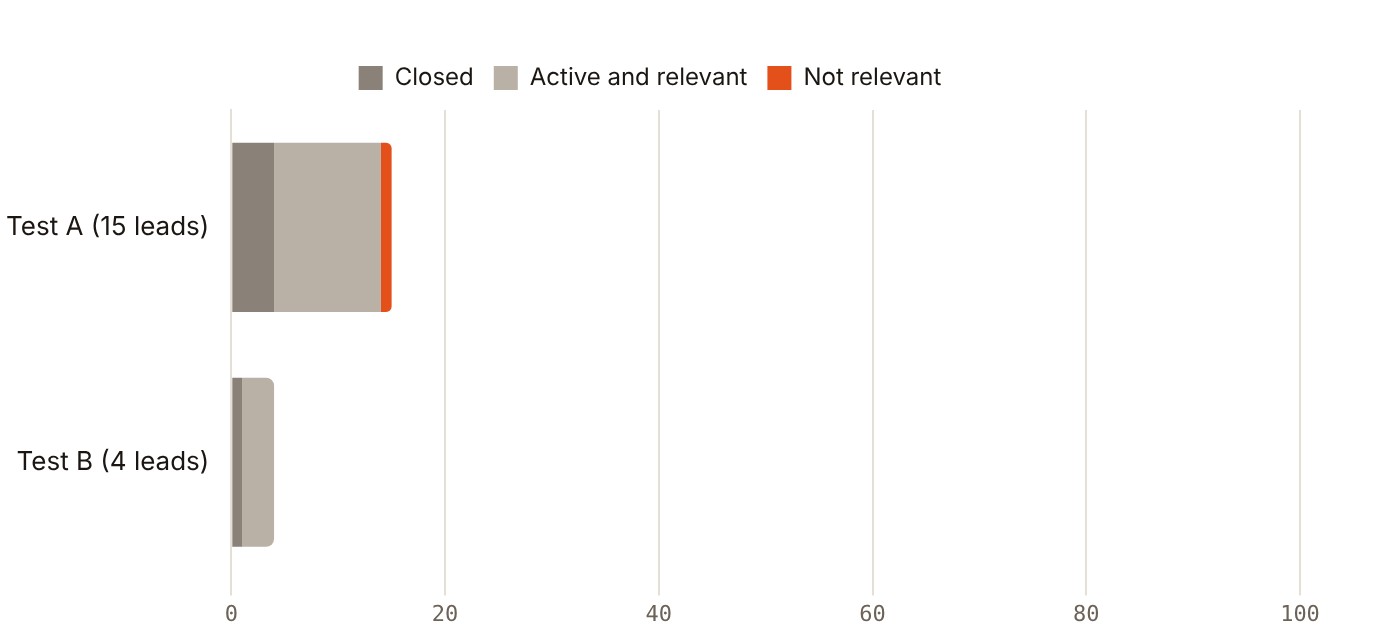
Each lead in the two tests sits in one of three states at the unpublished reporting point: closed, still active and relevant, or not relevant. In Test A, 4 leads had closed, 10 were active and 1 was not relevant, which accounts for all 15. In Test B, 1 had closed, 3 were active and none was not relevant, accounting for all 4.
Lead status by test, count of client-recorded leads, ONS-reported UAE tests, dates and cutoff not published
Source: ONS Digital, ChatGPT Ads agency Dubai and early client tests, checked 28 Oct 2026
Eighteen of nineteen reported leads were relevant or genuine, equal to 94.74% (ONS calculation D05). Five of nineteen had closed, equal to 26.32% at the reporting point (ONS calculation D06). These are descriptive ratios from a small, selected sample with an open pipeline. They are not final close rates and not expected results for another advertiser. Thirteen leads were still active, so the closed share could rise or stay the same; it cannot be read as the share that will eventually close.
ONS reading The high share of relevant leads is the most encouraging signal from these tests, because it speaks to lead quality rather than volume. A context-matched ad shown beside an answer may reach people who have already described their need in some detail. But two campaigns cannot separate that effect from the clients' own offers, landing pages and follow-up, and nineteen leads are too few to estimate a rate with useful precision. ONS treats this as a reason to keep testing, not as a result to promise.
Why no spend, cost per lead or combined CPC is published
The CPCs were published as rounded averages: AED 1.97 for Test A and AED 3.19 for Test B. Multiplying a rounded average by a click count gives a number that looks like spend but carries the rounding error into every figure built on it, and the register records the combined CPC as "Not computed" for that reason. Exact settled spend was not supplied. This book therefore publishes no spend, no cost per lead, no cost per qualified lead and no ROAS for either test.
Two further facts make a derived spend unreliable even as an estimate. Ads Manager reports spend with a lag of 7 to 8 hours behind delivery metrics, and an agency reading of OpenAI's help pages says ads may run for up to 24 hours after a pause and are billed for that delivery. A spend figure for a campaign that was paused, as both tests were, needs the settled invoice, not an average.
For UAE marketers: When an agency or vendor quotes a ChatGPT Ads cost per lead, ask whether it comes from settled spend and deduplicated CRM leads, or from a rounded CPC multiplied by a conversion rate. Only the first is a cost per lead.
Lessons that deserve more weight than the headline
Most Test A leads arrived by phone or WhatsApp
In Test A, thirteen of fifteen leads arrived through calls or WhatsApp, according to ONS's published case notes. The platform recorded four conversions, while the client recorded fifteen leads. The two totals come from different measurement systems: the platform counts events that its pixel or API received and attributed within the chosen window, which may include modelled conversions, while the client counts people who made contact (OpenAI Help; OpenAI). Their difference does not by itself prove a tracking error.
The practical lesson is that a UAE service business that takes most enquiries by phone and WhatsApp will under-report ChatGPT Ads in the platform unless calls and WhatsApp taps are tagged on the landing page and sent back as events, and the CRM records the source of each conversation (Chapter 10). If the platform is left to optimise towards form submissions only, it will be optimising towards the minority channel.
Test B changed more than one thing at once
Test B's conversion-focused approach performed better alongside changes in messaging and the landing page. The verification register records that objective, message and destination changed together, and grades the comparison as Qualified. It was not a controlled experiment isolating the choice of objective. A reader cannot conclude from Test B that the conversion objective outperforms the clicks objective for UAE advertisers.
The highest-CTR variants did not produce leads
In Test B, the three highest-CTR ad variants produced no leads. This is a useful reason to judge creative on enquiries and downstream quality rather than selecting a winner on CTR alone. It fits the wider pattern in the independent data: in one US comparison a brand's ChatGPT CTR was 0.91% against a 6.4% Google search benchmark in its sector, and agency executives quoted by MediaPost reported clicks with no conversions (Trending Topics, Jakob Steinschaden). CTR describes curiosity; it does not describe intent to buy.
Both clients paused when follow-up capacity was reached
Both clients paused activity when their teams reached follow-up capacity. The operational lesson is to agree response capacity and a pause procedure before launch, and to remember that a pause may not stop delivery immediately (Origami). It is not a promise that every campaign will produce more leads than a client can handle; two tests cannot support that.
How the observations compare with independent published figures
No independent source has published ChatGPT Ads CTR, CPC, CPM or conversion data for the UAE, GCC or MENA (PPC Land). The comparisons below therefore set two UAE client tests against figures from other countries, other periods and other measurement methods. They show where the ONS figures sit, not whether the UAE market performs better or worse.
Click-through rate
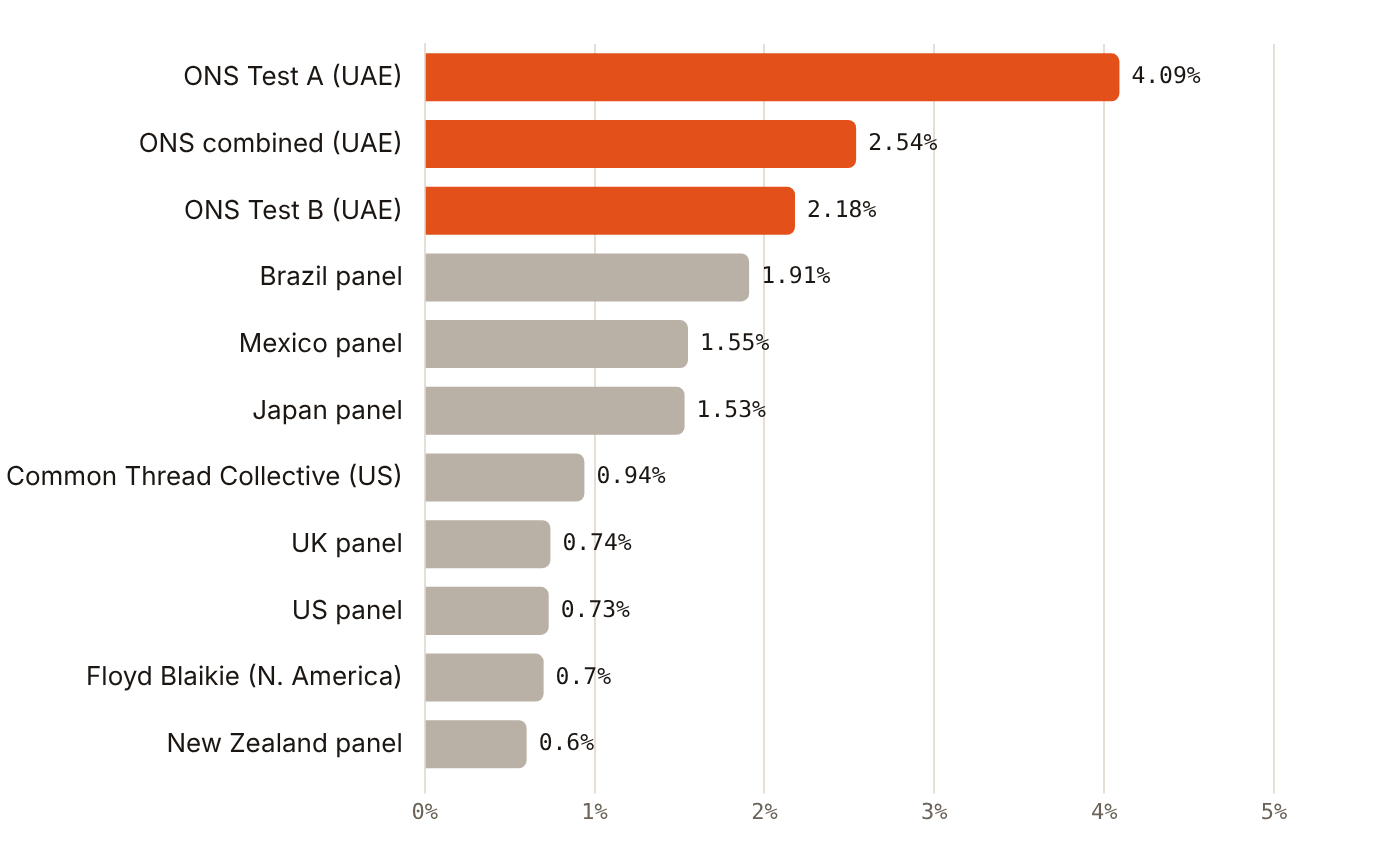
Similarweb and Graphite measured all-time ChatGPT ad CTR from 30 March to 16 September 2026 across nine markets, from 0.60% in New Zealand to 1.91% in Brazil, with the US at 0.73%; Brazil and Mexico rest on about one month of data (PPC Land). Similarweb recorded 0.50% on 17 August 2026, geography not stated (PPC Land). Advertiser-reported CTRs published by Search Engine Journal were 0.94% (Common Thread Collective, US) and 0.7% (Floyd Blaikie, North America), self-reported single-advertiser anecdotes rather than benchmarks. The ONS test CTRs of 4.09%, 2.18% and 2.54% combined are above all of these.
CTR, %. ONS: two UAE client campaigns, dates not published. Others: Similarweb and Graphite all-time panel, 30 Mar to 16 Sep 2026 (Brazil and Mexico about one month of data), and two single-advertiser reports to Sep 2026
Source: ONS Digital (checked 28 Oct 2026); PPC Land on Similarweb and Graphite, 4 Oct 2026; Search Engine Journal, 8 Sep 2026
Several reasons could explain the gap, and the data cannot choose between them. The ONS figures are two campaigns chosen and managed by one agency, while the panel figures average thousands of ads (PPC Land). The panel runs from March to September 2026, and Similarweb reports worldwide CTR up about 112% over that period, so the timing of any campaign changes its rate; the ONS test dates are not published (PPC Land). CTR falls as a conversation goes on, from approximately 0.66% at the first turn to 0.36% to 0.48% at turns 5 to 21 worldwide, read from a chart, so differences in where ads appear within conversations matter (PPC Land). And the UAE was added to the self-serve list only in September 2026, so any UAE campaign to date ran in a market in its first weeks (Digital Applied).
Cost per click
The ONS tests published average CPCs of AED 1.97 and AED 3.19. OpenAI recommends a starting maximum bid of USD 3 to USD 5 per click for CPC campaigns, which is not an expected CPC. Advertiser-reported CPCs from other markets published by Search Engine Journal range from USD 4.41 (Common Thread Collective, US) to USD 22.89 (Synter, New Zealand); these are single-advertiser anecdotes, not benchmarks. This book does not convert the AED figures to USD, because no exchange rate is recorded in its research notes, and because a currency conversion would suggest a precision the comparison does not have. Readers should compare the currencies as published.
| Figure | Value as published | Geography and period | Sample | Source |
|---|---|---|---|---|
| ONS Test A CTR | 4.09% | UAE, dates not published | One client campaign | ONS Digital [ONS] |
| ONS Test B CTR | 2.18% | UAE, dates not published | One client campaign | ONS Digital [ONS] |
| ONS combined CTR | 2.54% | UAE, dates not published | Two campaigns pooled | ONS Digital [ONS] |
| Panel CTR range | 0.60% to 1.91% | Nine markets, none in Middle East, 30 Mar to 16 Sep 2026; Brazil and Mexico about one month | Similarweb and Graphite panel | PPC Land [Industry] |
| Similarweb CTR | 0.50% | Geography not stated, recorded 17 Aug 2026 | Similarweb | PPC Land [Industry] |
| ONS Test A average CPC | AED 1.97 | UAE, dates not published | One client campaign | ONS Digital [ONS] |
| ONS Test B average CPC | AED 3.19 | UAE, dates not published | One client campaign | ONS Digital [ONS] |
| Starting maximum CPC bid | USD 3 to 5 | Global help guidance, read 28 Oct 2026 | OpenAI guidance, not a result | OpenAI Help [Platform] |
| Advertiser CPC | USD 4.41 | US, to Sep 2026 | Common Thread Collective | Search Engine Journal [Industry] |
| Advertiser CPC by market | USD 5.10 to 22.89 | UK, US, Australia, New Zealand, to Sep 2026 | Synter, one advertiser | Search Engine Journal [Industry] |
| UAE minimum daily budget | AED 65 | UAE, checked 28 Oct 2026 | OpenAI billing rule | OpenAI; OpenAI Help [Platform] |
Leads and outcomes
There is no independent published figure for ChatGPT Ads lead quality or close rates in any market that can be set against the ONS outcome counts. The nearest published claims are platform-selected or sponsored. OpenAI cites one unnamed ecommerce advertiser with 3x ROAS over 28 days and one technology partner reporting more than 80% of ad-driven ChatGPT traffic from new customers, without geography; these are OpenAI's chosen examples, not benchmarks. Common Thread Collective estimated ROAS of 3.3x to 6.8x on USD 9,620 of US spend, a self-reported single-advertiser anecdote (Search Engine Journal). A sponsored US legal-sector advertorial claimed 12 leads from about USD 2,000 in a month for one client, company-supplied content not reviewed by Adweek; legal services ads are not allowed outside the US, so it does not apply to UAE law firms. OpenAI told a MENA briefing that average cost per purchase had fallen about 60% over six weeks, globally (Al Bayan). None of these is comparable to two UAE lead-generation tests measured in a client CRM.
ONS reading The ONS CTRs and CPCs sit at the favourable end of everything published so far, and ONS does not claim that this will hold. Early UAE campaigns ran in a market that had only just opened to self-serve buying, and OpenAI's and Similarweb's figures show prices and click rates moving fast as markets mature. The fair conclusion is narrower: ChatGPT Ads delivered relevant enquiries for two UAE businesses at the published click costs shown above, and the measurement problems they exposed are common to UAE service businesses.
Category limits on what ONS can test
The tests could only run in categories OpenAI allows for UAE advertisers. As of the ad policy v1.6, updated 10 September 2026, health services outside the US are generally prohibited (OpenAI). The eligibility table read on 28 October 2026 marks minimally invasive cosmetic procedures, hospitals and urgent care, and medical testing and diagnosis as "Not allowed" outside the US (OpenAI Help Center). Legal services outside the US are prohibited, most financial products are restricted to select approved advertisers or not allowed, individual housing rentals or sales are prohibited, and alcohol and tobacco ads are disallowed (OpenAI; OpenAI Help Center). During the initial test period ads are primarily limited to consumer verticals such as lifestyle and household goods, local services, travel and experiences, and digital products or education (OpenAI).
For that reason ONS has no ChatGPT Ads observations for clinics, dental practices, hospitals, law firms or alcohol-led venues, and none of the observations in this chapter should be read as evidence for those sectors. For nightlife clients, ONS's rule is that alcohol and shisha cannot be promoted in Dubai, and no ad image or video shows shisha; this is consistent with UAE media regulation, which bans direct or indirect promotion of alcohol, tobacco and smoking (UAE Legislation portal).
Strengthening the next edition
The value of the next round of observations depends on the records kept now. For every ChatGPT Ads campaign that may be published in aggregate, ONS will retain:
- campaign start and end dates, and the date at which outcomes were counted;
- exact settled spend from the invoice, not from average CPC;
- the objective, bid strategy and selected optimisation event, and every change to them with its date;
- the attribution window and time basis used in reports (OpenAI);
- the lead deduplication rule across form, call and WhatsApp, and the qualification rule;
- revenue and cancellations only where the client can support them with records.
Publication will use aggregated cohorts with enough volume to protect confidentiality. ONS will avoid combinations of niche industry, location and unusual transaction value that could identify a client despite removing its name. Where a test changes more than one variable at once, as Test B did, the publication will say so and will not attribute the result to any single change.
ONS outlook ONS expects to have more UAE campaigns, across more eligible categories, by the next edition, and intends to publish them as pooled cohorts with dates, settled spend and a fixed outcome cutoff. ONS also expects independent panels to add Gulf markets at some point, since OpenAI now lists the UAE and its neighbours for self-serve buying; no such panel has been announced. When either arrives, the comparisons in this chapter should be replaced rather than extended.
Gaps in the evidence
No public data. For the two ONS tests: campaign dates, exact settled spend, revenue and outcome cutoff were not published, and no raw campaign export was audited. The sectors of the two clients are not disclosed, so no sector benchmark exists. Independently: no UAE, GCC or MENA ChatGPT Ads CTR, CPC, CPM or conversion data has been published, and no independent lead-quality or close-rate data exists for any market (PPC Land). A future edition should publish pooled ONS cohorts with dates and settled spend, and look for a Similarweb or comparable panel that includes Gulf markets.
Sources for this chapter
- Adweek Wire, ADSQUIRE, "ChatGPT ads just opened the door to law firms", 2026-09-04. https://www.adweek.com/adweek-wire/chatgpt-ads-just-opened-the-door-to-law-firms/
- Al Bayan, "OpenAI expands ChatGPT ads to MENA", 2026-09-16. https://www.albayan.ae/economy/1552481
- Digital Applied, "Where ChatGPT ads are sold: every market and date", 2026-09-01, mod 2026-10-22. https://www.digitalapplied.com/blog/where-chatgpt-ads-are-sold-every-market-and-date
- OpenAI Help Center, "Ads Manager Availability", Updated 27 to 28 Oct 2026 ("14 hours ago" when read 28 Oct 2026). https://help.openai.com/en/articles/20001245-ads-manager-availability
- OpenAI Help Center, "Troubleshooting Common Onboarding and Policy Issues, Ads Policy Eligibility Table", Updated about 26 Oct 2026 ("2 days ago" when read 28 Oct 2026). https://help.openai.com/en/articles/20001534-troubleshooting-common-onboarding-and-policy-issues
- OpenAI Help, "Create campaigns for ChatGPT Ads, fr-fr locale", undated, read 28 Oct 2026. https://help.openai.com/fr-fr/articles/20001210-create-campaigns-for-chatgpt-ads
- OpenAI, "Ad policies", 10 Sep 2026; read 28 Oct 2026. https://openai.com/policies/ad-policies/
- OpenAI, "Creating campaigns for ChatGPT Ads", checked 2026-10-28. https://help.openai.com/en/articles/20001210-creating-campaigns-for-chatgpt-ads
- Origami, "Your ad inside a ChatGPT answer", 2026-09-06. https://origami.sa/en/blog/chatgpt-ads-manager-saudi-advertisers/
- PPC Land, "ChatGPT ad click rate gains 112% worldwide", 2026-10-04. https://ppc.land/chatgpt-ad-click-rate-gains-112-worldwide-similarweb-and-graphite-find/
- Search Engine Journal, "6 months into ChatGPT ads", 2026-09-08. https://www.searchenginejournal.com/6-months-into-chatgpt-ads-advertisers-still-dont-know-what-good-looks-like/587583/
- Trending Topics, Jakob Steinschaden, "ChatGPT ads hits $1 billion run rate but advertisers are not sold", 2026-08-31. https://www.trendingtopics.eu/chatgpt-ads-hits-1-billion-run-rate-but-advertisers-are-not-sold/
- UAE Legislation portal, "Cabinet Resolution 68 of 2024", 10 Jun 2024. https://www.uaelegislation.gov.ae/en/legislations/2547/download
PUT THE INSIGHT TO WORK
Your market.
Your next move.
Explore how ONS approaches ChatGPT Ads, campaign readiness and measurement for UAE businesses.
Explore our expertise ↗