
In this chapter
ChatGPT is not the only AI assistant that carries advertising, but on 28 October 2026 it was the only assistant whose own ad product publicly listed the UAE as available (OpenAI Help Center). Microsoft Copilot ads are proven in English, French and German markets but not documented for the UAE, Perplexity is reported to be winding its ad programme down, Meta and Amazon monetise AI conversations in other ways, and Google says there are no ads in the Gemini app. Organic visibility inside AI answers is a separate workstream governed by crawler access and ordinary search quality, and the click studies show it matters even when it sends little traffic.
In brief
- In the UAE, ChatGPT took 80.99% of AI chatbot referral share in September 2026, followed by Gemini at 13.25%, Copilot at 2.26% and Perplexity at 2.25% (StatCounter).
- Microsoft says ads in Copilot are "fully ramped" in English-, French- and German-speaking markets (March 2025); Microsoft Advertising has covered the UAE since 2022, but no Copilot-specific UAE statement was found.
- Perplexity stopped accepting new advertisers in 2025, and the FT reported in February 2026 that it is "winding down its advertising programme by the end of 2026" (MediaPost; Campaign).
- Meta has used Meta AI chats to personalise ads on its apps since 16 December 2025, excluding the UK, EU and South Korea; no ads inside Meta AI were announced as of Q2 2026.
- Google said in December 2025 there were "no ads in the Gemini app"; in April 2026 its CBO said AI Mode formats "would transfer successfully to Gemini app" (Search Engine Land; Let's Data Science). Gemini has 950 million monthly active users (Q2 2026) (Google).
- OpenAI runs four separate crawlers: OAI-SearchBot for search, GPTBot for training, ChatGPT-User for user-requested visits and OAI-AdsBot for ad landing pages. Blocking the wrong one can remove a site from ChatGPT search or stop an ad passing review (OpenAI Help Center; OpenAI Help).
- When a Google AI summary appeared, US users clicked a traditional result in 8% of visits against 15% without one, and clicked a link inside the summary in 1% of visits (March 2025) (Pew Research Center).
- Seer found that brands cited in AI Overviews had higher organic and paid click-through rates than uncited brands, though it says it cannot prove citation causes the difference.
Keep the wider landscape proportionate
Conversational advertising now reaches beyond ChatGPT, but none of the other products establishes UAE inventory, buying controls or performance for a client account (Microsoft). Several are US only, and some are pilots with named brands rather than open products (Google; GIGAZINE, Jan 2026).
ONS evaluates each platform with five questions. Is advertising commercially available? Can this UAE legal entity buy it? Is the offer eligible? Can the UAE audience be reached? Can the business measure a useful outcome? A keynote or press report is not enough for a client media commitment. The table records each answer as read on 28 October 2026.
| Platform | Ad product status (dated) | UAE position | Planning treatment | Source |
|---|---|---|---|---|
| ChatGPT (OpenAI) | Self-service Ads Manager; 89 countries listed as "Available" (help page updated 27 to 28 Oct 2026) | UAE listed; listing is not category approval | Main focus of this book; check category first | OpenAI Help Center; OpenAI [Platform] |
| Microsoft Copilot | Ads "fully ramped" in English-, French- and German-speaking markets (5 Mar 2025) | Microsoft Advertising launched in the UAE (Sep 2022); no Copilot-specific UAE statement | Confirm buying route and reporting before any commitment | Microsoft Advertising; Adcore; Microsoft [Platform] |
| Perplexity | New advertisers not accepted (2025); programme reported to wind down by end of 2026 (Feb 2026) | No route for new advertisers | Organic visibility only | MediaPost; Campaign [Industry] |
| Meta AI | Chats used to personalise ads on Meta apps from 16 Dec 2025; no ads inside Meta AI announced (Q2 2026) | UAE not among named excluded regions; Meta does not name the UAE | Indirect: affects Facebook and Instagram targeting | Meta Newsroom; Reuters via TradingView; Nasdaq [Platform] |
| Google Gemini app | "No ads in the Gemini app" (Dec 2025); executives "not ruling them out" (Apr 2026) | No ad product | Watch; organic only | Search Engine Land; Let's Data Science [Industry] |
| Google AI Mode | Ads "in the US only, so far" (Aug 2026); India announced, live status not confirmed | Not confirmed for the UAE | Covered in chapter 13; prepare, do not sell | Adthena; Google [Industry] |
| Amazon Rufus | Sponsored prompts moving to general availability, cost-per-click (Mar to Apr 2026), described for the US only | No UAE Rufus launch found | Not a UAE channel today | Shopifreaks; Flywheel; TechCrunch [Industry] |
Microsoft Copilot
Microsoft was the first large platform to sell ads inside an assistant as a product. In March 2025 it said ads in Copilot were "fully ramped" in English-, French- and German-speaking markets, with Spanish and Japanese to follow, and piloted Showroom ads, an immersive format shown when a user expresses purchase intent (Microsoft Advertising). Copilot Checkout, launched in January 2026, is US only (GIGAZINE, Jan 2026). Microsoft's performance claims below all come from its own first-party data; none is independently audited or specific to the UAE.
| Claim | Value | Measure and period | Source |
|---|---|---|---|
| Click-through rate vs traditional search | 73% higher | Microsoft-reported; first-party data, search only, global, Feb to May 2025 | Microsoft Advertising [Platform] |
| Conversion rate vs traditional search | 16% stronger | Same dataset | Microsoft Advertising [Platform] |
| Customer journey length | 33% shorter | Same dataset | Microsoft Advertising [Platform] |
| Ad relevance metrics in Copilot | 25% better | Microsoft-reported; internal data, 2025 | Microsoft Advertising [Platform] |
| Purchases within 30 minutes, journeys involving Copilot | 53% up; 194% for explicit shopping intent | Edge users, 21 to 31 Dec 2024, purchases inferred from URLs | Microsoft Advertising [Platform] |
| Lower quick-back rate vs search | 59% multimedia; 53% DSA; 52% RSA; 19% shopping | Microsoft-reported data, 2025 | Microsoft Advertising [Platform] |
| Copilot conversion rate (secondary compilation) | 76% higher | Attributed to Microsoft by a compilation; not verified against the primary page | Stacker / WebFX [Estimate] |
Two figures conflict: Microsoft's own page says conversion rates are 16% stronger, while a secondary compilation attributes "76% higher" to Microsoft. ONS uses the primary figure.
Scale is harder to establish. A Microsoft spokesperson gave 150 million total Copilot users across commercial and consumer products in January 2026, with no absolute consumer figure (TechCrunch, Jan 2026). Microsoft's total advertising revenue passed USD 20 billion over twelve months to spring 2025 (PPC Land).
For UAE buyers, the question is whether a UAE account can reach Copilot inventory. Microsoft Advertising launched in the UAE in September 2022, extended in-market audiences to the UAE in January 2023, and works through InMobi as regional partner, with Arabic ad support (Adcore; PPC Land). No 2025 or 2026 page confirms Copilot placement, controls or reporting for UAE campaigns (Microsoft). Bing holds 3.96% of UAE search engine share, and Copilot 2.26% of UAE AI chatbot referrals (StatCounter, 2026).
For UAE marketers: Existing Microsoft Advertising search campaigns in the UAE may already be eligible for some Copilot placements, but no public document confirms it. Ask the account team for written confirmation of Copilot inventory, reporting and controls for the UAE before allocating a Copilot-specific budget.
Perplexity
Perplexity is the clearest example of an AI assistant stepping back from advertising. It began testing sponsored follow-up questions in November 2024, with CPMs that "reportedly exceed $50" according to unnamed sources (PPC Land). Its head of advertising left on 29 August 2025, and it then stopped accepting new advertisers, saying ads "will not become part of its AI browser, Comet" (PPC Land; MediaPost). It moved towards a model in which 80% of Comet Plus subscription revenue goes to participating publishers (MediaPost).
In February 2026 the FT reported that Perplexity "is now winding down its advertising programme by the end of 2026", that fewer than 0.5% of brands that applied were admitted, and quoted an executive: "A user needs to believe this is the best possible answer" (Campaign). Another quote in the coverage: "The challenge with advertising is that it makes users suspicious of everything" (GIGAZINE, 2026). No official Perplexity statement on the wind-down was found.
Perplexity holds 2.25% of UAE AI chatbot referrals (StatCounter, 2026). Its relevance to UAE businesses is organic. PerplexityBot is "designed to surface and link websites in search results on Perplexity" and "is not used to crawl content for AI foundation models", and Perplexity recommends allowing it in robots.txt. Its user-request fetcher, Perplexity-User, "generally ignores robots.txt rules" because a person asked for the page, and robots.txt changes can take up to 24 hours to apply.
ONS reading
Perplexity's exit is evidence that ads inside AI answers are a commercial choice, not an inevitability, and that trust is the constraint each platform is managing. OpenAI makes the same trust argument in its own principles, that "Ads do not influence the answers ChatGPT gives you". A UAE business should treat its AI ad presence as rented, and its organic presence in AI answers as something it builds and keeps.
Meta AI
Meta has not put ads inside Meta AI, but it uses Meta AI to sell ads elsewhere. From 16 December 2025, interactions with Meta AI are used to personalise content and ads across Meta's apps, with user notifications from 7 October 2025 and rollout in "most regions". Sensitive topics are excluded from ad use: religious views, sexual orientation, political views, health, racial or ethnic origin, philosophical beliefs and trade union membership; cross-app use applies only to accounts in the same Accounts Center (Meta Newsroom). Reuters reported that the UK, the EU and South Korea are excluded and that there is no opt-out. Meta says "More than 1 billion people use Meta AI every month" (October 2025).
The UAE is not among the named exclusions (Reuters via TradingView). ONS reads this as meaning UAE users of Meta AI are probably in scope, but Meta does not name the UAE, so this is an inference rather than a platform statement. The practical effect is on Facebook and Instagram campaigns, which reach 9.70 million and 8.05 million UAE users respectively by advertising reach (late 2025) (DataReportal).
Ads inside the assistant remain stated rather than launched. In Q1 2025 Mark Zuckerberg spoke of incorporating "product recommendations or ads" into Meta AI "later down the line" (Beebom). In Q2 2026 Meta reported its Business Agent on WhatsApp and Messenger serving more than 1 million businesses weekly, with no statement about ads inside Meta AI (Nasdaq).
Google Gemini app
Google's position on Gemini changed tone in 2026 without changing the product. In December 2025, Dan Taylor, Google VP Global Ads, responded to a report that Gemini would get ad placements in 2026: "There are no ads in the Gemini app and there are no current plans to change that" (Search Engine Land). In April 2026 Philipp Schindler, Google's chief business officer, said "we really believe a format that works well in AI mode would transfer successfully to Gemini app", and SVP Nick Fox said Google was "not ruling them out" (Let's Data Science). No launch has been announced.
The audience is large and growing. Gemini had 450 million monthly active users at Q2 2025, had crossed 750 million by February 2026, and reached 950 million at Q2 2026, with daily active users tripled over the year (TechCrunch, Jul 2025; TechCrunch). Similarweb's global web data shows Gemini's share of generative AI traffic rising from under 9% to about 27 to 28% between June 2025 and May 2026. In the UAE, Gemini holds 13.25% of AI chatbot referrals against ChatGPT's 80.99% (September 2026) (StatCounter).
Commerce is arriving in Gemini before ads: Universal Commerce Protocol checkout in AI Mode and the Gemini app is for "eligible U.S. retailers", with global expansion planned "in the coming months" (11 January 2026) (Google).
Amazon Rufus and retail assistants
Amazon's Rufus shows how a retailer's own assistant becomes ad inventory. Sponsored prompts began rolling out from November 2025, and Andy Jassy said nearly 20% of shoppers who interact with a brand prompt continue the conversation about that brand (Q1 2026 call) (Modern Retail). Sponsored Products and Sponsored Brands prompts were moving from open beta to general availability in spring 2026, billed "cost-per-click", with prompt-level reporting in the ads console (Shopifreaks). One industry source describes general availability for the United States only (Flywheel).
Amazon says about 300 million customers used Rufus in 2025 and that it drove nearly USD 12 billion in incremental annualised sales (Modern Retail). The last public market list found, from October 2024, does not mention the UAE (TechCrunch).
Amazon DSP also resells ChatGPT inventory to select US advertisers (10 September 2026); it does not confirm this for UAE campaigns.
Where UAE attention actually sits
Platform announcements should be weighed against where UAE users go. Semrush ranks chatgpt.com third among UAE websites with 27.73 million visits in September 2026, behind google.com at 258.97 million and youtube.com at 141.16 million.
AI chatbot market share by page views and referrals, UAE, all platforms, September 2026, %
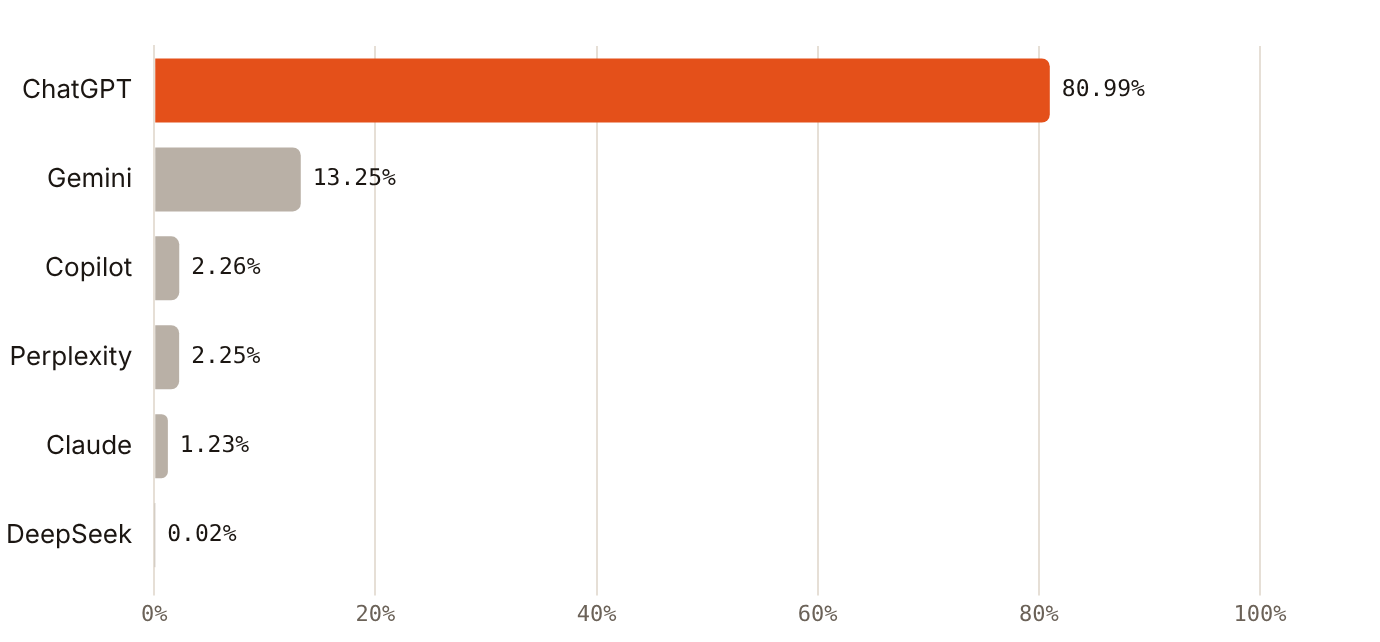
Source: StatCounter, AI chatbot market share United Arab Emirates, September 2026
The chatbot share is a referral and page-view measure inside StatCounter's network, not a count of users. Search is still much larger: Google holds 93.47% of UAE search engine share, and in StatCounter's direct comparison of Google and ChatGPT referrals Google has 99.57% and ChatGPT 0.43%. The two measures cannot be combined into a single market share.
ONS reading
For a UAE business, the order of priority follows the data. Google search, including the ads above and below AI Overviews, remains the largest paid channel. ChatGPT is the only AI assistant with a confirmed UAE self-service ad product and the dominant chatbot by referrals. Copilot, Gemini and Perplexity matter today mainly through organic visibility. A media plan that splits budget evenly across "AI platforms" misreads both availability and attention.
Organic AI visibility is a separate workstream
Paid placement and organic inclusion are separate systems. OpenAI's head of monetisation said ads "do not influence the core organic model", and organic AI visibility rests on factual, accessible content with no ranking guarantee. Organic work is therefore the main route into AI answers for businesses whose category cannot advertise on ChatGPT in the UAE, such as clinics and law firms (chapter 6).
Crawler access: the technical gate
The first step is technical. Each platform reads the web with named crawlers, and each crawler has a different job. Blocking a training crawler is a legitimate choice; blocking a search crawler removes the site from that assistant's search results; blocking an ad-review crawler can stop an ad being approved.
| Crawler | Operator | Purpose | robots.txt behaviour | Source |
|---|---|---|---|---|
| OAI-SearchBot | OpenAI | ChatGPT search; must not be blocked for a site to appear | Respected; changes applied in about 24 hours | OpenAI Help Center; OpenAI [Platform] |
| GPTBot | OpenAI | Model training; disallow to exclude content from training | Respected; one crawl may serve both bots if both allowed | OpenAI Help Center; OpenAI [Platform] |
| ChatGPT-User | OpenAI | Visits a page when a user asks; "not used for crawling the web in an automatic fashion" | "robots.txt rules may not apply" | OpenAI [Platform] |
| OAI-AdsBot | OpenAI | Checks landing pages submitted as ChatGPT ads; "only visits pages submitted as ads"; not used for training | Landing pages must not block it | OpenAI; OpenAI Help [Platform] |
| PerplexityBot | Perplexity | Surfaces and links websites in Perplexity search; not used for foundation-model training | Perplexity recommends allowing it | Perplexity Docs [Platform] |
| Perplexity-User | Perplexity | User-requested fetches | "generally ignores robots.txt rules"; changes up to 24 hours | Perplexity Docs [Platform] |
| Google-Extended | Controls use of content to train Gemini models | "does not control Search features" | Google [Platform] |
OpenAI states that "Any public website can appear in ChatGPT search"; to keep a page out, use the noindex meta tag, which the crawler must be allowed to read. A page disallowed in robots.txt may still appear as a link and title when there are "signals the page is relevant to a user's query" (OpenAI Help Center). Search, training and ad-review crawlers serve different purposes, and a training-crawler setting is not an advertising switch (OpenAI).
Google takes a different approach. Google-Extended governs Gemini training and "does not control Search features"; in January 2026 Google said it was "exploring updates to our controls" so sites could opt out of Search generative AI features, in the context of a UK CMA consultation, with no launch date. Sites that want to limit how their text appears in AI Overviews and AI Mode currently use the ordinary snippet controls: nosnippet, data-nosnippet, max-snippet and noindex (Google Search Central).
For UAE marketers: Ask the web team for the current robots.txt and any firewall or bot-protection rules. A security setting that blocks unknown bots can quietly block OAI-SearchBot and OAI-AdsBot, which removes the site from ChatGPT search and can cause a ChatGPT ad to fail review (OpenAI Help Center; OpenAI Help).
How assistants choose sources
The platforms describe their source selection only in general terms. OpenAI says ChatGPT search "sometimes partners with other search providers", rewrites a question into one or more targeted queries, ranks results "based on a number of factors", and that "There is no way to guarantee top placement". ChatGPT search is available to all Free, Plus, Team, Edu and Enterprise users, including logged-out Free users, and runs automatically when a question "might benefit from information on the web" (OpenAI Help Center).
Google says AI Overviews and AI Mode may use a "query fan-out" technique, running several related searches across subtopics and data sources, and that a supporting link must be "indexed and eligible to be shown in Google Search with a snippet"; "There are no additional technical requirements". Google adds: "You don't need to create new machine readable files, AI text files, or markup to appear in these features". A Google analyst was reported as saying Google "doesn't support LLMs.txt and isn't planning to", and that to appear in AI Overviews one should "simply use normal SEO practices"; this is secondhand, but consistent with Google's own documentation. No OpenAI or Perplexity statement on llms.txt was found.
On who wins citations, Pew found Wikipedia, YouTube and Reddit made up 15% of sources cited in Google AI summaries (US, March 2025), and BrightEdge reports that 34% of AI citations come from sources brands can influence through PR. Neither covers the UAE.
What the click studies show
The best evidence on how AI answers change behaviour comes from Google, because AI Overviews have run at scale since May 2024 (BrightEdge). The studies agree on direction: AI summaries reduce clicks to ordinary results. They differ on size, method and period, and all are correlational.
Share of Google search visits with a click, US adults, March 2025, %

Source: Pew Research Center, Google users are less likely to click on links when an AI summary appears, 22 July 2025
Pew tracked 900 US adults in March 2025 (Pew Research Center). Users clicked a traditional result in 8% of visits with an AI summary against 15% without, and clicked a link inside the summary in only 1% of visits (Pew Research Center, 2025). Of 68,879 unique searches, 18% produced an AI summary, and the session ended on 26% of visits with a summary against 16% without (Pew Research Center, 2025).
Ahrefs, using desktop Search Console data for 300,000 keywords, found that the presence of an AI Overview "correlates with a 58% lower average clickthrough rate" for the top-ranking page, with position-one CTR on AI Overview keywords falling from 0.073 in December 2023 to 0.016 in December 2025. Its earlier April 2025 study had put the reduction at 34.5%; in the 2026 update, reductions for positions two to ten ranged from 50.8% at position two to 19.4% at position ten (Ahrefs). The two Ahrefs figures conflict because they cover different periods; the later one is larger.
Google CTR by AI Overview presence and brand citation, 3,119 informational queries, mainly US, Q3 2025, %
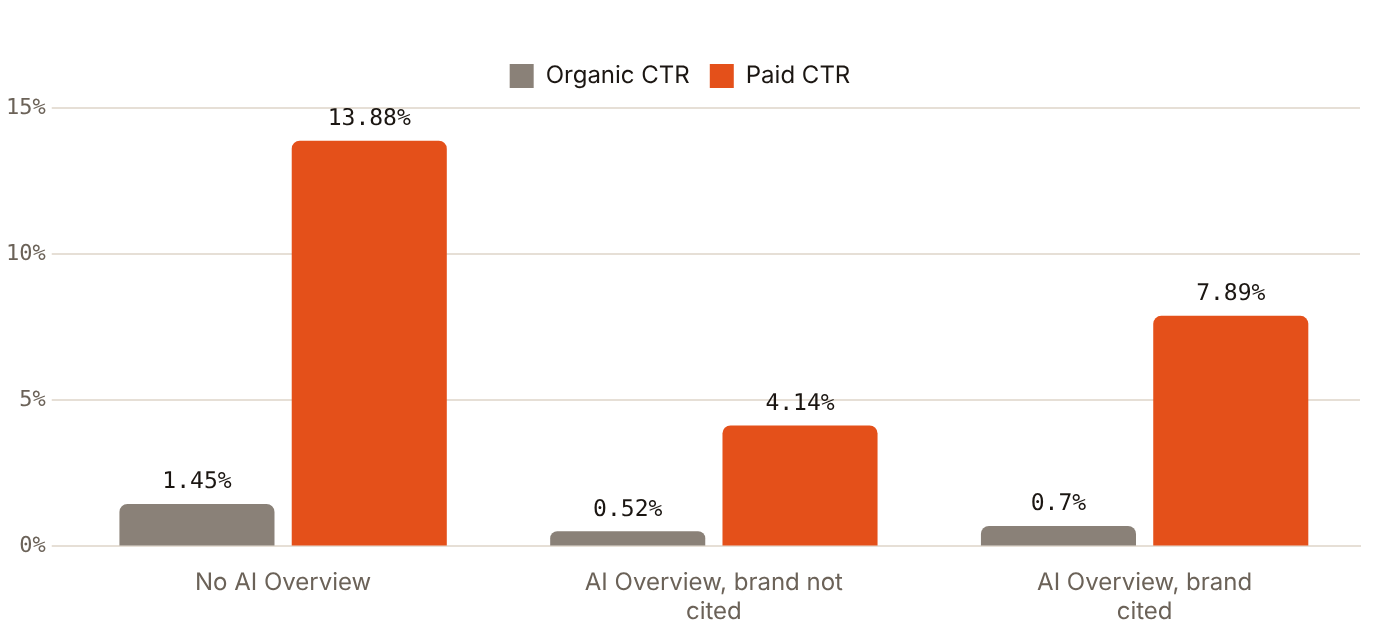
Source: Seer Interactive, AIO Impact on Google CTR: September 2025 Update, 4 November 2025
Seer Interactive studied 3,119 informational queries from June 2024 to September 2025. In Q3 2025, organic CTR was 1.45% with no AI Overview, 0.52% when one appeared and the brand was not cited, and 0.70% when the brand was cited; paid CTR was 13.88%, 4.14% and 7.89% respectively (Seer Interactive, 2024). Over the full period, organic CTR on AI Overview queries fell 61% (1.76% to 0.61%) and paid CTR fell from 19.70% to 6.34%, while non-AI Overview queries fell 41% organic and 32% paid (Seer Interactive). Seer puts the citation benefit at about 35% higher organic CTR and about 91% higher paid CTR, but warns "We cannot definitively prove that citation causes higher CTRs", and the source contains internal inconsistencies.
Prevalence estimates conflict. BrightEdge put AI Overviews in "over 11% of Google queries" a year after launch, with impressions up "over 49%" and click-throughs down nearly 30%, without describing its method; Semrush measured 20.22% of US desktop queries by April 2025 (Digiday). The query sets and dates differ.
AI assistants have not replaced lost search traffic. ChatGPT sent 396.8 million referral visits to 1,000 tracked sites in June 2025, 81.7% of their AI referral traffic, yet BrightEdge puts AI platforms at "less than 1% of referral traffic" for January to August 2025. Google reports an "over 10%" usage increase for queries showing AI Overviews in the US and India.
ONS reading
The studies are US-heavy and correlational, but they agree that an AI answer absorbs clicks, and the Seer data suggests that being one of the cited sources recovers part of the loss on both organic and paid results. For a UAE business the practical conclusion is to treat citation in AI answers as a visibility goal in its own right, measured separately from traffic, and not to expect AI referrals to replace search visits soon.
Build evidence a customer can inspect
Because neither OpenAI nor Google publishes a ranking formula for AI answers, ONS recommends content that a customer, a regulator and an assistant can all check: real service details, authorship, current contacts, explicit locations and supported claims, in readable text rather than images, with outdated offers removed.
Two UAE factors raise the stakes. First, UAE consumer protection rules require advertising and website information to be in Arabic as a minimum, and Google AI Overviews and AI Mode both support Arabic. An Arabic version of core service pages is therefore both a compliance point and a visibility point. Second, UAE residents are more willing than most to act on AI answers: 65% of UAE respondents told KPMG they are willing to rely on information provided by an AI system. A wrong price or an outdated service description repeated by an assistant reaches a receptive audience.
For a medical business excluded from paid ChatGPT campaigns outside the US, factual service and professional information can still help customers find and understand its website (OpenAI). Any clinical or promotional content still needs the appropriate regulatory review, since UAE law requires authority approval for health advertisements (UAE Legislation portal). This book makes no promise of organic rankings or AI recommendations for healthcare providers or anyone else.
Measure visibility without turning a sample into a census
Some measurement is now built in. "ChatGPT automatically includes the UTM parameter utm_source=chatgpt.com in referral URLs", so ChatGPT search referrals can be separated in analytics (OpenAI Help Center). Clicks from Google AI features are included in Search Console under the "Web" search type but are not reported separately, and Google Ads offers no segmented reporting for ads shown within AI Overviews.
ONS recommends a repeatable set of dated research questions, with separate logs for mentions, citations, referral visits and enquiries. A small prompt sample is exploratory, because answers vary; do not report a percentage of sampled prompts as the business's share of AI answers (OpenAI Help Center).
Use website analytics and customer enquiries alongside visibility observations. Where referral information is absent or ambiguous, record it as unknown; a direct visit after an AI interaction should not automatically be attributed to AI. Repeatable observations combined with qualified business outcomes support better decisions than a screenshot of one favourable answer.
ONS outlook
ONS expects at least one more assistant to add ads, since Google has stopped ruling out Gemini ads and Meta has described ads in Meta AI as coming "later down the line" (Let's Data Science, 2026; Beebom, 2025). Neither is announced. Until a platform publishes a UAE-available product, ONS treats it as a monitoring item, not a budget line.
Gaps in the evidence
No public data. Copilot ad availability and controls specific to the UAE; Copilot consumer monthly users (only the combined 150 million figure is public) (TechCrunch, Jan 2026). A future edition should request written confirmation from Microsoft Advertising's regional partner.
No public data. AI referral traffic for the UAE or GCC: none of Similarweb, Ahrefs, Seer, BrightEdge or Pew publishes regional figures. All click studies in this chapter are US or global. A future edition should run a dated UAE prompt panel and collect anonymised analytics from consenting clients.
No public data. Rufus availability on amazon.ae, an official Perplexity statement on ending ads, and any OpenAI or Perplexity statement on llms.txt. Meta has not named the UAE as in or out of scope for Meta AI ad personalisation.
Sources for this chapter
- Adcore, "Microsoft Advertising's global expansion launches in 34 markets", 25 Sep 2022. https://www.adcore.com/blog/micosoft-advertisings-global-expansion-launches-in-34-markets/
- Adthena, "Google AI Mode ads: Google is rebuilding your search ads for every conversation", 26 Aug 2026. https://www.adthena.com/?p=332622
- Ahrefs, "Update: AI Overviews Reduce Clicks by 58%", 4 Feb 2026. https://ahrefs.com/blog/ai-overviews-reduce-clicks-update
- Amazon Ads, "Amazon Ads ChatGPT advertising integration", 2026-09-10. https://advertising.amazon.com/library/news/amazon-ads-chat-gpt-advertising-integration
- Arabian Business, "Google AI search Arabic Gemini", 8 Oct 2025. https://www.arabianbusiness.com/culture-society/google-ai-search-arabic-gemini
- Arabian Marketer, "InMobi appoints regional leads for Microsoft Advertising partnership in the UAE", 20 Dec 2022. https://arabianmarketer.ae/?p=27747
- Axios, "OpenAI launches self-serve ad platform", 2026-05-05. https://axios.com/2026/05/05/openai-self-serve-ad-platform
- Beebom, "Zuckerberg outlines paid tier and ads are coming to Meta AI app soon", 1 May 2025. https://beebom.com/zuckerberg-meta-ai-app-premium-tier-and-ads-coming-soon/amp/
- BrightEdge via GlobeNewswire, "BrightEdge Data Finds AI Accounts for Less Than 1% Search", 12 Sep 2025. https://www.globenewswire.com/de/news-release/2025/09/12/3149225/0/en/BrightEdge-Data-Finds-AI-Accounts-for-Less-Than-1-Search-Organic-Traffic-Continues-to-Dominate.html
- BrightEdge, "One Year Into Google AI Overviews", 14 May 2025. https://brightedge.com/news/press-releases/one-year-google-ai-overviews-brightedge-data-reveals-google-search-usage
- Campaign, "Perplexity pulls the plug on ads, citing trust concerns for AI", Feb 2026 (undated on page). https://www.campaignlive.com/article/perplexity-pulls-plug-ads-citing-trust-concerns-ai/1949142
- DataReportal, "Digital 2026: The UAE", 5 Nov 2025. https://datareportal.com/reports/digital-2026-united-arab-emirates
- Digiday, "same article; Similarweb and Semrush data", 10 Jul 2025. https://digiday.com/media/in-graphic-detail-ai-platforms-are-driving-more-traffic-but-not-enough-to-offset-zero-click-search/
- Flywheel, "Amazon rolls out Sponsored Prompts to general availability in the US", 25 Mar 2026. https://www.flywheeldigital.com/video/amazon-sponsored-prompts-rufus-ads
- GIGAZINE, "Microsoft announces Copilot Checkout", 9 Jan 2026. https://gigazine.net/gsc_news/en/20260109-copilot-checkout
- GIGAZINE, "Perplexity drops ads, hurt trust AI", 19 Feb 2026. https://gigazine.net/gsc_news/en/20260219-perplexity-drops-ads-hurt-trust-ai
- Google Ads Help, "About ads and AI Overviews", undated, read 28 Oct 2026. https://support.google.com/google-ads/answer/16297775?hl=en
- Google Search Central, "AI features and your website", last updated 10 Dec 2025. https://developers.google.com/search/docs/appearance/ai-features
- Google Search Help, "Find information in faster and easier ways with AI Overviews", undated, read 28 Oct 2026. https://support.google.com/websearch/answer/14901683?hl=en
- Google, "blog.google, agentic commerce post", 11 Jan 2026. https://blog.google/products/ads-commerce/agentic-commerce-ai-tools-protocol-retailers-platforms/
- Google, "blog.google, GML 2025 post", 21 May 2025. https://blog.google/products/ads-commerce/google-search-ai-brand-discovery/
- Google, "Our approach to website controls for Search AI features", 28 Jan 2026. https://blog.google/products-and-platforms/products/search/search-ai-features-controls/
- Google, "Q2 2026 earnings call: Remarks from our CEO", 22 Jul 2026. https://blog.google/company-news/inside-google/message-ceo/alphabet-earnings-q2-2026/
- KPMG Lower Gulf, 9 Oct 2025. https://kpmg.com/ae/en/media/press-releases/2025/10/97-percent-of-uae-residents-now-use-ai.html
- Let's Data Science, "Google Executive Signals Ads Could Reach Gemini", 29 Apr 2026. https://letsdatascience.com/news/google-executive-signals-ads-could-reach-gemini-433f7132
- MediaPost, "Perplexity Stops Accepting New Advertisers", late 2025 (undated on page). https://www.mediapost.com/publications/article/409806/perplexity-stops-accepting-new-advertisers.html
- Meta Newsroom, "Improving Your Recommendations on Our Apps With AI at Meta", 1 Oct 2025. https://about.fb.com/news/2025/10/improving-your-recommendations-apps-ai-meta/
- Microsoft Advertising, "73% higher CTRs: why advertisers need to pay attention to conversational AI", 6 Aug 2025. https://preview-about.ads.microsoft.com/en/blog/post/august-2025/73-higher-ctrs-why-advertisers-need-to-pay-attention-to-conversational-ai
- Microsoft Advertising, "Transforming the future of audience engagement", 5 Mar 2025. https://preview-about.ads.microsoft.com/en/blog/post/march-2025/transforming-the-future-of-audience-engagement
- Microsoft, "Transforming audience engagement with generative AI", checked 2026-10-28. https://www.about.ads.microsoft.com/en/blog/post/october-2024/transforming-audience-engagement-with-generative-ai
- Modern Retail, "Amazon Q1 2026 earnings", 30 Apr 2026. https://www.modernretail.co/?p=159156
- Nasdaq, "Meta Platforms Q2 earnings call highlights", 29 Jul 2026. https://www.nasdaq.com/articles/meta-platforms-q2-earnings-call-highlights
- OpenAI Help Center, "Publishers and developers FAQ", undated ("Updated 23 days ago"), read 28 Oct 2026. https://help-lb.openai.com/en/articles/12627856-publishers-and-developers-faq
- OpenAI Help, "Create ads for ChatGPT, help-lb mirror", undated, read 28 Oct 2026. https://help-lb.openai.com/en/articles/20001212-create-ads-for-chatgpt
- OpenAI, "Ad policies", 10 Sep 2026; read 28 Oct 2026. https://openai.com/policies/ad-policies/
- OpenAI, "Our approach to advertising and expanding access", 2026-01-16. https://openai.com/index/our-approach-to-advertising-and-expanding-access/
- OpenAI, "Overview of OpenAI crawlers", undated, read 28 Oct 2026. https://developers.openai.com/docs/bots
- Perplexity Docs, "Perplexity crawlers", undated, read 28 Oct 2026. https://docs.perplexity.ai/docs/resources/perplexity-crawlers.md
- Pew Research Center, "Google users are less likely to click on links when an AI summary appears in the results", 22 Jul 2025. https://www.pewresearch.org/short-reads/2025/07/22/google-users-are-less-likely-to-click-on-links-when-an-ai-summary-appears-in-the-results/markdown
- Pinsent Masons, 6 Oct 2023. https://www.pinsentmasons.com/out-law/analysis/uae-consumer-protection-regime-revamped
- PPC Land, "Microsoft ad revenue tops 20 billion as Copilot transforms search", 1 May 2025. https://ppc.land/microsoft-ad-revenue-tops-20-billion-as-copilot-transforms-search/
- PPC Land, "Microsoft expands in-market audiences to the Middle East and Africa", 23 Jan 2023. https://ppc.land/microsoft-expands-in-market-audiences-to-the-middle-east-and-africa
- PPC Land, "Perplexity advertising head departs nine months after appointment", Aug/Sep 2025. https://ppc.land/perplexity-advertising-head-departs-nine-months-after-appointment/
- Reuters via TradingView, "Meta to use AI chats to personalize content and ads from December", 1 Oct 2025. https://de.tradingview.com/news/reuters.com,2025:newsml_L6N3VH1DX:0-meta-to-use-ai-chats-to-personalize-content-and-ads-from-december
- Search Engine Land, "Google corrects report claiming ads are coming to Gemini in 2026", Dec 2025 (approx., undated on page). https://searchengineland.com/google-corrects-report-claiming-ads-are-coming-to-gemini-in-2026-465856
- Search Engine Land, "Google says normal SEO works for ranking in AI Overviews and llms.txt won't be used", Jul 2025 (approx., undated on page). https://searchengineland.com/google-says-normal-seo-works-for-ranking-in-ai-overviews-and-llms-txt-wont-be-used-459422
- Seer Interactive, "AIO Impact on Google CTR: September 2025 Update", 4 Nov 2025. https://www.seerinteractive.com/blog/aio-impact-on-google-ctr-september-2025-update
- Semrush, "Top websites UAE", Sep 2026 data. https://www.semrush.com/trending-websites/ae/all
- Shopifreaks, "Amazon reveals pricing and measurement details for sponsored ads inside Rufus", 1 Apr 2026. https://www.shopifreaks.com/amazon-reveals-pricing-and-measurement-details-for-sponsored-ads-inside-rufus-ai-shopping-assistant/
- Similarweb, "AI Search Stats 2026: Market Share, Referral, and Citation Data", 2026 (undated; data to May 2026). https://aisearch.similarweb.com/blog/gen-ai-stats/
- Stacker / WebFX, "Inside Microsoft's Copilot search ads", 26 Feb 2026. https://stacker.com/stories/small-business/inside-microsofts-copilot-search-ads-and-what-makes-them-25-more-effective
- StatCounter, "Search engine market share UAE", Sep 2026 data. https://gs.statcounter.com/search-engine-market-share/all/united-arab-emirates
- tbreak, Abbas Jaffar Ali, "Amazon ChatGPT ads DSP partnership", 2026-09-11. https://tbreak.com/amazon-chatgpt-ads-dsp-partnership/
- TechCrunch, "Amazon brings its Rufus AI shopping assistant to more international markets", 29 Oct 2024. https://techcrunch.com/2024/10/29/amazon-brings-its-rufus-ai-shopping-assistant-to-more-international-markets
- TechCrunch, "Google closes in on another billion-user product with Gemini", 23 Jul 2026. https://techcrunch.com/2026/07/23/google-closes-in-on-another-billion-user-product-with-gemini/
- TechCrunch, "Google's AI Overviews have 2B monthly users, AI Mode 100M in the US and India", 23 Jul 2025. https://techcrunch.com/2025/07/23/googles-ai-overviews-have-2b-monthly-users-ai-mode-100m-in-the-us-and-india
- TechCrunch, "Satya Nadella insists people are using Microsoft's Copilot AI a lot", 29 Jan 2026. https://techcrunch.com/2026/01/29/satya-nadella-insists-people-are-using-microsofts-copilot-ai-a-lot
- UAE Legislation portal, 10 Jun 2024. https://www.uaelegislation.gov.ae/en/legislations/2547/download
PUT THE INSIGHT TO WORK
Your market.
Your next move.
Explore how ONS approaches ChatGPT Ads, campaign readiness and measurement for UAE businesses.
Explore our expertise ↗