
In this chapter
This chapter asks how much a UAE business needs to spend to learn anything useful from ChatGPT Ads, what published prices and benchmarks exist, and how to work out an affordable cost per enquiry before launch. The platform floor is low: an AED-billed campaign needs a daily budget of at least AED 65 (OpenAI; OpenAI Help, 2026). Every published price and performance benchmark, though, comes from the US or other non-Middle East markets, and no independent source publishes UAE figures (PPC Land). Planning therefore has to start from the advertiser's own unit economics, not from someone else's cost per click.
In brief
- The minimum daily budget for AED-billed ChatGPT Ads accounts is AED 65. GCC minimums also exist for SAR (50) and QAR (60), but the 30-currency table has no row for KWD, BHD or OMR (OpenAI; OpenAI Help, 2026).
- A daily budget is a 7-day average target. Spend on one day can reach twice the daily budget, and weekly spend up to seven times it, measured over a Sunday to Saturday budget week (OpenAI Help).
- Advertisers choose Views (CPM), Clicks (CPC) or Conversions (billed as oCPC or oCPM). OpenAI states that "you don't pay per conversion".
- OpenAI recommends that CPC campaigns start with a maximum bid of USD 3 to USD 5 per click. This is a US-dollar starting maximum bid, not an expected CPC and not a UAE benchmark (OpenAI Help).
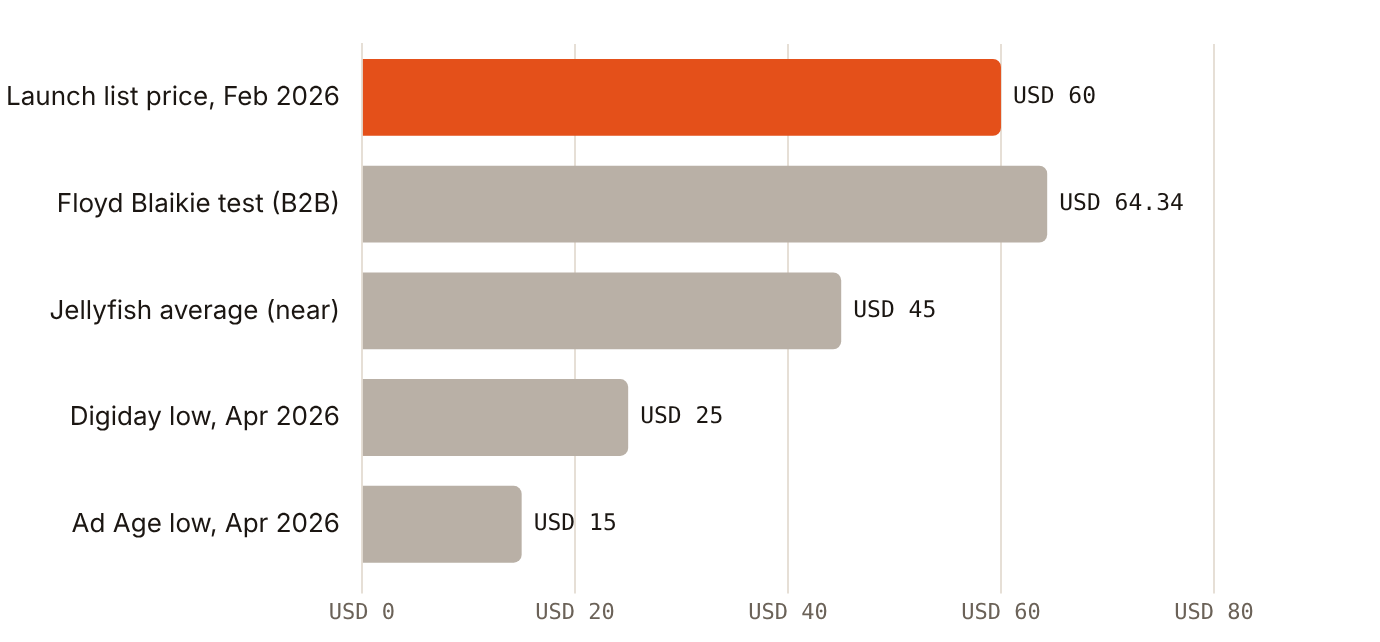
- Entry pricing fell fast during the US pilot. The launch CPM was USD 60 with a minimum commitment reported at USD 200,000 or USD 250,000, CPMs were reported as low as USD 25 (Digiday) and USD 15 (Ad Age) by April 2026, and the USD 50,000 test minimum was removed when self-serve opened on 5 May 2026.
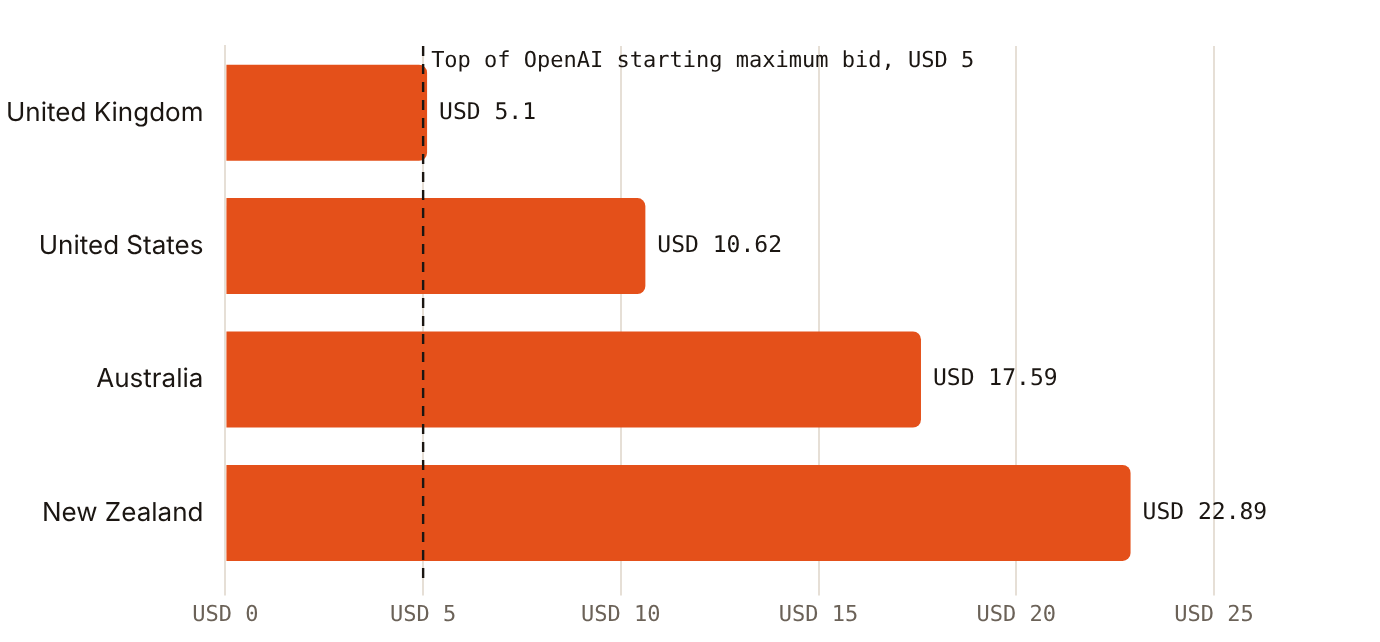
- Advertiser-reported CPCs range from USD 4.41 to USD 22.89, depending on market and advertiser; these are single-advertiser anecdotes, not benchmarks. One test priced the UK at USD 5.10 and New Zealand at USD 22.89 (Search Engine Journal).
- ONS's two UAE client tests published CPCs of AED 1.97 and AED 3.19. With no dates, spend or revenue published, these are not a market benchmark, and this book does not derive spend or cost per lead from them.
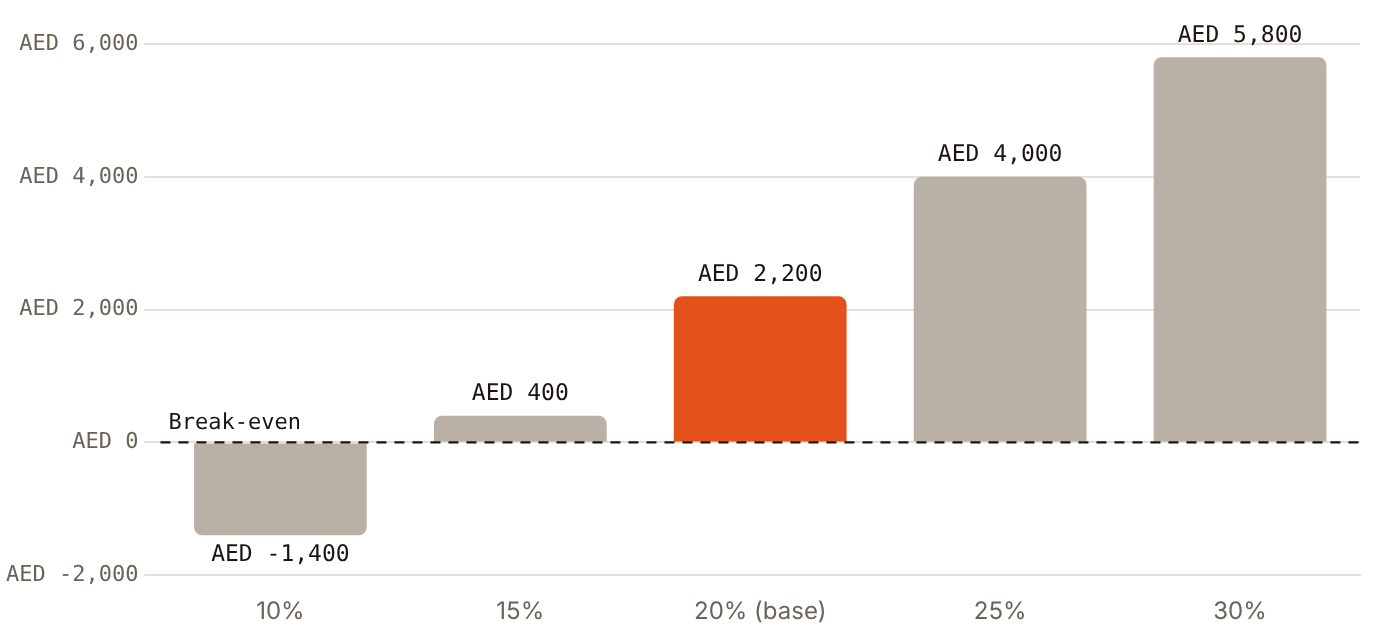
- In the illustrative ONS model, a business can afford AED 240 per lead all-in, and the scenario's all-in cost per lead is AED 166.67. If the close rate halves, the same scenario turns a AED 2,200 surplus into a AED 1,400 loss.
- Category eligibility sets the economics before price does. Outside the US, hospitals, diagnostics, minimally invasive cosmetic procedures and legal services are "Not allowed", so no budget makes them viable on ChatGPT Ads in the UAE today (OpenAI Help Center).
The platform floor: minimum budgets and pacing
As of 28 October 2026, OpenAI's campaign creation help article sets a minimum daily budget of AED 65 for accounts billed in UAE dirhams. The same table, read in its French-locale copy on the same day, gives SAR 50, QAR 60 and ILS 60 for other Middle East currencies. It has no row for the Kuwaiti dinar, Bahraini dinar, Omani rial, Egyptian pound or Jordanian dinar (OpenAI Help, 2026). Across 30 currencies, the other minimums include USD 25, EUR 15, GBP 15, INR 725 and SGD 25 (OpenAI Help). For a UAE business, the AED row is the one that matters. A group with entities in Kuwait, Bahrain or Oman should check its billing currency before opening accounts, because the help centre does not say which currency those advertisers are billed in.
| Currency | Market relevance | Minimum daily budget | Source |
|---|---|---|---|
| AED | United Arab Emirates | 65 | OpenAI; OpenAI Help [Platform] |
| SAR | Saudi Arabia | 50 | OpenAI Help [Platform] |
| QAR | Qatar | 60 | OpenAI Help [Platform] |
| ILS | Israel | 60 | OpenAI Help [Platform] |
| KWD, BHD, OMR, EGP, JOD | Kuwait, Bahrain, Oman, Egypt, Jordan | No row in table | OpenAI Help [Platform] |
| USD | United States and USD-billed accounts | 25 | OpenAI Help [Platform] |
| EUR / GBP | Euro area / United Kingdom | 15 / 15 | OpenAI Help [Platform] |
| INR | India | 725 | OpenAI Help [Platform] |
| SGD / MYR | Singapore / Malaysia | 25 / 35 | OpenAI Help [Platform] |
The figures are in different currencies and are not converted here. This book applies no exchange rate to platform minimums.
The minimum is a platform floor. It is not a recommended budget and it does not promise enough enquiries to judge performance. OpenAI treats a daily budget as a 7-day average target. Spend on a single day can reach twice the daily budget, and weekly spend can reach seven times it, within a budget week that runs Sunday to Saturday in the account's time zone (OpenAI Help). At the AED 65 floor, that means one day can cost up to AED 130 (65 × 2) and a budget week up to AED 455 (65 × 7). If the 7-day average holds for 30 days, spend comes to AED 1,950 (65 × 30). Finance teams used to hard daily caps should be told this before launch. A Saudi agency's reading of the same help pages adds that ads may keep running for up to 24 hours after a pause and that this delivery is billed (Origami). This comes from an agency, not from OpenAI's own text in the notes, so treat it as something to check in the account.
For UAE marketers: Brief finance on pacing before launch. A AED 65 daily budget is a weekly average, not a daily ceiling. Campaign-total budgeting gives tighter control over total spend, so set it when a test has a fixed allocation (OpenAI).
Account set-up costs that land before the first click
Some costs come before any media spend. The Account Legal Name must be the registered business name, and it is used for billing and business verification. Self-serve billing is by credit card, and the currency and time zone cannot be changed once the account is created (OpenAI Help). Business verification "may take up to 7 Business days" (OpenAI Help Center). Some new self-serve accounts can serve only in their home country until identity verification is approved and a required level of home-country spend has been reached (OpenAI Help). The help page does not publish that spend level, so a UAE advertiser that also wants to reach Saudi or Qatari users should not assume cross-border delivery from day one. Opening the account in the wrong currency is costly, because it cannot be changed later (OpenAI Help).
How ChatGPT Ads charge: objectives, auction and bids
The campaign article lists three objectives: Views, billed per thousand impressions (CPM); Clicks, billed per click (CPC); and Conversions, billed as optimised CPC or optimised CPM. OpenAI states plainly that "you don't pay per conversion". The draft verification check reached the same conclusion: conversion optimisation changes what the system aims for, not the unit the advertiser pays for (OpenAI). A UAE business that wants to pay only for enquiries cannot do so on ChatGPT Ads. The financial risk of weak conversion stays with the advertiser.
Ads are chosen in a relevance-weighted, second-price auction, with bids set at ad-group level (OpenAI Help). For CPC campaigns, OpenAI's basics article recommends a starting maximum bid of USD 3 to USD 5 per click, which is not an expected CPC. Trade press reports that from August 2026 the default bid strategy for eligible new ad groups is "Maximize results", and that a hard ceiling needs manual bidding (Search Engine Journal, Brooke Osmundson). The basics article documents no frequency cap or frequency control (OpenAI Help). For budget planning, this means the advertiser controls total spend, and the bid only if it chooses manual bidding, but not how often one person sees the ad.
Custom audiences add a threshold that small UAE advertisers may not reach. An inclusion audience needs at least 25,000 matched users, while exclusion lists can be smaller (OpenAI Help). A clinic or boutique hotel with a short customer list may only be able to use its list for exclusions.
Published pricing: how the US pilot reset entry costs
Almost everything published about ChatGPT Ads prices comes from the US pilot and from trade press, not from OpenAI price lists. The record shows a sharp fall in entry costs during the first half of 2026. The sources do not agree on every figure, and the disagreements are shown below rather than resolved.
| Date | Item | Reported value | Geography | Source |
|---|---|---|---|---|
| 9 Feb 2026 | Launch CPM and commitment | CPM USD 60; minimum commitment USD 200,000 | US pilot | PPC Land, Luis Rijo [Industry] |
| Feb to Apr 2026 | Minimum spend at launch (conflicting report) | USD 250,000 at launch, later USD 50,000 | US pilot | Digiday, Krystal Scanlon [Industry] |
| Apr 2026 | CPM range | As low as USD 25; Jellyfish averages near USD 45; Ad Age as low as USD 15 | US pilot | Digiday, Krystal Scanlon [Industry] |
| Apr 2026 | Monthly minimum | USD 30,000 to USD 50,000; pilot extended past end of March for underdelivery | US pilot | The Decoder, Maximilian Schreiner [Industry] |
| Apr 2026 | CPC bids offered | USD 3 to USD 5 | US pilot | Search Engine Journal, Matt G. Southern [Industry] |
| 5 May 2026 | Self-serve Ads Manager beta; CPC added | Previous USD 50,000 test minimum removed | US | OpenAI; Axios [Platform] |
| 5 May 2026 | StackAdapt partner minimum | USD 0 (reported by Digital Applied) | Partner route | Digital Applied [Estimate] |
| Jun 2026 | Criteo partner minimum | Cut from USD 50,000 to USD 10,000 (reported by Digital Applied) | Partner route | Digital Applied [Estimate] |
| By 30 Sep 2026 | HubSpot match for new accounts (offer has expired) | USD 750 match on ad spend applied to accounts opened by 30 Sep 2026 | HubSpot integration | PPC Land [Industry] |
| Undated, read 28 Oct 2026 | Thrad managed service | Lowest band under USD 10,000 per month | Vendor stating MENA service | Thrad [Estimate] |
| Read 28 Oct 2026 | Self-serve minimum, AED billing | AED 65 per day | UAE | OpenAI [Platform] |
The launch commitment is reported two ways. PPC Land gives USD 200,000, while Digiday gives a USD 250,000 minimum spend at launch, later USD 50,000. The two figures conflict, so this book gives the launch minimum as reported at USD 200,000 to USD 250,000. Both reports agree on the direction: entry moved from six-figure US commitments to a self-serve floor. OpenAI's own figures, reported at the Al Bayan MENA briefing, say average cost per purchase fell by about 60% and average CPM by about 20% over the six weeks before mid-September 2026. These are global platform figures repeated by the press. They are not audited and they are not UAE figures.
Reported cost per thousand impressions, USD, US and North American advertisers, February to September 2026; Jellyfish value reported as 'near' 45; Floyd Blaikie is one advertiser's self-reported anecdote, currency of CPM not stated
Source: PPC Land 25 Sep 2026; Digiday 17 Apr 2026; Search Engine Journal 8 Sep 2026
Hostinger reported, via its agency, CPMs above USD 65 on a test of about USD 70,000, according to Search Engine Journal; like the other advertiser figures here, this is a self-reported anecdote, not a benchmark. That puts it above the launch list price, even though other advertisers reported lower CPMs over the same months. The spread reflects different advertisers, categories, bidding methods and dates. It does not show a single market price.
Cost per click and click-through benchmarks, with geography
The best public CPC evidence is a set of advertiser self-reports collected by trade press in September 2026. Every one is from North America or another non-Middle East market.
| Advertiser or study | Geography | Spend | CPC | CPM | CTR | Source |
|---|---|---|---|---|---|---|
| Common Thread Collective (ecommerce) | US / North America | USD 9,620 | USD 4.41 | Not stated | 0.94% | Search Engine Journal [Industry] |
| Floyd Blaikie (B2B) | North America | CAD 7,000 | 9.29 (reported with USD sign) | 64.34 | 0.7% | Search Engine Journal [Industry] |
| Synter (all markets) | UK, US, Australia, NZ | USD 4,428.84 | USD 9.89 | Not stated | Not stated | Search Engine Journal [Industry] |
| Adthena, one brand | US | Not stated | Not stated | Not stated | 0.91% (vs 6.4% Google search, same sector) | Trending Topics, Jakob Steinschaden [Industry] |
| Similarweb, Free and Go users | Geography not stated, recorded 17 Aug 2026 | n/a | n/a | n/a | 0.50% | PPC Land [Industry] |
| ONS client Test A | UAE, dates not published | Not published | AED 1.97 | Not published | 4.09% (196 / 4,797) | ONS Digital [ONS] |
| ONS client Test B | UAE, dates not published | Not published | AED 3.19 | Not published | 2.18% (451 / 20,663) | ONS Digital [ONS] |
Average CPC by market, USD, Synter ChatGPT Ads test, reported September 2026; OpenAI's suggested starting maximum bid is USD 3 to 5, not an expected CPC
Source: Search Engine Journal, 6 months into ChatGPT ads, 8 Sep 2026; OpenAI Help, Ads in ChatGPT: the basics
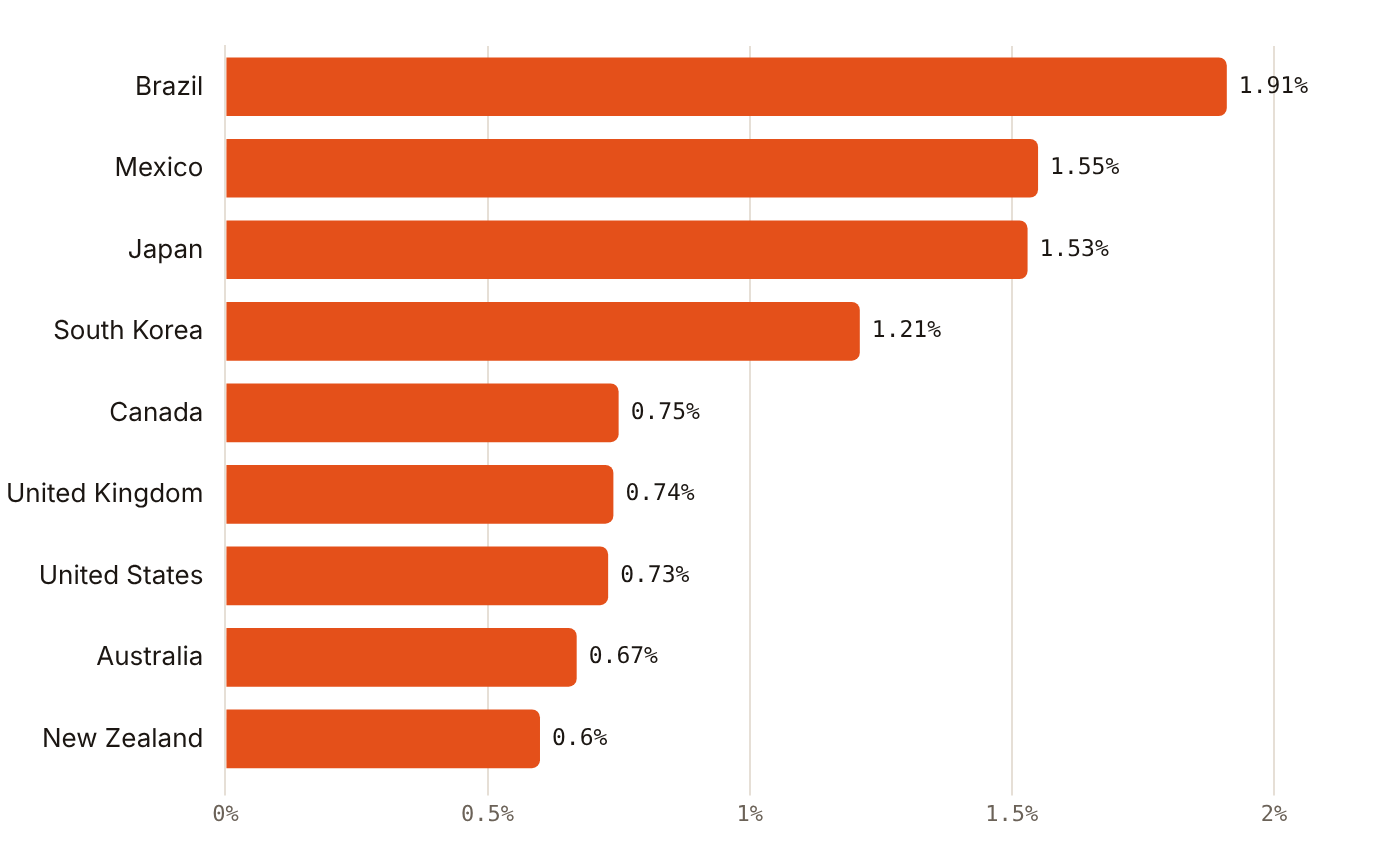
Synter's market split shows why a single figure travels badly. The same advertiser paid USD 5.10 per click in the UK and USD 22.89 in New Zealand, with an average of USD 9.89 across USD 4,428.84 of spend (Search Engine Journal). MediaPost reported agency executives seeing a CTR of about 0.6% and clicks of about USD 7, with no conversions (Trending Topics, Jakob Steinschaden). CTRs also vary by market. Similarweb and Graphite measured all-time CTRs from 30 March to 16 September 2026 and published no Middle East market; the Brazil and Mexico figures rest on about one month of data (PPC Land).
All-time click-through rate by market, %, 30 March to 16 September 2026; Brazil and Mexico rest on about one month of data; UAE and other Middle East markets not covered
Source: PPC Land on Similarweb and Graphite, 4 Oct 2026
CTR also falls as a conversation goes on. Similarweb and Graphite found approximately 0.66% at the first turn and 0.36% to 0.48% at turns 5 to 21, worldwide and read from a chart; the Graphite sample covered more than 95,000 ads from more than 500 US advertisers. Similarweb also reports worldwide CTR up about 112% between 30 March and 14 September 2026, without stating which weeks are compared (PPC Land). Over an overlapping period, ad density rose: Sensor Tower measured ads per user per hour on the US mobile app up 163% in August against April. The two trends affect cost in opposite directions, and nobody has published their net effect on CPC for the UAE.
ONS reading The ONS test CPCs of AED 1.97 and AED 3.19 come from two anonymised UAE clients with no dates, spend, sector or revenue published. In Test B, the objective, message and destination changed together. They show that UAE delivery at a few dirhams per click has happened. They do not show what another advertiser will pay. They are also in a different currency from every US benchmark, and this book does not convert them. Following its own rule, ONS does not multiply rounded CPCs by click counts to estimate spend or cost per lead. A UAE business should plan with a range of CPC inputs and test which one it actually gets.
Platform-selected results and vendor claims
Some figures come from parties with an interest in the result. OpenAI cites one ecommerce advertiser with 3x ROAS over 28 days, and one technology partner reporting that more than 80% of ad-driven ChatGPT traffic came from new customers. Neither the geography nor the advertiser is named (OpenAI). Criteo reports, without independent verification, conversion rates for LLM-referred traffic of 1.5x other referral channels (February 2026 sample, 500 US retailers) and close to twice traditional search in three categories (May 2026) (PPC Land). Common Thread Collective estimated its own ROAS at 3.3x to 6.8x, a single-advertiser anecdote (Search Engine Journal). A sponsored advertorial, company-supplied and not reviewed by Adweek, reported one US law firm getting 12 leads from about USD 2,000 in one month. Legal services ads are not allowed outside the US, including the UAE, so that example has no direct use for UAE planning even before its sponsored status is considered (OpenAI Help Center). None of these are benchmarks. They suggest that conversion economics vary widely, and that the platform rewards advertisers who measure well.
Scale and competition: who else is in the auction
In a second-price auction, the price depends on who else is bidding. OpenAI said on 21 October 2026 that more than 100,000 advertisers had run campaigns in just over eight months. Third-party counts are lower and measure different things, such as advertisers active in one week rather than a cumulative total, so they are not one series. Adthena counted 7,306 unique advertisers in the week of 9 July and 12,075 in the week of 31 August, and The Information, as reported by TNW, put the figure at about 20,000 in late August (PPC Land). Sensor Tower counted about 1,200 unique US advertisers in August 2026. In the US, the category mix shifted: shopping and retail fell from 37% to 21% of spend between April and August 2026, while financial services rose from 2% to 13%, travel from 5% to 11% and health and wellness from 1% to 5% (PPC Land on Sensor Tower).
No source gives a UAE advertiser count or category mix. A UAE travel or hospitality brand should note two things. In the US, travel's share of spend more than doubled over four months (PPC Land on Sensor Tower). Booking.com was the top US advertiser over a 30-day window, with more than 50 million impressions and more than 700 creatives (Sensor Tower). If global travel brands target the UAE as heavily, UAE hotel bids would face that competition.
Eligibility comes before price
A budget model is only worth building for an offer that can run. As of the eligibility table read on 28 October 2026, these categories are "Not allowed" in all countries other than the US: minimally invasive cosmetic procedures, hospitals and urgent care, medical testing and diagnosis, consumer medical devices, dietary supplements and disease awareness. Telehealth, prescription medicines, online pharmacies and OTC medicines are "Not allowed" in the US as well (OpenAI Help Center). Under the ad policies at v1.6 (updated 10 September 2026), "Ads for health services outside the US are generally prohibited" (OpenAI). Dental services appear only in the US list, and the eligibility table has no separate dental row (OpenAI). Outside the US, legal services, personal loans, BNPL, payments and remittances, financial planning, credit monitoring and cryptocurrency are "Not allowed". Deposit accounts, credit cards, non-health insurance, auto loans, mortgages and investing are "Restricted to Select Approved Advertisers" (OpenAI Help Center). Individual housing rentals or sales are prohibited everywhere (OpenAI). Alcohol and tobacco promotion, and gambling, are disallowed (OpenAI).
OpenAI also warns that "A registered or licensed business is not automatically eligible for every advertising category or market", that it is "not accepting applications for approval in certain policy categories", and that an ad "can pass review and still be ineligible to serve in its selected countries". Anyone planning a budget needs to know this, because an approved ad with no delivery still uses up set-up time and creative cost.
For UAE marketers: Settle eligibility before you model returns. For a UAE clinic, hospital, diagnostics centre, law firm or most lenders, the economic question on ChatGPT Ads today is not "what can we afford to pay per lead" but "can we run at all", and the current answer is no (OpenAI Help Center). Nightlife venues cannot promote alcohol or shisha on any channel, and ONS does not put shisha in any ad image or video.
Separate media cost from total acquisition cost
Media spend is only part of what a pilot costs. Management fees, landing-page work, creative production and measurement set-up should all be counted when judging the investment. Decide whether set-up costs are charged entirely to the pilot or spread over a stated useful period, and show that choice rather than hiding it in a headline return. Some of these costs are fixed by UAE rules. Advertising and website information must be in Arabic as a minimum under the consumer protection regime, as summarised by a law firm (Pinsent Masons). Ads for real estate, medical services, financial services, education and food need approval from the relevant authority under Article 33(10) of Cabinet Resolution No. 68 of 2024 (UAE Legislation portal). For health ads, MOHAP states licence processing takes "1 - 3 working days". Each requirement adds time or production cost before the first impression. Where an approval is needed, it has to be in place before launch. A test budget that ignores these costs will overstate the return.
Measurement costs time as well. OpenAI's reporting shows recent conversions with a delay of 24 to 48 hours. Impressions, clicks and CTR refresh about every 15 minutes, but spend can lag by 7 to 8 hours (OpenAI Help). Reporting windows are 7, 14 or 30 days after a click and 0 or 1 day after a view (OpenAI). A test judged on its first few days will mostly be judging incomplete data.
A worked planning model with illustrative inputs
The model below repeats and recomputes the draft's scenario. Every input is an illustrative assumption chosen to make the arithmetic clear. None is a platform benchmark, an ONS quotation or an ONS campaign result. The calculations are ONS's own.
| Illustrative input | Value | Basis | Source |
|---|---|---|---|
| Media spend | AED 3,000 | Scenario input | [Scenario] |
| Management and production | AED 2,000 | Scenario input, not an ONS quotation | [Scenario] |
| CPC | AED 5.00 | Scenario input, not a platform benchmark | [Scenario] |
| Click-to-lead rate | 5% | Scenario input | [Scenario] |
| Qualified share of leads | 60% | Scenario input | [Scenario] |
| Close rate of qualified leads | 20% | Scenario input | [Scenario] |
| Contribution per sale before acquisition | AED 2,000 | Scenario input, not revenue | [Scenario] |
| Ref | Measure | Formula | Result | Limitation | Source |
|---|---|---|---|---|---|
| D07 | Scenario clicks | 3,000 / 5 | 600 clicks | Hypothetical | [ONS] |
| D08 | Scenario leads | 600 × 0.05 | 30 leads | Hypothetical | [ONS] |
| D09 | Qualified leads | 30 × 0.60 | 18 leads | Hypothetical | [ONS] |
| D10 | Expected sales | 18 × 0.20 | 3.6 | Fractional expected value, not an outcome | [ONS] |
| D11 | Expected contribution | 3.6 × 2,000 | AED 7,200 | Before acquisition cost; not revenue | [ONS] |
| D12 | Net contribution | 7,200 − (3,000 + 2,000) | AED 2,200 | Before unmodelled overhead | [ONS] |
| D13 | Break-even allowance per lead | 0.60 × 0.20 × 2,000 | AED 240 | All-in, before profit reserve | [ONS] |
| D14 | All-in cost per lead | (3,000 + 2,000) / 30 | AED 166.67 | Includes illustrative fees and production | [ONS] |
| D15 | Media-only cost per lead | 3,000 / 30 | AED 100 | Media only | [ONS] |
| D16 | Half close rate sensitivity | 18 × 0.10 × 2,000 − 5,000 | −AED 1,400 | One variable changed, all else fixed | [ONS] |
The model gives 600 clicks, 30 leads, 18 qualified leads and 3.6 expected sales. A fractional sale is an expected value, not something that will literally happen. Expected contribution is AED 7,200. After AED 5,000 of all-in acquisition cost, AED 2,200 remains. These are illustrations, not forecasts or ONS campaign results.
The affordable cost per enquiry
The figure that links the campaign to the business is the break-even allowance per lead. It is the qualified share times the close rate times contribution per sale: 0.60 × 0.20 × AED 2,000 = AED 240 (D13). This is the most the business can pay per lead, all in, before keeping any profit. The scenario's all-in cost per lead is AED 166.67 (D14), so it clears the allowance. The media-only cost per lead is AED 100 (D15). The gap between AED 100 and AED 166.67 is the fixed cost of management and production spread over 30 leads. At small budgets that fixed cost dominates.
The allowance can be turned into a maximum affordable CPC by multiplying it by the click-to-lead rate. Here that is AED 240 × 0.05 = AED 12.00 per click. Above AED 12 per click, the scenario loses money on every lead even before fixed costs. The required close rate can be solved the same way. Break-even needs 5,000 / (18 × 2,000) = 13.89% of qualified leads to close. Below that, the scenario does not recover its all-in cost.
Fixed costs also set a minimum scale. With AED 2,000 of fixed cost and the scenario's per-click economics, each AED 1 of media returns AED 2.40 of expected contribution (0.05 / 5 × 240), a net AED 1.40. Break-even media spend is therefore AED 2,000 / 1.4 = AED 1,428.57. Below that, even a campaign with good unit economics does not recover its set-up cost.
| Planning quantity | Formula | Scenario result | Source |
|---|---|---|---|
| Break-even allowance per lead | qualified share × close rate × contribution per sale | AED 240 | [ONS] (D13) |
| Maximum affordable CPC, variable costs only | allowance per lead × click-to-lead rate | AED 12.00 | [ONS] |
| Break-even close rate | all-in cost / (qualified leads × contribution per sale) | 13.89% | [ONS] |
| Break-even media spend given fixed cost | fixed cost / (click-to-lead rate / CPC × allowance − 1) | AED 1,428.57 | [ONS] |
| Expected leads per day at the AED 65 minimum | (65 / CPC) × click-to-lead rate | 0.65 | OpenAI [ONS], |
| Days to 30 leads at the AED 65 minimum | 30 / expected leads per day | 46.15 days | OpenAI [ONS], |
What the minimum budget buys in time
The last two rows show what the minimum budget means in practice. At AED 65 a day, with the scenario's AED 5 CPC and 5% click-to-lead rate, a campaign would expect 13 clicks and 0.65 leads a day (OpenAI). Reaching the scenario's 30 leads would take 46.15 days, before allowing for the 24 to 48 hour conversion delay or a sales cycle of several weeks (OpenAI). The floor is cheap enough to start, but slow enough that a business could wait two months to get a sample worth judging. Set the test budget by the decision to be made. If the business needs 30 leads to decide, it can buy them faster with a higher budget or wait longer at the minimum. It should choose deliberately.
Sensitivity: why a cheap click can coexist with poor economics
If the close rate halves to 10% and everything else stays fixed, expected contribution falls to AED 3,600 and the pilot loses AED 1,400 before any unmodelled overhead (D16). The chart extends that one-variable test across five close rates. It is a sensitivity analysis, not a forecast of the market.
Net contribution after AED 5,000 all-in cost, AED, by close rate of qualified leads; illustrative ONS scenario, all other inputs fixed; not a forecast
Source: ONS illustrative calculation (D10 to D16 and extensions); scenario inputs, not market data
The formula behind each bar is 18 × close rate × 2,000 − 5,000. At 15%, net contribution is AED 400. At 25% it is AED 4,000, and at 30% it is AED 5,800. The lesson is that sales follow-up can matter more than media price. A training provider that answers WhatsApp enquiries in minutes and one that replies the next day could see the same CPC and very different returns.
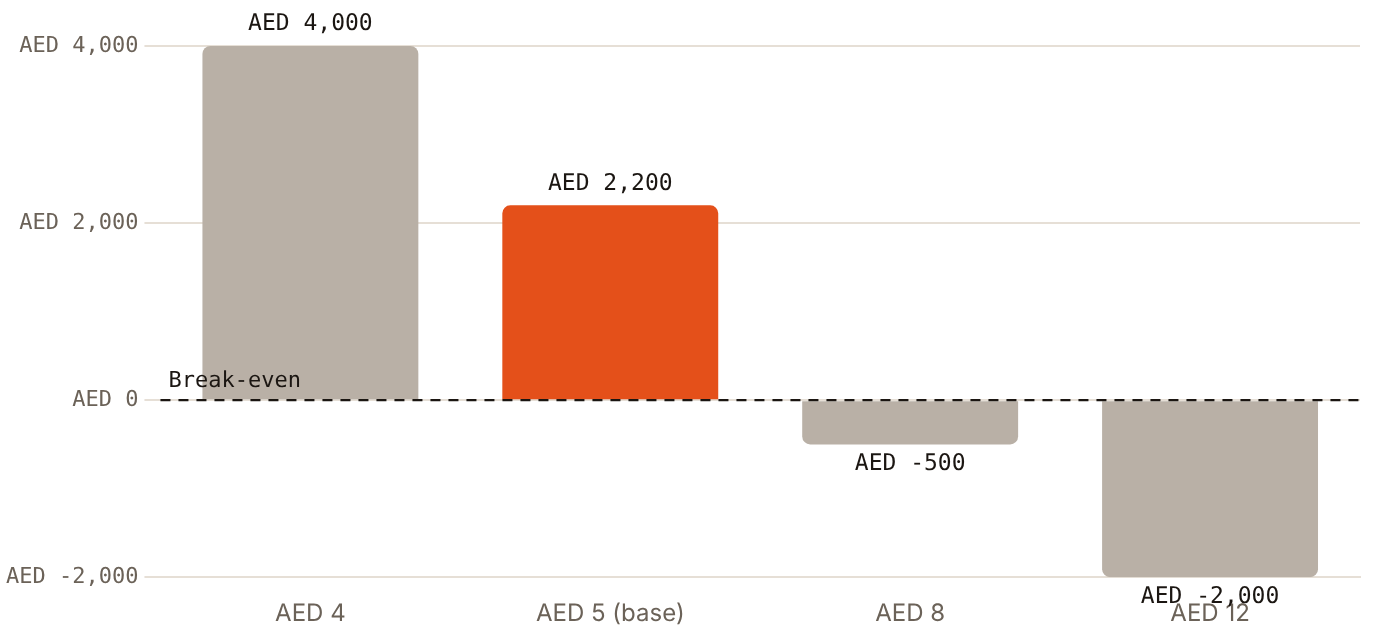
The second test changes CPC alone, holding media at AED 3,000, fixed cost at AED 2,000 and the other inputs at base values. Leads are 3,000 / CPC × 0.05, and net contribution is leads × 240 − 5,000.
Net contribution after AED 5,000 all-in cost, AED, by CPC; AED 3,000 media; illustrative ONS scenario, all other inputs fixed; CPCs are inputs, not benchmarks
Source: ONS illustrative calculation; scenario inputs, not market data
At AED 4 per click the scenario yields 37.5 leads, an all-in cost per lead of AED 133.33 and a surplus of AED 4,000. At AED 8 it yields 18.75 leads, an all-in cost per lead of AED 266.67 and a AED 500 loss. At AED 12 the media-only cost per lead is AED 240, exactly the break-even allowance. Fixed costs then produce a AED 2,000 loss. Single advertisers have reported CPCs from USD 4.41 (US) to USD 22.89 (New Zealand), which shows how wide the range a model has to cover can be (Search Engine Journal). The UAE price is unpublished, so the model should be run on several CPC inputs, not one.
ONS reading For most UAE lead-generation businesses, the variables they control (qualification, close rate and follow-up speed) move the result more than the media price within a plausible CPC range. ONS therefore suggests building the allowance per lead from the client's own CRM history before the first campaign. Bids and budgets should follow from that allowance, not from a US benchmark. Where the client has no CRM history, the first test should be judged on lead quality and pipeline progression, not on closed revenue, and the agreed review date should allow for the sales cycle.
Where ChatGPT Ads sits in a UAE media budget
Budget allocation should reflect where UAE users actually spend their time. StatCounter puts Google at 93.47% of UAE search engine share in September 2026. On StatCounter's separate Google versus ChatGPT referral measure, Google holds 99.57% and ChatGPT 0.43%. Among AI chatbots in the UAE, ChatGPT had 80.99% share in the same month (StatCounter, 2026). Semrush ranks chatgpt.com third by visits in the UAE in September 2026, with 27.73 million, behind google.com at 258.97 million and youtube.com at 141.16 million. These measures count different things (referrals, page views, visits), as the notes explain, and should not be combined. Together they suggest a large ChatGPT audience in the UAE, though one far smaller than Google search as a source of referral traffic. Not all of that audience is ad-eligible. Ads show only on Free and Go plans, never to users who say or are predicted to be under 18, and never in Temporary Chats (OpenAI; OpenAI Help).
ONS outlook ONS expects ChatGPT Ads to sit as a test line beside established search and social budgets for most eligible UAE businesses through 2027, rather than replacing them. If OpenAI or an independent measurement firm publishes UAE or GCC CPC and CTR figures, planning can move from scenario ranges to market benchmarks. ONS will update this chapter if that happens. This is a view, not a prediction of any platform decision.
Agree stop and scale decisions in advance
Stop at once for a material policy problem, broken measurement or an inability to fulfil the offer. Review weak commercial performance only after the agreed data and maturation period, which in the minimum-budget scenario above can be more than six weeks. Expand only when the business can handle the extra volume and the economics still work under realistic assumptions. Remember that OpenAI's ad review covers the advertiser, creative, landing page and placement, and that ads are monitored after approval. A scaled campaign can still be paused if a problem appears.
Do not treat early wins as a reason to multiply budgets without review. More delivery can change the mix of customers, the sales workload and the marginal cost of acquisition. Graphite's finding that CTR falls in later conversation turns is one mechanism (PPC Land). Broader delivery can reach less engaged moments. Keep a reserve for website or follow-up improvements where these offer a clearer route to growth than more impressions.
- Stop immediately on a policy rejection or ineligibility, broken conversion tracking, or an offer that cannot be fulfilled. Check ad review status and serving eligibility and the conversion event set-up (OpenAI; OpenAI Help Center).
- Review when the agreed lead count or date is reached, after the 24 to 48 hour conversion delay (OpenAI). Compare leads, qualified share and cost per lead against the allowance per lead.
- Scale when all-in cost per lead sits below the allowance with a profit reserve and the sales team has confirmed capacity. Remember the pacing headroom of up to seven times the daily budget in a week (OpenAI Help).
- Hold when the category is restricted or awaiting approval under the non-US eligibility table (OpenAI Help Center).
Gaps in the evidence
No public data. No independent source publishes ChatGPT Ads CPM, CPC, CTR or conversion data for the UAE, the GCC or MENA. The Similarweb and Graphite panel covers nine markets, none in the Middle East (PPC Land). OpenAI does not publish a UAE price, a frequency cap, or the home-country spend needed before cross-border delivery. The minimum-budget table has no KWD, BHD or OMR row, and it does not say how advertisers in those countries are billed (OpenAI Help, 2026). The ONS client tests have no published dates, spend or revenue. A future edition should fetch: any OpenAI regional pricing or benchmark release; a Similarweb or Sensor Tower panel that includes the UAE; and the ONS tests' dated, audited exports with spend, so that cost per lead can be calculated directly rather than from rounded CPCs.
Sources for this chapter
- Adweek Wire, ADSQUIRE, "ChatGPT ads just opened the door to law firms", 2026-09-04. https://www.adweek.com/adweek-wire/chatgpt-ads-just-opened-the-door-to-law-firms/
- Al Bayan, "OpenAI expands ChatGPT ads to MENA", 2026-09-16. https://www.albayan.ae/economy/1552481
- Axios, "OpenAI launches self-serve ad platform", 2026-05-05. https://axios.com/2026/05/05/openai-self-serve-ad-platform
- Digiday, Krystal Scanlon, "Everything is coming down: ChatGPT ads are getting cheaper", 2026-04-17. https://digiday.com/marketing/everything-is-coming-down-chatgpt-ads-are-getting-cheaper/
- Digital Applied, "Where ChatGPT ads are sold", 2026-09-01, mod 2026-10-22. https://www.digitalapplied.com/blog/where-chatgpt-ads-are-sold-every-market-and-date
- MOHAP, "Issue/renew licence for a health advertisement", undated, read 28 Oct 2026. https://mohap.gov.ae/en/w/issue-license-/-renew-license-for-a-health-advertisement
- OpenAI Help Center, "Troubleshooting Common Onboarding and Policy Issues, Ads Policy Eligibility Table", Updated about 26 Oct 2026 ("2 days ago" when read 28 Oct 2026). https://help.openai.com/en/articles/20001534-troubleshooting-common-onboarding-and-policy-issues
- OpenAI Help, "Create campaigns for ChatGPT Ads, fr-fr locale", undated, read 28 Oct 2026. https://help.openai.com/fr-fr/articles/20001210-create-campaigns-for-chatgpt-ads
- OpenAI, "Ad policies", 10 Sep 2026; read 28 Oct 2026. https://openai.com/policies/ad-policies/
- OpenAI, "Creating campaigns for ChatGPT Ads", checked 2026-10-28. https://help.openai.com/en/articles/20001210-creating-campaigns-for-chatgpt-ads
- Origami, "ChatGPT Ads now open to Saudi businesses", 2026-10-25. https://origami.sa/en/blog/chatgpt-ads-saudi-arabia-open/
- Pinsent Masons, 6 Oct 2023. https://www.pinsentmasons.com/out-law/analysis/uae-consumer-protection-regime-revamped
- PPC Land on Sensor Tower, 2026-09-03. https://ppc.land/chatgpt-ads-pass-1bn-run-rate-as-financial-services-spend-triples/
- PPC Land, "Over 1,000 brands now live on ChatGPT ads via Criteo", 2026-05-06. https://ppc.land/over-1-000-brands-now-live-on-chatgpt-ads-via-criteo-as-ai-conversions-near-2x/
- Search Engine Journal, "6 months into ChatGPT ads", 2026-09-08. https://www.searchenginejournal.com/6-months-into-chatgpt-ads-advertisers-still-dont-know-what-good-looks-like/587583/
- Semrush, "Top websites UAE", Sep 2026 data. https://www.semrush.com/trending-websites/ae/all
- Sensor Tower, "ChatGPT ads are here; now we are tracking the machine", undated (c. Aug 2026), read 28 Oct 2026. https://sensortower.com/blog/chatgpt-ads-are-here-now-we-are-tracking-the-machine
- StatCounter, "Search engine market share UAE", Sep 2026 data. https://gs.statcounter.com/search-engine-market-share/all/united-arab-emirates
- The Decoder, Maximilian Schreiner, "OpenAI wants to sell more ads in ChatGPT but advertisers are struggling with basic tools", 2026-04-16. https://the-decoder.com/openai-wants-to-sell-more-ads-in-chatgpt-but-advertisers-are-struggling-with-basic-tools/
- Thrad, "Launch paid ads in ChatGPT with Thrad", undated, read 28 Oct 2026. https://www.thrad.ai/chatgpt-ads
- Trending Topics, Jakob Steinschaden, "ChatGPT ads hits $1 billion run rate but advertisers are not sold", 2026-08-31. https://www.trendingtopics.eu/chatgpt-ads-hits-1-billion-run-rate-but-advertisers-are-not-sold/
- UAE Legislation portal, 10 Jun 2024. https://www.uaelegislation.gov.ae/en/legislations/2547/download
PUT THE INSIGHT TO WORK
Your market.
Your next move.
Explore how ONS approaches ChatGPT Ads, campaign readiness and measurement for UAE businesses.
Explore our expertise ↗