
In this chapter
This chapter explains what ChatGPT Ads can measure for a UAE advertiser, what it cannot, and how to connect platform reports with website analytics and a CRM without forcing them to agree. OpenAI publishes a Pixel, a Conversions API, a click reference called oppref, event deduplication and reporting windows of 7, 14 or 30 days after a click, but advertisers receive only aggregated views and clicks, never chats. No independent source has published ChatGPT Ads CPM, CPC or CTR figures for the UAE or any Middle East market, so every external benchmark in this chapter is from another geography and must be read that way (PPC Land).
In brief
- OpenAI launched its Conversions API and pixel with the self-serve Ads Manager beta on 5 May 2026. The pixel stores the oppref click reference in a first-party cookie, a shared event ID deduplicates pixel and API events, and reported totals may include modelled conversions (OpenAI Help).
- Conversion-optimised campaigns need a supported standard event, and the billing unit (click or impression) is separate from the outcome objective (OpenAI). OpenAI states "you don't pay per conversion".
- Reporting windows are 7, 14 or 30 days after a click and 0 or 1 day after a view; recent conversions can take 24 to 48 hours to appear (OpenAI). Spend may lag 7 to 8 hours behind impressions and clicks (OpenAI Help).
- Advertisers never receive chats, chat history, memories, names, emails, precise location or IP addresses; they receive aggregated views and clicks (OpenAI Help). Ads data is deleted from OpenAI servers within up to 30 days.
- ChatGPT adds utm_source=chatgpt.com to organic referral links, and advertisers may add their own UTM parameters to ad landing pages (OpenAI Help Center; OpenAI Help). Paid and organic ChatGPT visits therefore need separate tagging.
- In the UAE, ChatGPT held 80.99% of AI chatbot referral share in September 2026, but only 0.43% in StatCounter's Google versus ChatGPT comparison. AI referrals are concentrated in one assistant and small against search.
- Independent CTR panels cover nine markets, none in the Middle East: all-time CTR ranged from 0.60% in New Zealand to 1.91% in Brazil, with the US at 0.73%; Brazil and Mexico rest on about one month of data (PPC Land).
- Advertiser-reported CPCs range from USD 4.41 (US) to USD 22.89 (New Zealand) in single-advertiser reports, which are anecdotes rather than benchmarks, and launch CPMs of USD 60 fell to as low as USD 25 by April 2026 in the US (Search Engine Journal; Digiday, Krystal Scanlon).
- The UAE PDPL has been in force since 2 January 2022, but its implementing regulations had not been issued by June 2026, and no later issuance was found by 28 October 2026 (Primerus / Reina Consulting; Morgan Lewis). DIFC lists prior opt-in consent for behavioural advertising (Baker McKenzie).
| 7 / 14 / 30 Click attribution windows, days OpenAI, checked 28 Oct 2026. OpenAI | 24 to 48 h Approximate delay before recent conversions appear OpenAI, checked 28 Oct 2026. OpenAI | 80.99% ChatGPT share of AI chatbot referrals, UAE StatCounter, Sep 2026. StatCounter |
|---|---|---|
| 0.43% ChatGPT share in Google vs ChatGPT referrals, UAE StatCounter, Sep 2026. StatCounter |
Use three connected records
The measurement design ONS uses for ChatGPT Ads keeps three records separate but reconcilable. The platform record reports delivery and the events it attributes to ads under its own windows. Website analytics describes sessions and on-site actions under its own rules. The CRM records enquiries, qualification, sales and lost reasons. None of the three should silently overwrite another, because each answers a different question.
The platform record is the only one that can see an ad impression. OpenAI's ads system "controls all delivery decisions", and the advertiser cannot audit an individual impression because conversation content is never shared. Analytics can see the landing-page visit and what happened next, but it cannot see an ad that was shown and not clicked. The CRM is the only record that knows whether a lead was real, relevant and closed. A UAE business that relies on one record alone will either overstate the ads (platform only) or miss view-led demand (analytics only).
For UAE marketers: Decide before launch which record answers which question. Platform for delivery and cost, analytics for site behaviour, CRM for commercial outcome. Write it down in the campaign brief.
What OpenAI publishes on conversion measurement
OpenAI's 5 May 2026 announcement rolled out the beta self-serve Ads Manager, added CPC bidding alongside CPM, and launched the Conversions API and pixel. The measurement help page describes two routes for sending events, the Pixel in the browser and the Conversions API from the advertiser's server, together with oppref preservation, deduplication, permitted data and modelled measurement (OpenAI).
Pixel, oppref and the Conversions API
When a user clicks an ad, the landing URL carries a click reference called oppref. The pixel captures oppref into a first-party cookie so later events on the same site can be tied back to the click (OpenAI Help). If the same event is sent by both the pixel and the Conversions API, a shared event ID lets OpenAI count it once. Automatic Advanced Matching hashes identifiers in the browser with SHA-256 before they are sent (OpenAI Help).
An industry report describes the fields each route accepts: the pixel supports hashed phone, first name, last name, region and postal code, and the Conversions API adds hashed email, external ID, city, country and the Android advertising ID (TechWyse). OpenAI's own help text read for this book did not list these fields, so they should be confirmed in the account before a developer builds against them.
OpenAI states that reported conversion totals may include modelled conversions. That matters for reconciliation: a platform count can exceed what the site's own tag recorded without either being wrong, because one includes estimates and the other does not.
Event quality and the Conversions page
An Event Quality Score from 1 to 10 sits under Tools then Conversions in Ads Manager, according to PPC Land's September 2026 report. Search Engine Roundtable reported a redesigned Conversions page and weekly performance emails around 16 October 2026. Neither report gives the scoring method, so a score should be read as a prompt to check the implementation, not as a measure of commercial quality.
| Component | What it does | Status and date | Source |
|---|---|---|---|
| Pixel | Browser tag; captures oppref into a first-party cookie | Launched 5 May 2026; help page read 28 Oct 2026 | OpenAI; OpenAI Help [Platform] |
| Conversions API | Server-to-server events; adds hashed email, external ID, city, country, GAID | Launched 5 May 2026; field list from industry report | OpenAI; TechWyse [Industry] |
| Deduplication | Same event ID sent by pixel and API counted once | Help page read 28 Oct 2026 | OpenAI Help; OpenAI [Platform] |
| Automatic Advanced Matching | SHA-256 hashing in the browser | Help page read 28 Oct 2026 | OpenAI Help [Platform] |
| Modelled conversions | Totals may include modelled events | Help page read 28 Oct 2026 | OpenAI Help; OpenAI [Platform] |
| Event Quality Score | 1 to 10 score under Tools > Conversions | Reported 17 Sep 2026 | PPC Land [Industry] |
| Measurement partners | Click attribution, full-funnel and geo-experiment vendors | Reported 5 Oct 2026 | TechCrunch, Sarah Perez [Industry] |
Conversion optimisation and what it changes
ChatGPT Ads offers three objectives: Views, billed on CPM; Clicks, billed on CPC; and Conversions, billed as optimised CPC or optimised CPM (OpenAI Help). OpenAI's help text is explicit that "you don't pay per conversion", and the draft verification record confirms that the conversion objective does not mean payment per conversion. A conversion campaign needs a supported standard optimisation event, and click or impression billing is distinct from the outcome objective (OpenAI).
Conversion-optimised campaigns began rolling out on 5 June 2026 for accounts that had conversions configured by 1 June, according to PPC Land. Optimised CPC for product-feed campaigns and the product carousel was reported from 24 August 2026 by an agency source (Common Thread Collective). PPC Land reported in September 2026 that conversion optimisation with impression billing was generally available. OpenAI said on 31 August 2026 that CPC and outcome-optimised bidding account for most campaigns, without giving a percentage.
Two settings change how measurement and spend interact. From August 2026, "Maximize results" became the default bid strategy for eligible new ad groups, and Search Engine Journal reports that manual bidding is needed for a hard ceiling. The daily budget is a seven-day average target, so daily spend can reach twice the daily budget and weekly spend up to seven times it, with the budget week running Sunday to Saturday in the account time zone (OpenAI Help). A day-by-day comparison of spend against leads will therefore look noisy even when the week is on plan.
ONS reading A conversion objective is only as good as the event it optimises towards. For most UAE service businesses the first reliable event is a submitted enquiry form or a click on a tracked call or WhatsApp button, not a sale. If the optimisation event is a soft action such as a page view, the system will find more of that action, which may not be more customers. ONS starts lead-generation accounts on clicks or on a hard enquiry event, and moves to conversion optimisation only when the event is firing consistently and the CRM confirms that the events correspond to real enquiries.
Reporting windows, time basis and latency
OpenAI's reporting guidance offers click windows of 7, 14 or 30 days and either no view-through credit or a one-day view window. Changing the reporting window affects reported credit rather than bidding or billing (OpenAI). Reports can be shown on ad-event time or conversion time, and recent conversion totals may take 24 to 48 hours to appear, which OpenAI describes as approximate.
The Ads Manager overview adds two latency figures: impressions, clicks and CTR refresh about every 15 minutes, while spend may lag 7 to 8 hours (OpenAI Help). An agency reading of the Saudi help pages says ads may run for up to 24 hours after a pause and are billed for that delivery (Origami). Account currency and time zone cannot be changed after the account is created, so a UAE account opened in the wrong time zone will misalign every daily comparison with a Dubai-time CRM for the life of the account (OpenAI Help).
| Setting or behaviour | Published value | Why it matters for reconciliation | Source |
|---|---|---|---|
| Click window | 7, 14 or 30 days | Longer window credits more conversions to the ad | OpenAI [Platform] |
| View window | 0 or 1 day | View credit has no matching analytics session | OpenAI [Platform] |
| Conversion delay | 24 to 48 hours (approximate) | Recent days will be revised upwards | OpenAI [Platform] |
| Delivery metrics refresh | About every 15 minutes | Clicks visible before cost | OpenAI Help [Platform] |
| Spend lag | 7 to 8 hours | Same-day CPC is understated | OpenAI Help [Platform] |
| Daily budget | Seven-day average; daily up to 2x, weekly up to 7x | Daily spend varies by design | OpenAI Help [Platform] |
| UAE minimum daily budget | AED 65 | Floor for any test design | OpenAI; OpenAI Help [Platform] |
| Currency and time zone | Fixed at account creation | Set Asia/Dubai and AED at the start | OpenAI Help [Platform] |
| Delivery after pause | Up to 24 hours, billed | Pausing at capacity is not instant | Origami [Estimate] |
For month-on-month review, keep a fixed comparison basis. If a window or time basis changes, restate both periods where feasible or explain the break in the report. A sale recorded this month may relate to an earlier lead cohort, so show both the monthly operating view and the lead-cohort view when the sales cycle makes that distinction material.
Privacy limits on what advertisers can see
OpenAI's first ads announcement on 16 January 2026 said: "We keep your conversations with ChatGPT private from advertisers, and we never sell your data to advertisers". The current help page is specific. Advertisers never receive chats, chat history, memories, name, email, precise location or IP address; they receive only aggregated views and clicks; and when personalisation is off, ads use the current thread only (OpenAI Help). The draft verification record confirms that paid placement is separate from answers and conversation content is private (OpenAI).
Several audience rules reduce what can be measured. Ads appear only to Free and Go users; under-18 users, whether stated or predicted, do not see ads (OpenAI). Temporary Chats carry no ads, logged-out users see ads "designed to be suitable for all ages", and ads data is deleted from servers within up to 30 days (OpenAI Help). Free users can choose an ad-free option with "lower usage limits and reduced feature access" (OpenAI Help). The current ad policy, v1.6 updated 10 September 2026, excludes ads from conversations in sensitive categories and from "vulnerable user-model interactions", including "Mental and personal health conversations" (OpenAI).
Personalisation consent differs by region. In the US, ad personalisation is on by default with an opt-out; in the EU and UK, it requires opt-in consent, according to a report on OpenAI's privacy-policy updates (Crypto Briefing via Gizmodo). At the European launch, personalisation from conversation context, general location and device was withheld (TechWyse, DJ Kennedy, 2026). OpenAI's 31 August 2026 post says targeting uses the current conversation and, "depending on country and user settings", broader ChatGPT context. No source in this book states which personalisation setting applies by default to UAE users.
Audience measurement has its own thresholds. A custom audience used for inclusion needs at least 25,000 matched users, while exclusion audiences can be smaller (OpenAI Help). An industry report says custom audiences can exceed 5 million members and accept the Google Advertising ID (TechWyse, 2026). Brand-suitability pilots with DoubleVerify and IAS, reported on 5 October 2026, assess safeguards without access to conversations (Adweek, Trishla Ostwal).
| Data item | Available to the advertiser? | Source |
|---|---|---|
| Aggregated impressions and clicks | Yes | OpenAI Help [Platform] |
| Attributed conversions, possibly including modelled | Yes, from the advertiser's own pixel or API events | OpenAI Help [Platform] |
| Conversation text, chat history, memories | No | OpenAI Help [Platform] |
| User name, email, precise location, IP address | No | OpenAI Help [Platform] |
| The prompt that triggered an ad | No; not listed among data shared | OpenAI Help [Platform] |
| Reporting split for ads within Google AI Overviews | No segmented reporting (Google) | Google Ads Help; Google [Platform] |
UAE data protection context
The UAE Personal Data Protection Law, Federal Decree-Law 45 of 2021, has been in force since 2 January 2022 and requires consent that is "clear, specific, and unambiguous"; it excludes DIFC, ADGM and other free zones with their own data laws, and health and banking data fall under sector laws (Primerus / Reina Consulting). Morgan Lewis wrote in June 2026 that the PDPL implementing regulations "have still not been issued" and that no supervisory authority had been unambiguously designated for private-sector oversight; no later issuance was found by 28 October 2026. A Federal Authority for AI and Data was announced on 14 June 2026, absorbing the UAE AI Office, the TDRA digital government sector and the Emirates Data Office (Morgan Lewis).
Inside the DIFC, Baker McKenzie lists prior opt-in consent for online behavioural advertising, social media targeting and ad personalisation, while noting that the DIFC has no specific cookie or tracking rules. DIFC Regulation 10, effective 1 September 2023, requires "a clear and explicit notice" on initial use of a system where AI processes personal data (Clyde & Co). For a DIFC-based advertiser, a pixel that hashes and sends personal identifiers falls squarely within that consent framework.
No public data. No onshore UAE rule on cookies or pixels, and no Dubai mainland rule specific to tracking tags, was found; the PDPL has no published implementing regulations (Morgan Lewis, 2026). A future edition should check for PDPL implementing regulations, guidance from the Federal Authority for AI and Data, and ADGM direct-marketing and cookie guidance, which was not fetched for this edition.
ONS reading Until the PDPL regulations are published, ONS treats the DIFC opt-in standard as the safe operating benchmark for any UAE client that sends hashed personal data through a pixel or API: a visible consent banner, a privacy notice that names ad measurement, and a server-side route that sends identifiers only for users who consented. This is a prudent default, not a statement of what onshore law requires, and clients should take their own legal advice.
Attribution from AI assistants in GA4 and the CRM
Two kinds of ChatGPT traffic reach a website, and they must be separated. The first is organic: a user clicks a cited link inside a ChatGPT answer. OpenAI's publisher FAQ says "ChatGPT automatically includes the UTM parameter utm_source=chatgpt.com in referral URLs". The second is paid: a user clicks a sponsored unit below the answer. OpenAI's ad creation help says advertisers can use their own UTM parameters and should link to the most relevant page rather than a generic homepage.
If the advertiser does not tag paid links, analytics may merge them with organic ChatGPT referrals, and the ads will appear to perform worse in the platform than in analytics, or the reverse. The fix is a distinct utm_medium for paid ChatGPT clicks, set on every ad, so that GA4 or any other analytics tool reports paid and organic ChatGPT sessions separately. The oppref click reference added by OpenAI is a second signal that a visit came from an ad.
Landing pages must be reachable and must not block OAI-AdsBot or OAI-SearchBot (OpenAI Help). OpenAI's crawler documentation distinguishes search, training and ad-review crawlers, and ads or landing pages that cannot be reviewed are not eligible to run. A site that blocks the ad-review crawler to stop training will also stop its ads.
Google AI features in analytics
Google states that clicks from its AI features are included in the Search Console "Web" search type, and that Google Ads "currently doesn't offer segmented reporting when ads show within Search AI Overviews". In the UAE, ads within AI Overviews are not available at all: Google's list is 12 English-language countries and the UAE is absent. A UAE advertiser cannot, therefore, isolate AI-feature performance on Google from ordinary search performance in either Search Console or Google Ads.
CRM integrations and partners
PPC Land reported in September 2026 that HubSpot is the first CRM partner and Shopify the first ecommerce partner for ChatGPT Ads, with the Shopify app international from 23 September 2026 in ChatGPT Ads markets. TechCrunch listed measurement partners on 5 October 2026: AppsFlyer, Triple Whale, Adjust, DV Rockerbox, Northbeam, Branch, Singular, Kochava, Airbridge and Tenjin for click attribution; Fospha, Measured and INCRMNTAL for full-funnel measurement; and Haus, Measured and WorkMagic for geo experiments (TechCrunch, Sarah Perez). OpenAI said on 31 August 2026 that it has more than 50 technology and measurement partners. None of these sources states whether each integration is available to UAE-registered accounts.
| Traffic type | Suggested tagging (ONS convention) | Platform basis | Source |
|---|---|---|---|
| Organic ChatGPT citation | Arrives with utm_source=chatgpt.com; keep as organic AI referral | Added automatically by ChatGPT | OpenAI Help Center [Platform] |
| Paid ChatGPT ad | utm_source=chatgpt, utm_medium=paid_ai, utm_campaign and utm_content per ad group and ad | Own UTMs allowed on ads | OpenAI Help [Platform] |
| Google AI Overviews and AI Mode | No separate tag possible; read with Search Console Web type | No segmented ads reporting | Google Search Central; Google Ads Help [Platform] |
| Call or WhatsApp from a ChatGPT landing page | Tracked click event plus a source-specific number or prefilled message | No OpenAI call-tracking feature found | See gap below |
The UTM values in the second column are an ONS naming convention, not an OpenAI requirement. What matters is that the convention is fixed before launch and used on every ad.
How large AI referral traffic is: published studies
Before setting expectations for ChatGPT traffic, a UAE marketer should know how small AI referrals still are compared with search, and how concentrated they are in ChatGPT.
UAE figures
StatCounter's AI chatbot share for the UAE in September 2026, measured on page views and referrals across its network, puts ChatGPT at 80.99%, Gemini at 13.25%, Copilot at 2.26%, Perplexity at 2.25%, Claude at 1.23% and DeepSeek at 0.02%. In the same month, StatCounter's Google versus ChatGPT comparison gave Google 99.57% and ChatGPT 0.43% across all platforms, and 99.94% against 0.06% on mobile. Google held 93.47% of UAE search engine share and Bing 3.96% (StatCounter, 2026). These are referral shares, not counts of users.
AI chatbot share of page views and referrals, UAE, all platforms, September 2026, %
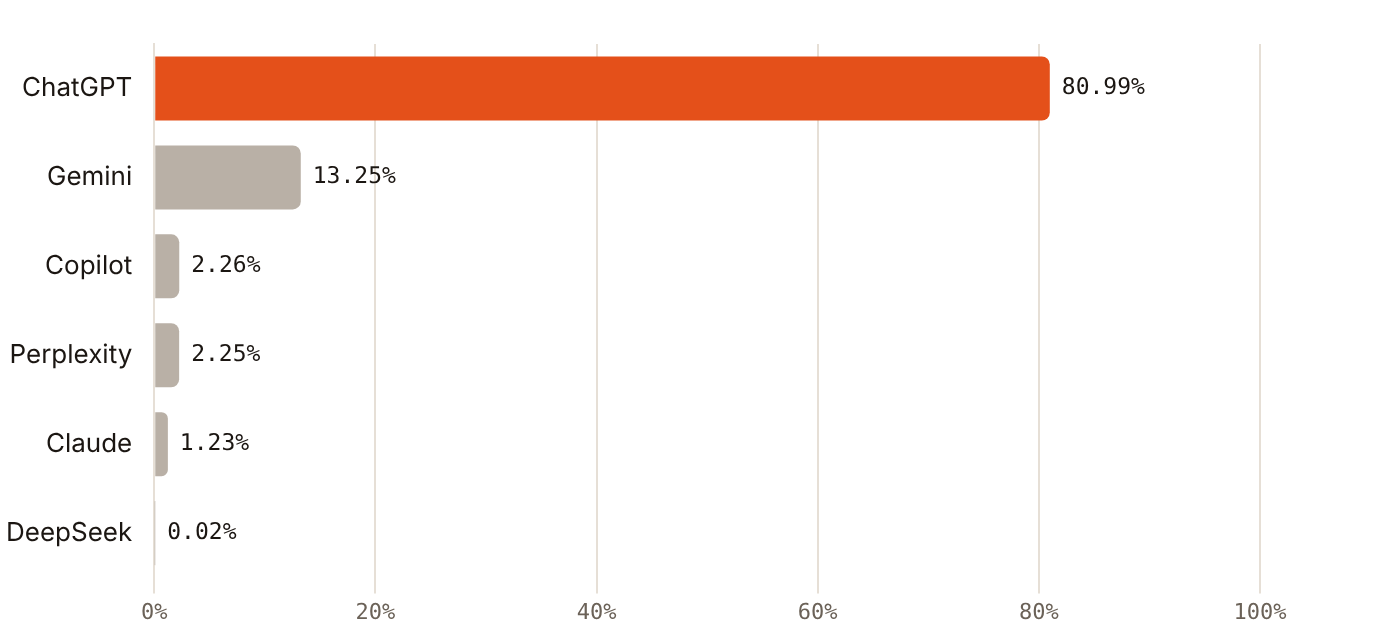
Source: StatCounter, AI chatbot market share UAE, September 2026
Semrush counted 27.73 million visits to chatgpt.com from the UAE in September 2026, ranking it third behind google.com at 258.97 million and youtube.com at 141.16 million, and ahead of facebook.com at 27.52 million. claude.ai ranked 17th with 5.17 million visits and bing.com 18th with 4.8 million. So ChatGPT is heavily used in the UAE, but very little of that use currently sends people on to other websites compared with Google search.
For UAE marketers: Expect ChatGPT to be the dominant AI referrer in analytics, and expect AI referrals of all kinds to remain a small share of total sessions. Paid ChatGPT clicks will usually be a small line next to Google Ads and Meta.
Global and US studies
Similarweb's global data shows ChatGPT's share of generative AI web traffic falling from about 76% to about 53% between June 2025 and May 2026, while Gemini rose from under 9% to about 27 to 28% and Claude from about 2% to about 9%; category visits averaged 9.5 billion a month, up 70% year on year. Similarweb data reported by Digiday showed ChatGPT sending 396.8 million referral visits to 1,000 tracked sites in June 2025, 81.7% of AI referral traffic to those sites. BrightEdge, which does not describe its method, found AI platforms accounted for "less than 1% of referral traffic" from January to August 2025.
Several studies measure how AI summaries change clicks from Google. They are correlational and mainly US.
- Pew Research Center, US, March 2025, 900 adults: users clicked a traditional result in 8% of visits with an AI summary against 15% without, and clicked a link inside the summary in 1% of visits. 18% of 68,879 searches produced an AI summary, and the session ended on 26% of visits with a summary against 16% without (Pew Research Center).
- Ahrefs, global desktop Search Console data on 300,000 keywords: AI Overview presence "correlates with a 58% lower average clickthrough rate" for the top-ranking page, with position-one CTR on AI Overview keywords falling from 0.073 in December 2023 to 0.016 in December 2025. Its April 2025 study had found a 34.5% reduction (Ahrefs).
- Seer Interactive, 3,119 informational queries across 42 client organisations, mainly US, June 2024 to September 2025: on AI Overview queries organic CTR fell 61% (1.76% to 0.61%) and paid CTR fell from 19.70% to 6.34% (the article gives this decline as 68% in one section and 65% in another).
- Digiday on Similarweb and Semrush: organic search referrals to US sites fell from over 2.3 billion visits in July 2024 to 1.8 billion in June 2025, and AI Overviews' share of US desktop queries rose from 6.49% to 20.22% between January and April 2025.
- BrightEdge, one year of AI Overviews: impressions up "over 49%" and click-throughs down nearly 30% since May 2024, with AI Overviews in "over 11% of Google queries".
Seer's Q3 2025 figures also show that being cited in an AI Overview is associated with higher CTR than not being cited, for both organic and paid results. Seer's author states "We cannot definitively prove that citation causes higher CTRs", and the source contains internal inconsistencies.
Organic and paid CTR by AI Overview presence, Q3 2025, 3,119 informational queries, mainly US, %
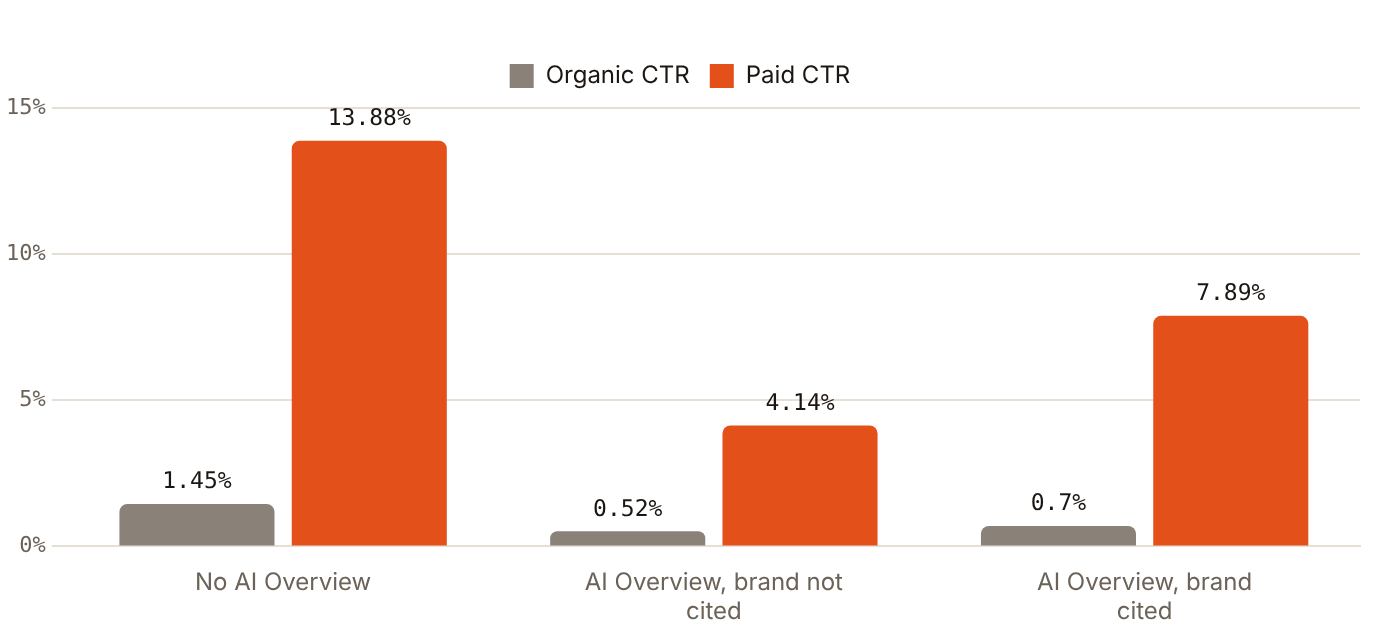
Source: Seer Interactive, AIO Impact on Google CTR: September 2025 Update, 4 Nov 2025
No public data. No AI referral traffic study for the UAE or GCC was found in Similarweb, Ahrefs, Seer, BrightEdge or Pew material. StatCounter and Semrush give UAE shares and visit counts, but not the volume of clicks from AI answers to UAE websites. A future edition should look for a Similarweb country view of chatgpt.com referrals and for UAE panels in click-impact studies.
UTM, call and WhatsApp tracking
A ChatGPT ad has one destination and a "Learn more" call to action in the multi-image beta dated 26 October 2026 (OpenAI). There is no published call extension, click-to-call unit or WhatsApp destination in the OpenAI material read for this book. Every call or WhatsApp lead from a ChatGPT ad therefore starts with a landing-page visit, which means it can be tagged on the page.
ONS's working method for UAE service businesses has four parts. First, every ad carries UTM parameters as set out above (OpenAI Help). Second, the landing page shows a phone number and a WhatsApp button that fire a tracked click event, sent to analytics and, where consent allows, to OpenAI as a standard event through the pixel or Conversions API. Third, the WhatsApp button opens with a prefilled first message that names the source, and the phone line on that page is either a dedicated number or logged by the receptionist with a source field. Fourth, the CRM records the source of each lead from that tag or field, not from memory.
A tracked tap on a WhatsApp button is not a lead. It is an intent to contact. The lead exists only when a message or call is received and logged. That is why platform conversions, analytics events and CRM leads should be expected to differ, and why ONS's first UAE tests showed a large gap between platform-recorded conversions and client-recorded leads when most enquiries came by phone or WhatsApp (see Chapter 11).
No public data. No OpenAI documentation on call tracking, offline conversion import from a CRM, or a WhatsApp destination for ChatGPT ads was found in the notes for this edition. Meta reports that its Business Agent on WhatsApp and Messenger serves more than 1 million businesses weekly, but that is a Meta product, not a ChatGPT Ads measurement route (Nasdaq, Q2 2026). A future edition should check whether OpenAI adds offline or CRM conversion upload, and whether the HubSpot integration returns CRM stages to Ads Manager (PPC Land).
Independent CPM, CPC and CTR figures, by geography
No independent source has published ChatGPT Ads CPM, CPC, CTR or conversion data for the UAE, GCC or MENA; the Similarweb panel covers nine markets, none in the Middle East (PPC Land). Every figure below is from another geography. They are useful for understanding the shape of the market, not for forecasting UAE costs.
Click-through rates
Similarweb and Graphite measured all-time CTR from 30 March to 16 September 2026: US 0.73%, UK 0.74%, Canada 0.75%, Australia 0.67%, New Zealand 0.60%, Brazil 1.91%, Mexico 1.55%, Japan 1.53% and South Korea 1.21%; the Brazil and Mexico figures rest on about one month of data (PPC Land). Similarweb reports worldwide CTR up about 112% between 30 March and 14 September 2026 without stating which weeks are compared, and CTR falls as a conversation goes on, from approximately 0.66% at the first turn to 0.36% to 0.48% at turns 5 to 21; the Graphite sample covered more than 95,000 ads from more than 500 US advertisers, 1 April to 16 August 2026 (PPC Land). Similarweb separately recorded a 0.50% CTR on 17 August 2026, with sponsored placements in 26% of responses to Free and Go users; geography was not stated (PPC Land).
All-time CTR by market, 30 Mar to 16 Sep 2026, Similarweb and Graphite panel; Brazil and Mexico rest on about one month of data, %

Source: PPC Land on Similarweb and Graphite, 4 Oct 2026
Advertiser-reported CTRs sit in the same range. Common Thread Collective reported 0.94% and Floyd Blaikie, a B2B advertiser, 0.7% (North America); these are self-reported single-advertiser anecdotes, not benchmarks (Search Engine Journal). Adthena, via Campaign, found one brand at 0.91% CTR against a 6.4% Google search benchmark in the same sector, and agency executives quoted by MediaPost put CTR at about 0.6% (US) (Trending Topics, Jakob Steinschaden). Microsoft's own first-party data claims Copilot ads have "73% higher click-through rates" than traditional search (global, February to May 2025); this is a vendor claim about a different product.
Cost per thousand impressions
US pilot pricing started at a USD 60 CPM on 9 February 2026, with a launch minimum commitment reported at USD 200,000 (PPC Land, Luis Rijo). By April 2026 Digiday reported CPMs as low as USD 25, Jellyfish averages near USD 45 and an Ad Age report of USD 15, with the minimum spend falling from USD 250,000 to USD 50,000. Note the conflict: PPC Land gives the launch minimum as USD 200,000 and Digiday as USD 250,000. Floyd Blaikie reported a CPM of 64.34 (reported as "$", on CAD 7,000 spend) and Hostinger CPMs above USD 65 (Search Engine Journal). OpenAI told a MENA briefing reported by Al Bayan on 16 September 2026 that average CPM had fallen about 20% and average cost per purchase about 60% over the previous six weeks, globally. For comparison, Perplexity's CPMs "reportedly exceed USD 50", from unnamed sources in 2024 (PPC Land).
Cost per click
OpenAI's help page recommends starting CPC campaigns with a maximum bid of USD 3 to USD 5 per click; this is a starting maximum bid, not an expected CPC. Search Engine Journal had reported the same range from pilot advertisers' screenshots in April 2026, when the pilot was US-only. Advertiser results published by Search Engine Journal on 8 September 2026 show a wider spread: Common Thread Collective USD 4.41 on USD 9,620 spend, Floyd Blaikie 9.29 per click (reported as "$", on CAD 7,000 spend), and Synter USD 9.89 on average from USD 4,428.84 spend. Synter's market split was UK USD 5.10, US USD 10.62, Australia USD 17.59 and New Zealand USD 22.89 (Search Engine Journal). Agency executives quoted by MediaPost put clicks at about USD 7 with no conversions (Trending Topics, Jakob Steinschaden).
Average CPC by market, Synter campaign, USD, reported 8 Sep 2026; single advertiser, not a market average
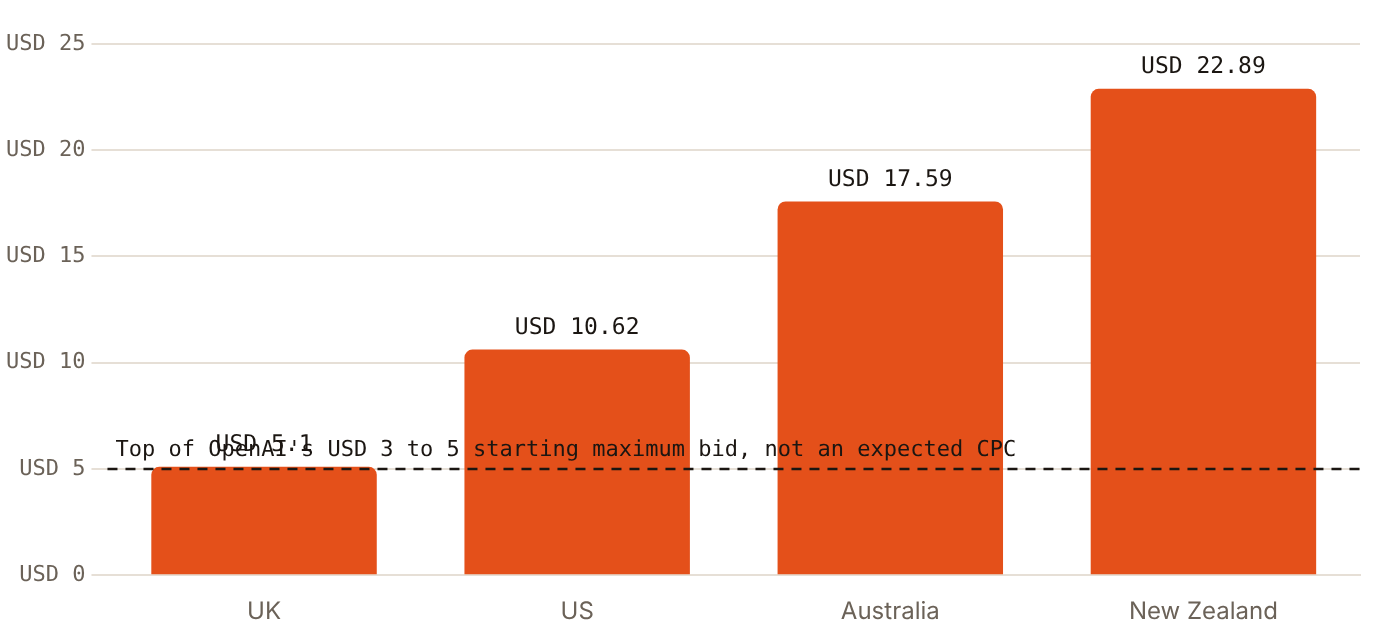
Source: Search Engine Journal, 6 months into ChatGPT ads, 8 Sep 2026
| Metric | Value | Geography and period | Who reported | Source |
|---|---|---|---|---|
| Launch CPM | USD 60 | US, 9 Feb 2026 | PPC Land | PPC Land, Luis Rijo [Industry] |
| CPM range | USD 15 to 45 reported | US, Feb to Apr 2026 | Digiday, Jellyfish, Ad Age | Digiday, Krystal Scanlon [Industry] |
| CPM, B2B advertiser | 64.34 ("$", CAD spend) | North America, to Sep 2026 | Floyd Blaikie via SEJ | Search Engine Journal [Industry] |
| CPM, Hostinger | Above USD 65 | Not stated, to Sep 2026 | SEJ | Search Engine Journal [Industry] |
| CPM change | About 20% lower over six weeks | Global, to Sep 2026 | OpenAI via Al Bayan | Al Bayan [Industry] |
| Starting maximum CPC bid (not an expected CPC) | USD 3 to 5 | Global help guidance | OpenAI | OpenAI Help [Platform] |
| CPC | USD 4.41 | US, to Sep 2026 | Common Thread Collective | Search Engine Journal [Industry] |
| CPC | 9.29 ("$", CAD spend) | North America, to Sep 2026 | Floyd Blaikie | Search Engine Journal [Industry] |
| CPC by market | USD 5.10 to 22.89 | UK, US, AU, NZ, to Sep 2026 | Synter | Search Engine Journal [Industry] |
| CPC | About USD 7 | US, to Aug 2026 | Agency executives via MediaPost | Trending Topics, Jakob Steinschaden [Industry] |
| CTR, all-time | 0.60% to 1.91% | Nine markets, 30 Mar to 16 Sep 2026 (Brazil, Mexico about one month) | Similarweb and Graphite | PPC Land [Industry] |
| CTR | 0.50% | Geography not stated, recorded 17 Aug 2026 | Similarweb | PPC Land [Industry] |
| CTR, single brand vs Google | 0.91% vs 6.4% | US, to Aug 2026 | Adthena via Campaign | Trending Topics, Jakob Steinschaden [Industry] |
| Cost per purchase change | About 60% lower over six weeks | Global, to Sep 2026 | OpenAI via Al Bayan | Al Bayan [Industry] |
| Any of the above | No data | UAE, GCC, MENA | None found | PPC Land |
Delivery and reach context
Three further measures help interpret these costs. The share of ad-eligible users who saw at least one ad in September 2026 ranged from 27.8% in Mexico to 45.7% in the UK, with the US at 43.4% (PPC Land). SE Ranking found that 25.94% of 50,006 US commercial prompts collected on 23 July 2026 returned an ad, and that 14.35% of ad impressions were no closer to the prompt than random (Search Engine Journal). Similarweb's undated 2026 data says about 26% of ChatGPT responses contain an ad, geography not stated, and about a third of ad impressions come in the first response of a session. Combined with the turn-by-turn CTR decline, this suggests that most clicks happen early in a conversation (PPC Land).
Platform-selected performance claims should be read as examples, not benchmarks. OpenAI cites one unnamed ecommerce advertiser with 3x ROAS over 28 days and one technology partner reporting more than 80% of ad-driven ChatGPT traffic from new customers, without geography. Criteo reports, without independent verification, conversion rates for LLM-referred traffic of 1.5x other referral channels (February 2026 sample, 500 US retailers) and close to 2x traditional search in consumer electronics, lifestyle and wellbeing, and home and garden (May 2026) (PPC Land). A sponsored US legal-sector advertorial claimed 12 leads from about USD 2,000 in one month for one client, company-supplied content not reviewed by Adweek; legal services ads are not allowed outside the US, so it does not apply to UAE law firms.
ONS reading US and European ChatGPT costs should not be converted into AED and used as UAE forecasts. The UAE appeared on the self-serve list only in September 2026, the auction is relevance-weighted, and the advertiser pool is different. The useful lessons from the independent figures are directional: CTRs well below Google search, a wide CPC range between markets, CPMs that fell sharply in the first months, and CTR that declines with conversation depth. ONS uses its own early UAE observations (Chapter 11) only as operating evidence for those clients, and sets each new account's targets from its first weeks of data.
Build a metric dictionary
Write down every metric before launch, with its formula and the condition that makes it valid. The dictionary below is the one ONS uses for ChatGPT Ads alongside Google and Meta.
| Metric | Formula or definition | Critical condition | Source |
|---|---|---|---|
| CTR | Clicks / impressions | Same scope and dates; sum clicks and impressions before dividing | ONS method [ONS] |
| CPC | Media spend / clicks | OpenAI Help Settled spend; allow for the 7 to 8 hour spend lag | ONS method [ONS] |
| CPL | Media spend / unique leads | Define and deduplicate leads across form, call and WhatsApp | ONS method [ONS] |
| Qualified CPL | Media spend / qualified leads | One written qualification rule, applied by the client | ONS method [ONS] |
| Close rate | Closed sales / eligible lead cohort | Allow the sales cycle to mature before reporting | ONS method [ONS] |
| Media ROAS | Attributed revenue / media spend | State window, attribution basis and revenue basis | ONS method [ONS] |
| Acquisition contribution | Contribution before marketing minus acquisition costs | Include agency fees, production and other agreed costs | ONS method [ONS] |
| Platform conversions | Events attributed by OpenAI in the chosen window | OpenAI Help May include modelled conversions | OpenAI [Platform] |
Reconcile without forcing agreement
When totals differ, inspect dates, time zones, event definitions, consent conditions, duplicate events, redirects and attribution windows. Do not add platform conversions to CRM leads as though they represent different customers. Do not sum every platform's attributed revenue and call the result total business revenue, because Google, Meta and OpenAI may each claim the same customer under their own windows.
A standard reconciliation sheet has one row per week and four columns of counts: platform clicks, analytics sessions with the paid ChatGPT tag, analytics enquiry events, and CRM leads with the ChatGPT source. The expected pattern is that sessions are below clicks (some clicks never load the page), enquiry events are below sessions, and CRM leads differ from enquiry events in both directions: lower where taps do not become messages, higher where users call without tapping a tracked button. A sudden change in any ratio is the signal to investigate, not the absolute gap.
Ask customers how they heard about the business as a supplementary signal, not a replacement for tracking. Self-reported exposure can be useful, particularly for view-led demand that no click records, but it does not prove a click or isolate the incremental effect of an ad. Keep the original answer, the source classification and a confidence level appropriate to the evidence. Where budgets allow, the geo-experiment partners listed by TechCrunch offer a route to incrementality testing; none has published a UAE case.
Report what management can act on
The monthly report should explain spend, qualified demand, sales progression, revenue or contribution where available, and the next decision. Include unresolved tracking defects and sales follow-up limitations. Use CTR and CPC to diagnose the path from ad to page, but judge commercial performance against agreed business KPIs. Weekly performance emails from Ads Manager are a delivery summary, not a business report (Search Engine Roundtable, Barry Schwartz, 2026).
Category eligibility also shapes what a UAE report can contain. Outside the US, health services are generally prohibited, and the eligibility table marks minimally invasive cosmetic procedures, hospitals and urgent care, and medical testing and diagnosis as "Not allowed" (OpenAI; OpenAI Help Center). Legal services are prohibited outside the US, and alcohol and tobacco ads are disallowed everywhere (OpenAI). A UAE clinic, law firm or alcohol-led venue will therefore have no ChatGPT Ads data to measure; its AI measurement work is organic referrals tagged utm_source=chatgpt.com (OpenAI Help Center).
ONS outlook ONS expects OpenAI's measurement stack to keep moving quickly, given the pace of releases between May and October 2026. Likely next steps, which have not been announced for the UAE, include CRM stage feedback through partners such as HubSpot, more partner integrations, and wider incrementality testing. ONS also expects the gap between platform-attributed conversions and CRM-confirmed leads to remain wide for UAE service businesses that take most enquiries by phone and WhatsApp, until an offline conversion route exists. These are expectations, not platform commitments.
Gaps in the evidence
No public data. UAE, GCC or MENA ChatGPT Ads CPM, CPC, CTR or conversion data from an independent source: none found; the Similarweb panel covers nine markets outside the Middle East (PPC Land). Frequency capping: no OpenAI documentation found. The default ad-personalisation setting for UAE users: not stated in any source read. OpenAI documentation on call tracking, CRM or offline conversion import: not found. Onshore UAE pixel and cookie rules: none, pending PDPL implementing regulations, none issued as of June 2026 and none found by 28 October 2026 (Morgan Lewis). A future edition should request anonymised UAE benchmarks from OpenAI's MENA team, repeat the Similarweb market panel if it adds Gulf markets, and check the OpenAI conversion measurement page for offline import.
Sources for this chapter
- Adweek Wire, ADSQUIRE, "ChatGPT ads just opened the door to law firms", 2026-09-04. https://www.adweek.com/adweek-wire/chatgpt-ads-just-opened-the-door-to-law-firms/
- Adweek, Trishla Ostwal, "OpenAI is piloting brand suitability controls with DoubleVerify and IAS", 2026-10-05. https://www.adweek.com/media/openai-is-piloting-brand-suitability-controls-with-doubleverify-and-ias/
- Ahrefs, "Update: AI Overviews Reduce Clicks by 58%", 4 Feb 2026. https://ahrefs.com/blog/ai-overviews-reduce-clicks-update
- Al Bayan, "OpenAI expands ChatGPT ads to MENA", 2026-09-16. https://www.albayan.ae/economy/1552481
- Baker McKenzie, "DIFC: cookies, online tracking and direct marketing", reviewed 23 Dec 2024. https://resourcehub.bakermckenzie.com/en/resources/global-data-and-cyber-handbook/emea/dubai-international-financial-center/topics/cookies-online-tracking-and-direct-marketing
- BrightEdge via GlobeNewswire, "BrightEdge Data Finds AI Accounts for Less Than 1% Search", 12 Sep 2025. https://www.globenewswire.com/de/news-release/2025/09/12/3149225/0/en/BrightEdge-Data-Finds-AI-Accounts-for-Less-Than-1-Search-Organic-Traffic-Continues-to-Dominate.html
- BrightEdge, "One Year Into Google AI Overviews", 14 May 2025. https://brightedge.com/news/press-releases/one-year-google-ai-overviews-brightedge-data-reveals-google-search-usage
- Clyde & Co, Sep 2023 (older). https://www.clydeco.com/en/insights/2023/09/difc-enacts-landmark-regulation-autonomous-systems
- Common Thread Collective, "ChatGPT Ads August 2026", 2026-08-30. https://commonthreadco.com/blogs/coachs-corner/chatgpt-ads-ocpc-conversion-bidding-product-feeds-ecommerce-2026
- Crypto Briefing via Gizmodo, "OpenAI updates privacy policy for ad personalization", 2026-08-16. https://cryptobriefing.com/openai-privacy-policy-chatgpt-ad-personalization/
- Digiday, "AI platforms are driving more traffic but not enough to offset zero-click search", 10 Jul 2025. https://digiday.com/media/in-graphic-detail-ai-platforms-are-driving-more-traffic-but-not-enough-to-offset-zero-click-search/
- Digiday, Krystal Scanlon, "Everything is coming down: ChatGPT ads are getting cheaper", 2026-04-17. https://digiday.com/marketing/everything-is-coming-down-chatgpt-ads-are-getting-cheaper/
- Google Ads Help, "About ads and AI Overviews", undated, read 28 Oct 2026. https://support.google.com/google-ads/answer/16297775?hl=en
- Google Search Central, "AI features and your website", last updated 10 Dec 2025. https://developers.google.com/search/docs/appearance/ai-features
- Microsoft Advertising, "73% higher CTRs: why advertisers need to pay attention to conversational AI", 6 Aug 2025. https://preview-about.ads.microsoft.com/en/blog/post/august-2025/73-higher-ctrs-why-advertisers-need-to-pay-attention-to-conversational-ai
- Morgan Lewis, "UAE establishes Federal Authority for AI and Data", 15 Jun 2026. https://www.morganlewis.com/pubs/2026/06/uae-establishes-federal-authority-for-artificial-intelligence-and-data
- Nasdaq, "Meta Platforms Q2 earnings call highlights", 29 Jul 2026. https://www.nasdaq.com/articles/meta-platforms-q2-earnings-call-highlights
- OpenAI Help Center, "Publishers and developers FAQ", undated, read 28 Oct 2026. https://help-lb.openai.com/en/articles/12627856-publishers-and-developers-faq
- OpenAI Help Center, "Troubleshooting Common Onboarding and Policy Issues, Ads Policy Eligibility Table", Updated about 26 Oct 2026 ("2 days ago" when read 28 Oct 2026). https://help.openai.com/en/articles/20001534-troubleshooting-common-onboarding-and-policy-issues
- OpenAI Help, "Create campaigns for ChatGPT Ads", undated, read 28 Oct 2026. https://help.openai.com/fr-fr/articles/20001210-create-campaigns-for-chatgpt-ads
- OpenAI, "Ad policies", 10 Sep 2026; read 28 Oct 2026. https://openai.com/policies/ad-policies/
- OpenAI, "Creating campaigns for ChatGPT Ads", checked 2026-10-28. https://help.openai.com/en/articles/20001210-creating-campaigns-for-chatgpt-ads
- Origami, "ChatGPT Ads now open to Saudi businesses", 2026-10-25. https://origami.sa/en/blog/chatgpt-ads-saudi-arabia-open/
- Pew Research Center, "Google users are less likely to click on links when an AI summary appears in the results", 22 Jul 2025. https://www.pewresearch.org/short-reads/2025/07/22/google-users-are-less-likely-to-click-on-links-when-an-ai-summary-appears-in-the-results/markdown
- PPC Land, "OpenAI's ChatGPT ads are getting conversion optimization", 2026-05-30. https://ppc.land/openais-chatgpt-ads-are-getting-conversion-optimization-heres-what-changes/
- PPC Land, "Perplexity advertising head departs nine months after appointment", Aug/Sep 2025. https://ppc.land/perplexity-advertising-head-departs-nine-months-after-appointment/
- Primerus / Reina Consulting, "UAE Data Privacy Law", Mar 2026 (from URL). https://www.primerus.com/sites/default/files/2026-03/UAE%20Data%20Privacy%20Law.pdf
- Search Engine Journal, "6 months into ChatGPT ads", 2026-09-08. https://www.searchenginejournal.com/6-months-into-chatgpt-ads-advertisers-still-dont-know-what-good-looks-like/587583/
- Search Engine Roundtable, Barry Schwartz, "OpenAI ChatGPT ads updates", 2026-10-19. https://seroundtable.com/openai-chatgpt-ads-updates-42321.html
- Seer Interactive, "AIO Impact on Google CTR: September 2025 Update", 4 Nov 2025. https://www.seerinteractive.com/blog/aio-impact-on-google-ctr-september-2025-update
- Semrush, "Top websites UAE", Sep 2026 data. https://www.semrush.com/trending-websites/ae/all
- Similarweb, "AI Search Stats 2026: Market Share, Referral, and Citation Data", 2026 (undated; data to May 2026). https://aisearch.similarweb.com/blog/gen-ai-stats/
- StatCounter, "Search engine market share UAE", Sep 2026 data. https://gs.statcounter.com/search-engine-market-share/all/united-arab-emirates
- TechCrunch, Sarah Perez, "OpenAI launches visual ads that appear alongside image generation results", 2026-10-05. https://techcrunch.com/2026/10/05/openai-launches-visual-ads-that-appear-alongside-image-generation-results/
- TechWyse, "ChatGPT Ads go global with new ad stack features", 2026-09-07. https://www.techwyse.com/news/platform-updates/chatgpt-ads-global-expansion-audience-measurement-tools-2026
- Trending Topics, Jakob Steinschaden, "ChatGPT ads hits $1 billion run rate but advertisers are not sold", 2026-08-31. https://www.trendingtopics.eu/chatgpt-ads-hits-1-billion-run-rate-but-advertisers-are-not-sold/
PUT THE INSIGHT TO WORK
Your market.
Your next move.
Explore how ONS approaches ChatGPT Ads, campaign readiness and measurement for UAE businesses.
Explore our expertise ↗