
In this chapter
This chapter sets out how a ChatGPT Ads account is built, what each level controls, and what context hints can and cannot do, using the settings OpenAI publishes in its help centre as read on 28 October 2026. The headline finding is that ChatGPT Ads has no keyword targeting: advertisers describe relevance through context hints, which OpenAI says are relevance signals and not delivery controls, while budgets, geography, platforms and bids sit at campaign and ad-group level. Examples here are limited to sectors that can run in the UAE under the policy described in Chapter 06.
In brief
- Campaign objectives are Views (CPM), Clicks (CPC) and Conversions, billed as oCPC or oCPM; "you don't pay per conversion" (OpenAI Help; OpenAI).
- The minimum daily budget for an AED-billed account is AED 65 (OpenAI; OpenAI Help, 2026). The daily budget is a 7-day average target: daily spend can reach 2x and weekly spend 7x the daily budget (OpenAI Help).
- Bids are set at ad-group level, and eligible ads are chosen through a relevance-weighted, second-price auction (OpenAI Help). OpenAI recommends a starting maximum CPC bid of USD 3 to 5; this is a starting bid, not an expected CPC.
- Context hints describe relevance; they "cannot enforce geography or exclusions" and are not exact-match keywords (OpenAI).
- Geography: campaigns can target regions, cities, markets and postcodes where available; new product-feed campaigns are country-level only (OpenAI Help). The draft edition rated sub-national targeting qualified, varying by country and account (OpenAI).
- Custom audiences need at least 25,000 matched users for inclusion; exclusions can be smaller (OpenAI Help).
- No frequency cap is documented (OpenAI Help). Exclusion targeting and brand suitability controls are in tests or pilots (eMarketer; Adweek, Trishla Ostwal, 2026).
- Default bid strategy for eligible new ad groups has been "Maximize results" since August 2026; a hard ceiling needs manual bidding (Search Engine Journal, Brooke Osmundson).
- Currency and time zone cannot be changed after account creation (OpenAI Help).
The account sets limits you cannot change later
The account is the level above campaigns, and three of its settings shape every UAE campaign. The Account Legal Name must be the registered business name and is used for billing and business verification; self-service billing is by credit card; and the currency and time zone "cannot be changed after account creation" (OpenAI Help). Business verification "may take up to 7 Business days" (OpenAI Help Center). The legal entity must be in a listed country to use self-service Ads Manager, and the UAE is listed as "Available" (OpenAI Help Center).
Currency choice matters for GCC advertisers. OpenAI's minimum daily budget table has rows for AED 65, SAR 50 and QAR 60, but no KWD, BHD, OMR or EGP row. The table covers 30 currencies in total, including USD 25 (OpenAI Help). A UAE business planning to advertise in Kuwait, Bahrain or Oman later should decide at account creation which currency it will bill in, because the decision is permanent (OpenAI Help).
Some new self-service accounts can serve only in their home country until identity verification is approved and a required home-country spend is reached (OpenAI Help). OpenAI does not publish that spend threshold. A Dubai company targeting Saudi Arabia from day one may therefore find its first campaigns restricted to the UAE.
What it means for UAE marketersOpen the account in the legal entity's name, choose AED and the Gulf time zone deliberately, and allow up to 7 business days for verification before the planned launch (OpenAI Help; OpenAI Help Center).
What each level controls
OpenAI's help articles describe a three-level structure under the account: campaign, ad group and ad. The table brings together the settings each level holds, as published.
| Level | Setting | Published detail | Source |
|---|---|---|---|
| Account | Legal name, billing, currency, time zone | Registered business name; credit card billing; currency and time zone fixed after creation | OpenAI Help [Platform] |
| Campaign | Objective | Views (CPM), Clicks (CPC), Conversions (oCPC or oCPM) | OpenAI Help [Platform] |
| Campaign | Daily budget | AED 65 minimum; 7-day average target; up to 2x daily, 7x weekly; budget week Sunday to Saturday in account time zone | OpenAI; OpenAI Help [Platform] |
| Campaign | Geography | Regions, cities, markets, postcodes where available; product-feed campaigns country-level only | OpenAI Help; OpenAI [Platform] |
| Campaign | Platforms | Android app, web on Android, desktop web, iOS app, web on iOS | OpenAI Help [Platform] |
| Campaign | Custom audiences | Inclusion needs at least 25,000 matched users; exclusions can be smaller | OpenAI Help [Platform] |
| Ad group | Bid and bid strategy | Bids set at ad-group level; default "Maximize results" for eligible new ad groups from August 2026; manual bidding for a hard ceiling | OpenAI Help; Search Engine Journal, Brooke Osmundson [Platform] [Industry] |
| Ad group | Context hints | Relevance signals, not delivery controls; not exact-match keywords; cannot enforce geography or exclusions | OpenAI [Platform] |
| Ad | Card content | Advertiser name, favicon, title, description, landing page and image, shown below responses | OpenAI Help [Platform] |
| Ad | Multi-image | Open beta dated 26 Oct 2026; four to six square images, one destination, Learn more CTA | OpenAI [Platform] |
| Ad | Landing page | Must be reachable; must not block OAI-AdsBot or OAI-SearchBot; own UTM parameters allowed; link to the most relevant page | OpenAI Help [Platform] |
Campaigns: objective, budget and pacing
A campaign holds one objective. OpenAI's campaign article lists three: Views, billed per thousand impressions; Clicks, billed per click; and Conversions, billed as optimised CPC or optimised CPM (OpenAI Help). OpenAI states plainly that with the Conversions objective "you don't pay per conversion", and the draft edition verified the same point.
| Objective | Billing | Requirement | Date | Source |
|---|---|---|---|---|
| Views | CPM | None stated | Supported since launch; read 28 Oct 2026 | OpenAI Help; OpenAI [Platform] |
| Clicks | CPC | None stated | CPC added 5 May 2026 | OpenAI Help; OpenAI [Platform] |
| Conversions | oCPC or oCPM; not per conversion | A supported standard event, with pixel and Conversions API deduplicated | Rolled out from 5 Jun 2026 for accounts with conversions configured by 1 Jun | OpenAI Help; OpenAI; PPC Land [Platform] [Industry] |
| Product feed (Conversions) | oCPC | Feed in Ads Manager, up to 1 million SKUs; country-level targeting | oCPC for feeds announced 24 Aug 2026 | Common Thread Collective; PPC Land; OpenAI Help [Estimate] [Industry] |
OpenAI says CPC and outcome-optimised bidding now account for most campaigns, without giving a percentage. For a UAE business with a working enquiry form, the choice is usually between Clicks, which is simple to read, and Conversions, which needs a standard event that fires reliably. Chapter 10 covers conversion setup.
The daily budget is not a daily cap. OpenAI treats it as a 7-day average target: spend on a single day can reach 2x the daily budget, and spend over the week can reach 7x, with the budget week running Sunday to Saturday in the account time zone. At the AED 65 minimum, that gives the following ONS calculation: maximum single-day spend AED 65 × 2 = AED 130, and maximum weekly spend AED 65 × 7 = AED 455 (OpenAI).
ONS calculation from OpenAI pacing rules: daily budget, 2x daily ceiling, 7x weekly ceiling, AED, UAE AED-billed account, read 28 Oct 2026
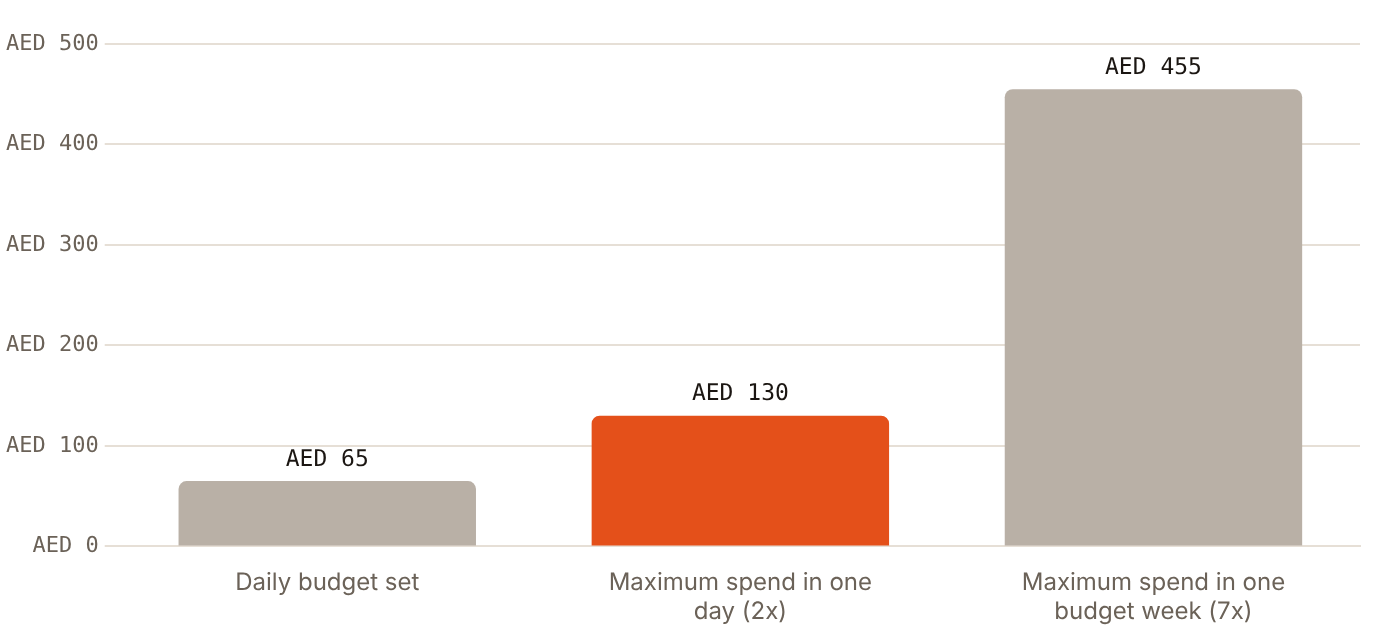
Source: OpenAI Help, Create campaigns for ChatGPT Ads, read 28 Oct 2026; ONS calculation
Two further timing effects affect budget control. Origami, a Saudi agency reading OpenAI's help pages, reports that ads may run for up to 24 hours after a pause and are billed. OpenAI's own beta overview says impressions, clicks and CTR refresh about every 15 minutes, but spend may lag 7 to 8 hours. A UAE advertiser ending a promotion at midnight should pause well before then and should not judge the day's spend from the dashboard until the next morning.
Campaigns: geography, platforms and audiences
Standard campaigns can target regions, cities, markets and postcodes where available; new product-feed campaigns support country-level targeting only (OpenAI Help). The draft edition graded sub-national targeting as qualified, because availability varies by country and account (OpenAI). OpenAI does not publish which UAE regions or emirates are selectable, so a Dubai-only or Abu Dhabi-only plan should be checked in the account before it is promised to a client.
Platform targeting splits five surfaces: Android app, web on Android, desktop web, iOS app and web on iOS (OpenAI Help). Splitting desktop from mobile in separate campaigns gives cleaner reporting for B2B offers, where desktop sessions may convert differently, but it also halves the budget per campaign.
Custom audiences need at least 25,000 matched users for inclusion, while exclusion lists can be smaller (OpenAI Help). TechWyse reported in September 2026 that custom audiences can exceed 5 million members and accept the Google Advertising ID, and that members can be added or removed without rebuilding. For most UAE small and medium businesses, the 25,000 inclusion threshold rules out customer-list targeting, but a smaller list of existing customers can still be used to exclude them from acquisition campaigns (OpenAI Help).
| Control | Status | Read or published | Source |
|---|---|---|---|
| Keyword targeting | Not available; advertisers get broad topic tags (April 2026) | 16 Apr 2026 | The Decoder [Industry] |
| Context hints | Available; relevance only | Read 28 Oct 2026 | OpenAI [Platform] |
| Geographic targeting | Country; sub-national where available | Read 28 Oct 2026 | OpenAI Help; OpenAI [Platform] |
| Platform targeting | Five surfaces | Read 28 Oct 2026 | OpenAI Help [Platform] |
| Custom audiences | 25,000 matched users minimum for inclusion | Read 28 Oct 2026 | OpenAI Help [Platform] |
| Exclusion targeting (contexts to avoid) | Test with a small group of advertisers | Undated, read 28 Oct 2026 | eMarketer [Industry] |
| Brand suitability | Pilots with DoubleVerify and IAS | Announced 5 Oct 2026 | Adweek, Trishla Ostwal [Industry] |
| Frequency cap | None documented | Read 28 Oct 2026 | OpenAI Help [Platform] |
| Age | No ads to users who say, or are predicted to be, under 18 | 16 Jan 2026 | OpenAI [Platform] |
| Day-parting or scheduling | Context hints cannot enforce it; no scheduling control found in notes | Read 28 Oct 2026 | OpenAI [Platform] |
Ad groups: bids and bid strategy
Eligible ads are chosen through a relevance-weighted, second-price auction, and bids are set at ad-group level (OpenAI Help). Relevance-weighted means a higher bid does not guarantee delivery if the ad is a poor match for the conversation; second-price means the winner pays a price set by the next competitor rather than its full bid. OpenAI's statement that its "ads system controls all delivery decisions" applies to partners and self-service buyers alike.
Search Engine Journal reported in September 2026 that the default bid strategy for eligible new ad groups has been "Maximize results" since August 2026, and that a hard cost ceiling requires manual bidding. A UAE advertiser with a fixed acceptable cost per click should switch to manual bidding at setup rather than rely on the default.
For CPC campaigns, OpenAI recommends starting with a maximum bid of USD 3 to 5 per click; it is a starting maximum bid, not an expected CPC, and not a UAE benchmark. The same range was reported for pilot advertisers (US-only pilot at the time) in April 2026 (Search Engine Journal, Matt G. Southern). Reported actual CPCs vary widely by market. Synter reported an average of USD 9.89 across USD 4,428.84 of spend, with UK USD 5.10, US USD 10.62, Australia USD 17.59 and New Zealand USD 22.89 (Search Engine Journal); Common Thread Collective reported USD 4.41 on USD 9,620 of spend (both reported 8 Sep 2026) (Search Engine Journal). All of these are self-reported results from single advertisers outside the UAE: anecdotes, not benchmarks.
Average cost per click, USD, self-reported by single advertisers (anecdotes, not benchmarks), US, UK, Australia and New Zealand, reported 8 Sep 2026; no UAE or GCC data published
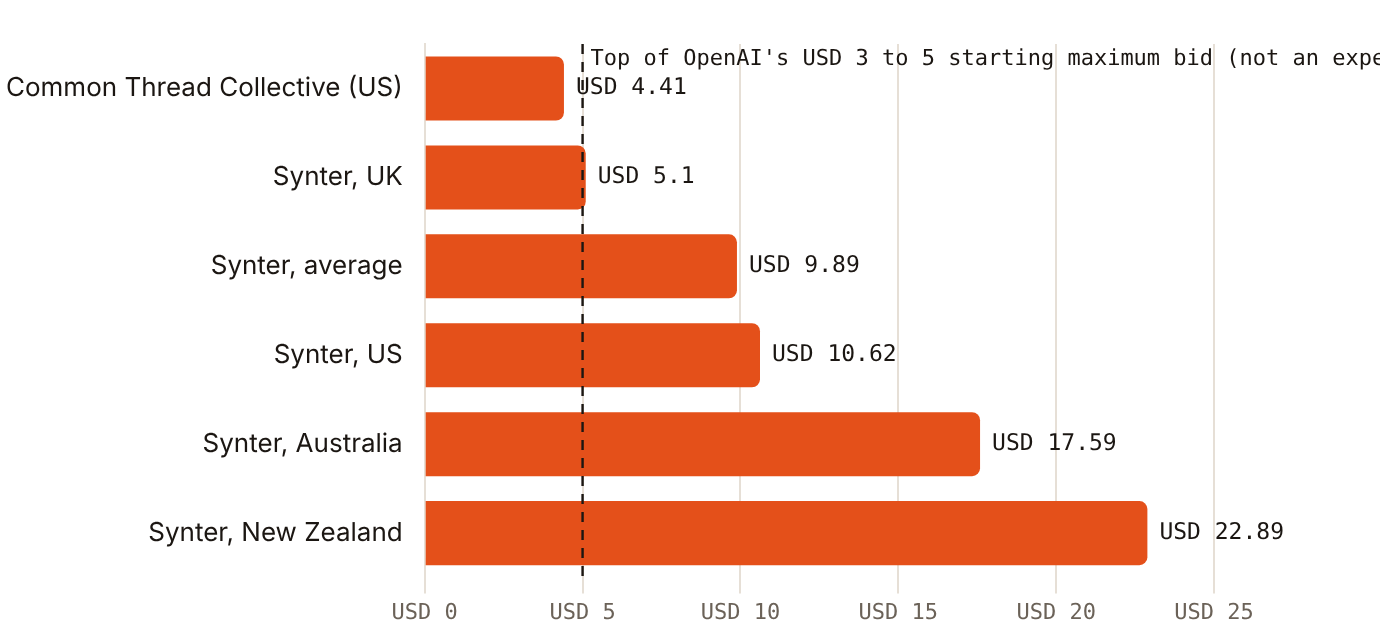
Source: Search Engine Journal, 6 months into ChatGPT ads, 8 Sep 2026; OpenAI Help, Ads in ChatGPT: the basics, read 28 Oct 2026
ONS's two anonymised UAE client tests published CPCs of AED 1.97 and AED 3.19. The tests have no published dates, spend or revenue, and the sample is two accounts. They are not a UAE benchmark, and they cannot be compared with the USD figures above without an exchange rate, which this edition's notes do not hold. Chapter 11 discusses them.
ONS reading Because bids sit at ad-group level, the ad group is where a UAE advertiser expresses what an enquiry is worth. Two offers with different values, for example a short course and a full diploma, belong in separate ad groups so that each can carry its own bid. ONS sets a manual ceiling for new accounts until conversion data exists, and treats OpenAI's USD 3 to 5 starting maximum bid as a starting point for the auction, not as a forecast of UAE costs.
Context hints: what they are and what they are not
ChatGPT Ads has no keyword targeting. The Decoder, citing The Information, reported in April 2026 that advertisers receive broad topic tags instead. Ads are matched to the current conversation and, depending on country and user settings, broader ChatGPT context (OpenAI). At the US test launch in February 2026, TechCrunch reported matching on conversation topic, past chats and previous ad interactions.
Context hints are the advertiser's input into that matching. OpenAI's ad-group article says to organise ad groups by shared need or offer and that hints are not exact-match keywords. Its context-hints article says hints describe relevance and "cannot enforce geography or exclusions" (OpenAI). The draft edition verified the summary: context hints are relevance signals, not delivery controls (OpenAI).
That distinction changes how hints should be written. A Google Ads keyword list is a set of triggers; a context hint is closer to a short brief that tells the system which conversations the offer helps with. Three consequences follow for UAE campaigns.
- Location belongs in campaign settings, not in hints. Writing "Dubai" or "Abu Dhabi" in a hint does not restrict delivery to those cities (OpenAI). Geography is set in the campaign (OpenAI Help).
- Exclusions cannot be written as hints. A hint saying "not for students" does not stop delivery to students (OpenAI). Exclusion targeting is only in a small test (eMarketer).
- Hints do not change eligibility. A hint cannot make a disallowed category eligible, and OpenAI does not place ads on excluded conversations such as personal health conversations whatever the hint says.
The draft edition advised describing the customer's situation and need rather than listing product terms. A useful hint states who the offer helps, the problem they are trying to solve, and the choice they are comparing. OpenAI does not publish a character limit, a recommended number of hints per ad group, or data on how much hints change delivery; this is recorded as a gap below.
How matching plays out in a conversation
The ad unit appears below a response, with the advertiser's name, favicon, title, description, landing page and image (OpenAI Help). Users see ads only on eligible plans; the draft edition verified that not all ChatGPT users are in the ad-supported audience (OpenAI). Logged-out users see ads "designed to be suitable for all ages", and there are no ads in Temporary Chats (OpenAI Help). Advertisers never receive chats, chat history, memories, name, email, precise location or IP address, and when personalisation is off, matching uses the current thread only (OpenAI Help).
Personalisation consent differs by market. In the US, ad personalisation is on by default with an opt-out; the EU and UK require opt-in consent (Crypto Briefing via Gizmodo). The notes contain no statement of the UAE default.
Third-party data suggests the first turns of a conversation matter most. Similarweb's worldwide data (30 March to 30 August 2026, read from a chart) shows CTR falling from approximately 0.66% at turn 1 to between about 0.36% and 0.48% at turns 5 to 21 (PPC Land). Similarweb also reported that about a third of ad impressions fall in the first response of a session, without stating the geography.
Click-through rate by conversation turn, %, worldwide, 30 Mar to 30 Aug 2026, approximate values read from a Similarweb chart; no UAE data
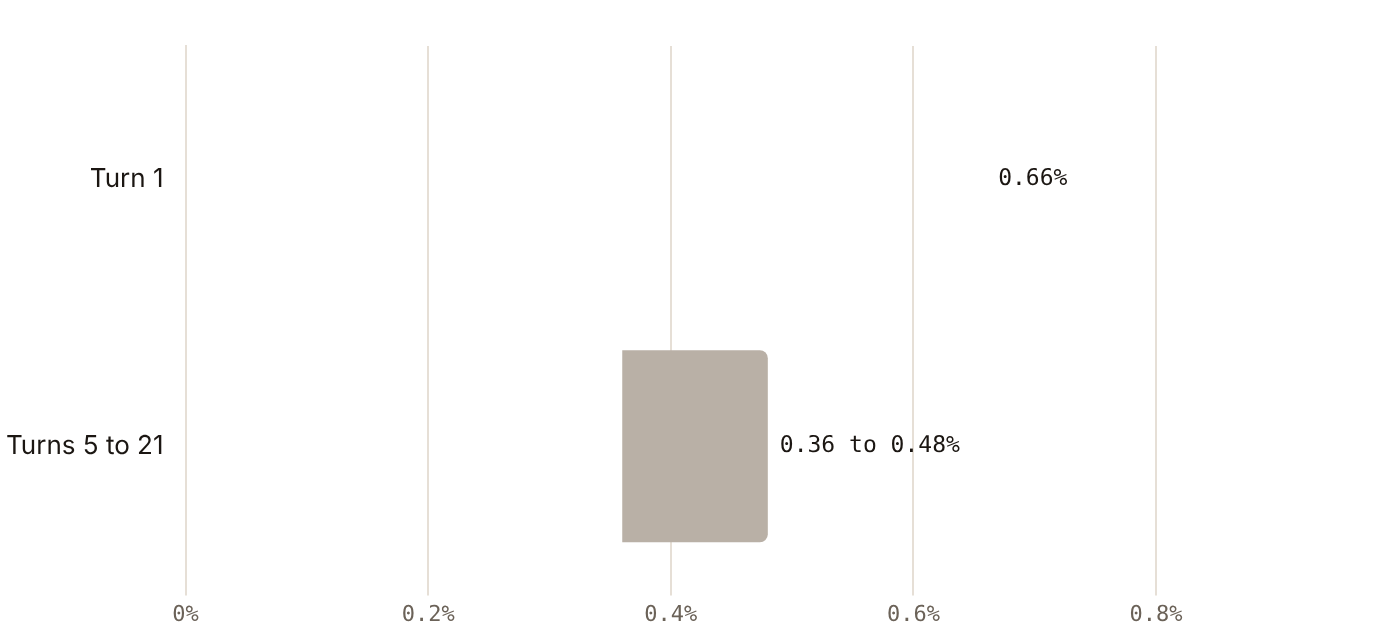
Source: PPC Land on Similarweb and Graphite, ChatGPT ad click rate gains 112% worldwide, 4 Oct 2026
ONS reading If most value sits in the opening turns, context hints should describe the question a customer asks first, not the detail they reach later. A UAE hotel hint about "families planning a winter break with young children" matches an opening question; a hint about a specific room configuration matches a later turn that fewer ads reach. This is an inference from approximate worldwide data with no UAE breakdown, and ONS will test it in UAE accounts rather than assume it.
OpenAI is also testing placements that change the structure of the auction. MarTech reported a test of multiple advertisers within one sponsored placement, for a small subset of users, in June 2026. Sponsored agents, which let a user open a labelled conversation with a business-sponsored agent after clicking an ad, were in test with select US advertisers from 16 September 2026 (Reuters via Zawya, Anzar Mehraj). Visual ads beside generated images were due later in October 2026, US only (TechCrunch). None of these is confirmed for the UAE.
Ads inside the ad group
Creative is covered in Chapter 08, but three structural points belong here. First, there are two sets of character figures, and they do not conflict: per Adobe Advertising's ChatGPT ad settings, the hard limits are a 50-character title and 100-character description, with square JPG or PNG images up to 20 MB, while PPC Land describes what typically displays: about 16 characters for the headline and about 32 for the description. Second, the multi-image format in open beta from 26 October 2026 takes four to six square images, one destination and a Learn more CTA (OpenAI). Third, OpenAI's tools can suggest copy and images from the landing page and offer opt-in headline adaptation and translation into the user's language (Reuters via Zawya).
Translation interacts with UAE law. A law firm's reading of the UAE consumer protection regime says advertising and website information must be in Arabic as a minimum (Pinsent Masons). OpenAI publishes Arabic-language pages, but the notes do not state whether an Arabic ad card can be submitted directly or only produced by translation.
ONS reading ONS plans separate Arabic and English ad groups for UAE consumer offers, each with its own landing page, rather than relying on automatic translation. That keeps review of Arabic copy in human hands, makes reporting by language possible, and meets the Arabic-minimum reading of consumer protection law with a page that is actually in Arabic. Whether OpenAI treats language as a delivery signal is not published.
Organise around a business decision
Use campaigns for distinct goals and ad groups for genuinely different offers or customer needs, in line with OpenAI's advice to organise ad groups by shared need or offer. The first planning task is to choose an offer the business can deliver now. Write down who it helps, what it includes, what it costs or how a quote is formed, and what the customer should do next. A campaign that covers every service at once makes both creative and lead qualification less informative.
The practical hierarchy ONS uses for UAE accounts is:
- Campaign = one objective, one market, one budget. Separate the UAE from other GCC markets, because currency is fixed per account and budgets and pacing run per campaign (OpenAI Help).
- Ad group = one offer and one customer need, with its own bid and its own context hints (OpenAI Help; OpenAI). Split by language where the landing page differs.
- Ad = two or three variants that differ in the reason to choose, all pointing to the page that answers the promise (OpenAI Help).
Illustrative structures for eligible UAE offers
The table shows structures for sectors that fall within OpenAI's named verticals. Dental, cosmetic, hospital, legal, most finance and alcohol- or shisha-led offers are excluded because they cannot run in the UAE (see Chapter 06) (OpenAI; OpenAI Help Center). These examples must be rewritten from the client's real offer. They do not establish eligibility and do not guarantee that an ad will appear in the described conversation.
| Business | Campaign | Ad-group theme | Example context information | Destination | UAE condition |
|---|---|---|---|---|---|
| Hotel, Dubai | Clicks, UAE | Family stay | Families comparing connecting rooms and child facilities for a city break | Accurate room and facilities page | OpenAI Landing path must not introduce disallowed content |
| Hotel, Dubai | Clicks, UAE | Business stay | Travellers comparing hotels near an exhibition venue with meeting space | Meetings page with availability | OpenAI As above |
| Professional training | Conversions, UAE | Evening study | Working adults comparing evening and weekend study options | Exact course page | UAE Legislation portal; OpenAI Educational services ads need authority approval; adult audience |
| Online retailer | Product feed, UAE | Home goods | Feed-driven; country-level targeting | Product pages from feed | OpenAI Help Feed items lapse after two weeks; country-level only |
| Business software | Clicks, UAE desktop | Retail operations | Retailers needing to reconcile online and physical-store activity | Relevant product use case | OpenAI Help Center Financial software and health software are separate allowed rows |
| Home services | Conversions, UAE | Planned maintenance | Households comparing scheduled maintenance coverage | Coverage and quotation page | OpenAI Local services are a named vertical |
| Tours and experiences | Clicks, UAE | Desert and city tours | Visitors planning a first trip and comparing half-day options | Bookable tour page | OpenAI Travel and experiences a named vertical |
For a hotel, do not advertise a room arrangement unless it can be reserved or is clearly marked as subject to availability. For the online retailer, food items in a feed bring the food-advertising approval requirement into scope, and regulated goods such as supplements are not allowed outside the US (UAE Legislation portal; OpenAI Help Center).
Write useful differences between variants
Create variants around different reasons to choose the offer: timetable, product compatibility, service coverage, included support or a substantiated qualification. Changing only an adjective produces little business learning. Each variant should have a recorded hypothesis and a destination that answers the promise made. OpenAI asks advertisers to link to the most relevant page rather than a generic homepage, which supports one destination per promise.
ONS recommends starting with a set the budget and sales team can support. There is no universal ideal number. Too many variants with little delivery make it hard to tell a weak message from an untested one, and at the AED 65 minimum a campaign has limited impressions to share (OpenAI). Consolidate where the same customer need and page apply; separate when the offer or qualification process changes.
Keep a change log
Record the date and reason for every edit to objectives, budgets, copy, images, destinations, context hints and sales qualification. If several variables change together, describe the result as a combined change, not a controlled test of one factor. ONS's own early comparison changed the objective, message and destination together, and the draft edition graded it qualified for that reason. Recent conversion figures can also change for 24 to 48 hours after the event, so a change log should note when a figure was read (OpenAI).
| Field | Why it matters | Source |
|---|---|---|
| Date and time (account time zone) | Budget week and pacing run in account time zone | OpenAI Help [Platform] |
| Level changed (campaign, ad group, ad) | Bids sit at ad group; objective and budget at campaign | OpenAI Help [Platform] |
| Old and new value | Separates one change from several | ONS Digital [ONS] |
| Reason and hypothesis | Turns an edit into a test | ONS practice |
| Stable campaign and ad IDs | Names can be edited; IDs persist in measurement | ONS practice |
| Date figures were read | Spend lags 7 to 8 hours; recent conversions can shift for 24 to 48 hours | OpenAI Help; OpenAI [Platform] |
Use clear names that identify the offer, market and language without personal data. Record a stable campaign or ad identifier in the measurement system; a readable name helps the team but does not replace a stable ID when names change. Landing-page URLs can carry the advertiser's own UTM parameters, which makes the campaign and ad-group structure visible in analytics (OpenAI Help).
Bulk tools and integrations
CSV bulk upload is available but does not support product-feed campaigns (OpenAI Help). HubSpot and Shopify are integration partners; the Shopify app has been international since 23 September 2026 in ChatGPT Ads markets (PPC Land). An Ads Manager plugin offers natural-language campaign management (Reuters via Zawya). For UAE agencies running many small accounts, these tools reduce setup time, but each still writes into the same campaign, ad-group and ad structure described above.
ONS outlook The controls missing today, keyword-style exclusions, frequency caps and brand suitability settings, are the ones OpenAI is testing or piloting. ONS expects some of them to reach self-service accounts, but OpenAI has published no dates and no UAE timing. Structures built now around clean offers, separate ad groups by need and language, and a change log will adapt to new controls without a rebuild.
Gaps in the evidence
No public data. OpenAI does not publish a character limit for context hints, a recommended number of hints per ad group, or any measure of how much hints change delivery. A future edition should test hint variations in UAE accounts and report the method.
No public data. Which UAE sub-national locations (emirates, cities, postcodes) are selectable is not published (OpenAI; OpenAI Help). The home-country spend threshold for cross-border serving is not published (OpenAI Help). The UAE default for ad personalisation consent is not stated in the notes.
No public data. No frequency cap is documented; the categories in the exclusion-targeting test are not published (OpenAI Help; eMarketer). No UAE or GCC CPC, CPM or CTR benchmark exists from any independent source; US and other-market figures should not be used as UAE forecasts.
No public data. Ad-card text figures come from third parties only: 50 and 100 characters are hard maxima in Adobe Advertising's integration spec, and about 16 and 32 characters are what typically displays (PPC Land). OpenAI's own help copy fetched for this edition did not state numbers.
Sources for this chapter
- Adobe Experience League, "ChatGPT Ads chat card ad settings", 2026-10-06. https://experienceleague.adobe.com/en/docs/advertising/search-social-commerce/new-ui/manage/ads/ad-settings-by-network/ad-settings-chatgpt
- Adweek, Trishla Ostwal, "OpenAI is piloting brand suitability controls with DoubleVerify and IAS", 2026-10-05. https://www.adweek.com/media/openai-is-piloting-brand-suitability-controls-with-doubleverify-and-ias/
- Common Thread Collective, "ChatGPT Ads August 2026", 2026-08-30. https://commonthreadco.com/blogs/coachs-corner/chatgpt-ads-ocpc-conversion-bidding-product-feeds-ecommerce-2026
- Crypto Briefing via Gizmodo, "OpenAI updates privacy policy for ad personalization", 2026-08-16. https://cryptobriefing.com/openai-privacy-policy-chatgpt-ad-personalization/
- eMarketer, "ChatGPT ad exclusions give brands safeguards as targeting gaps persist", undated, read 28 Oct 2026. https://www.emarketer.com/content/chatgpt-ad-exclusions-give-brands-safeguards-targeting-gaps-persist
- MarTech, Constantine von Hoffman, "OpenAI tests multi-advertiser ad placements in ChatGPT", 2026-06-09. https://martech.org/openai-tests-multi-advertiser-ad-placements-in-chatgpt/
- OpenAI Help Center, "Ads Manager Availability", Updated 27 to 28 Oct 2026 ("14 hours ago" when read 28 Oct 2026). https://help.openai.com/en/articles/20001245-ads-manager-availability
- OpenAI Help Center, "Troubleshooting Common Onboarding and Policy Issues, Ads Policy Eligibility Table", Updated about 26 Oct 2026 ("2 days ago" when read 28 Oct 2026). https://help.openai.com/en/articles/20001534-troubleshooting-common-onboarding-and-policy-issues
- OpenAI Help, "Create campaigns from product feeds", undated, read 28 Oct 2026. https://help.openai.com/en/articles/20001268-create-campaigns-from-product-feeds
- OpenAI, "Ad policies", 10 Sep 2026; read 28 Oct 2026. https://openai.com/policies/ad-policies/
- OpenAI, "Introducing ChatGPT Go, Arabic page", 16 Jan 2026. https://openai.com/ar/index/introducing-chatgpt-go/
- OpenAI, "Writing context hints for ChatGPT Ads", checked 2026-10-28. https://help.openai.com/en/articles/20001521-writing-context-hints-for-chatgpt-ads
- Origami, "ChatGPT Ads now open to Saudi businesses", 2026-10-25. https://origami.sa/en/blog/chatgpt-ads-saudi-arabia-open/
- Pinsent Masons, 6 Oct 2023. https://www.pinsentmasons.com/out-law/analysis/uae-consumer-protection-regime-revamped
- PPC Land, "OpenAI's ChatGPT ads are getting conversion optimization", 2026-05-30. https://ppc.land/openais-chatgpt-ads-are-getting-conversion-optimization-heres-what-changes/
- Reuters via Zawya, Anzar Mehraj, "OpenAI tests advertiser-sponsored agents", 2026-09-16. https://www.zawya.com/en/business/ai-shaping-digital-future/openai-tests-advertiser-sponsored-agents-expands-ai-tools-for-chatgpt-ads-806532
- Search Engine Journal, Brooke Osmundson, "6 months into ChatGPT ads", 2026-09-08. https://www.searchenginejournal.com/6-months-into-chatgpt-ads-advertisers-still-dont-know-what-good-looks-like/587583/
- Similarweb, "AI Search Stats 2026", 2026 (undated). https://aisearch.similarweb.com/blog/gen-ai-stats/
- TechCrunch, "OpenAI launches visual ads that appear alongside image generation results", 2026-10-05. https://techcrunch.com/2026/10/05/openai-launches-visual-ads-that-appear-alongside-image-generation-results/
- TechWyse, "ChatGPT Ads go global with new ad stack features", 2026-09-07. https://www.techwyse.com/news/platform-updates/chatgpt-ads-global-expansion-audience-measurement-tools-2026
- The Decoder, "OpenAI wants to sell more ads in ChatGPT", 2026-04-16. https://the-decoder.com/openai-wants-to-sell-more-ads-in-chatgpt-but-advertisers-are-struggling-with-basic-tools/
- UAE Legislation portal, 10 Jun 2024. https://www.uaelegislation.gov.ae/en/legislations/2547/download
PUT THE INSIGHT TO WORK
Your market.
Your next move.
Explore how ONS approaches ChatGPT Ads, campaign readiness and measurement for UAE businesses.
Explore our expertise ↗