
In this chapter
This chapter asks how prospective learners use search engines and AI answers to find courses, what AI Overviews have done to clicks on education queries, and how UAE providers should structure course, campus and branch pages so that both readers and automated systems can check the information. The headline finding is that search remains the main research channel (84% of US graduate prospects call search engines their most important source, and organic search brought 46% of users to US higher education websites) while AI Overviews now appear on close to 90% of education and healthcare queries and cut position-one click-through by 58% where they appear.
In brief
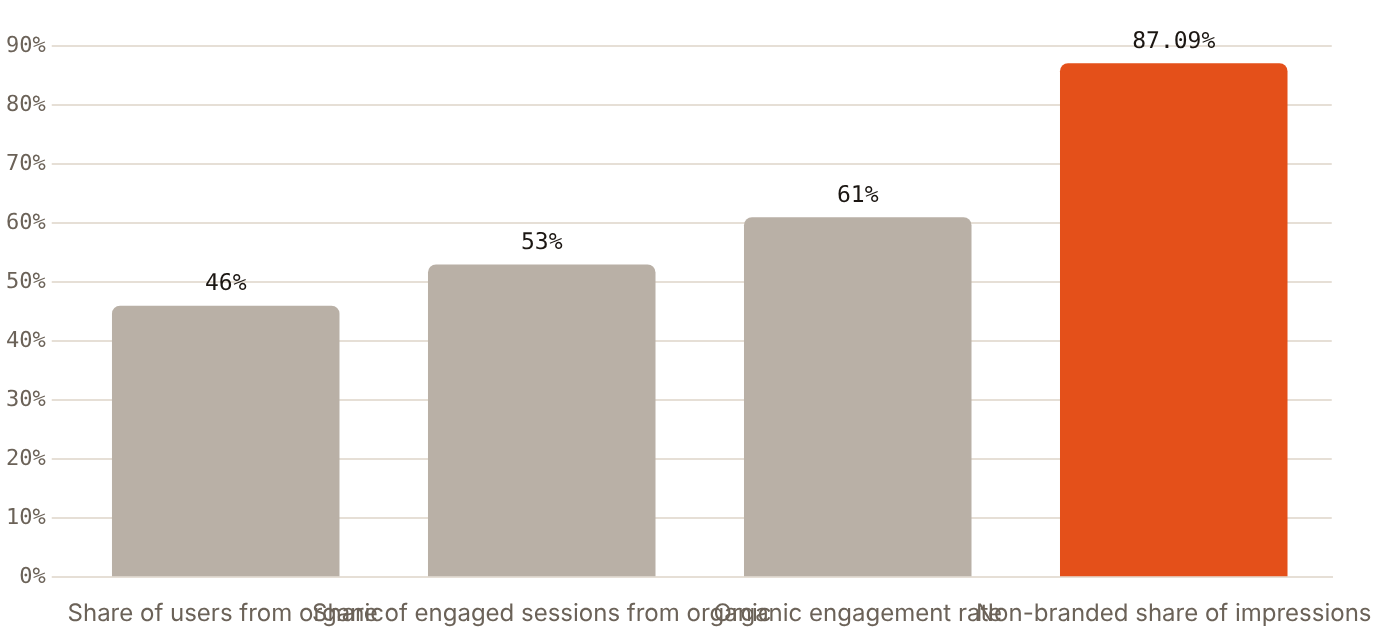
Organic search was the largest channel for 200+ US higher education websites: 46% of users and 53% of engaged sessions, with non-branded keywords at 87.09% of impressions (Carnegie, July 2023 to June 2024).
84% of US graduate prospects rate search engines as their most important source and 71% began with a keyword search (RNL 2025) (Ruffalo Noel Levitz).
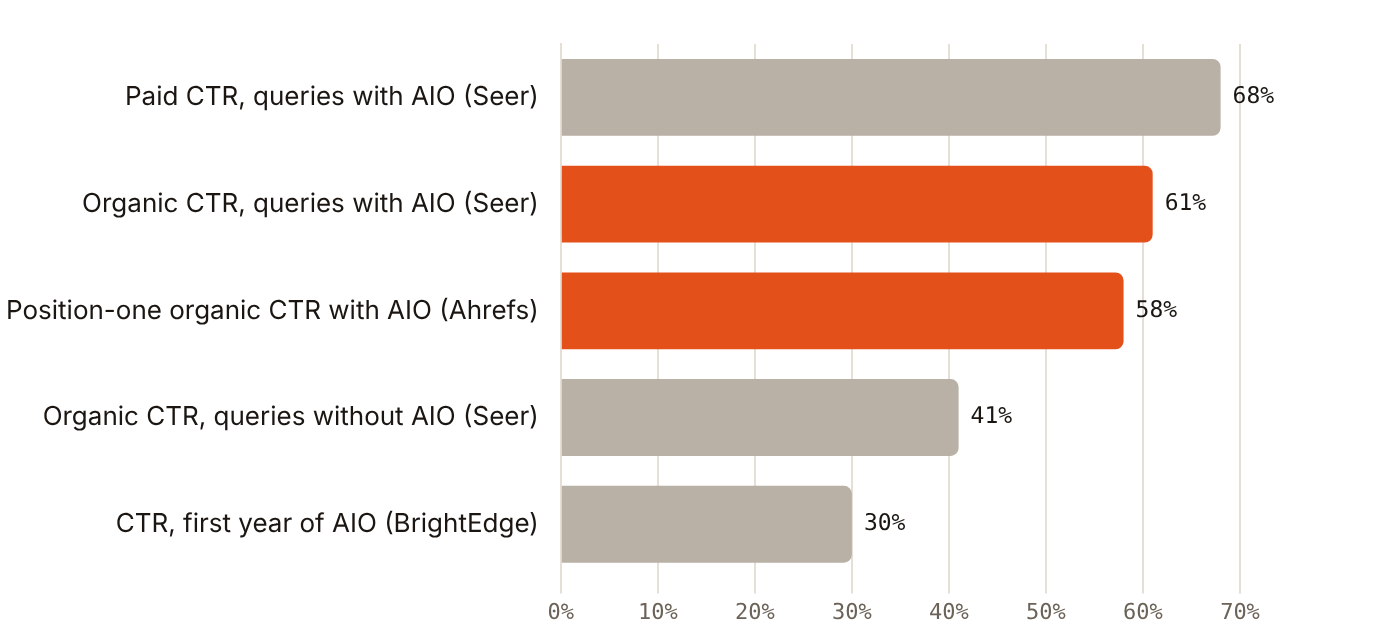
BrightEdge reports AI Overview coverage of education and healthcare queries approaching 90% (Search clicks fell 30% in last year, via Search Engine Land); Ahrefs found position-one organic CTR 58% lower when an AI Overview appears (PPC Land, 2025).
On 3,119 informational and educational search terms, Seer states that organic CTR with an AI Overview fell 61% and paid CTR 68% between June 2024 and September 2025; in Q3 2025, brands cited in the Overview earned 35% higher organic and 91% higher paid CTR. Seer's page is not fully consistent on these percentages.
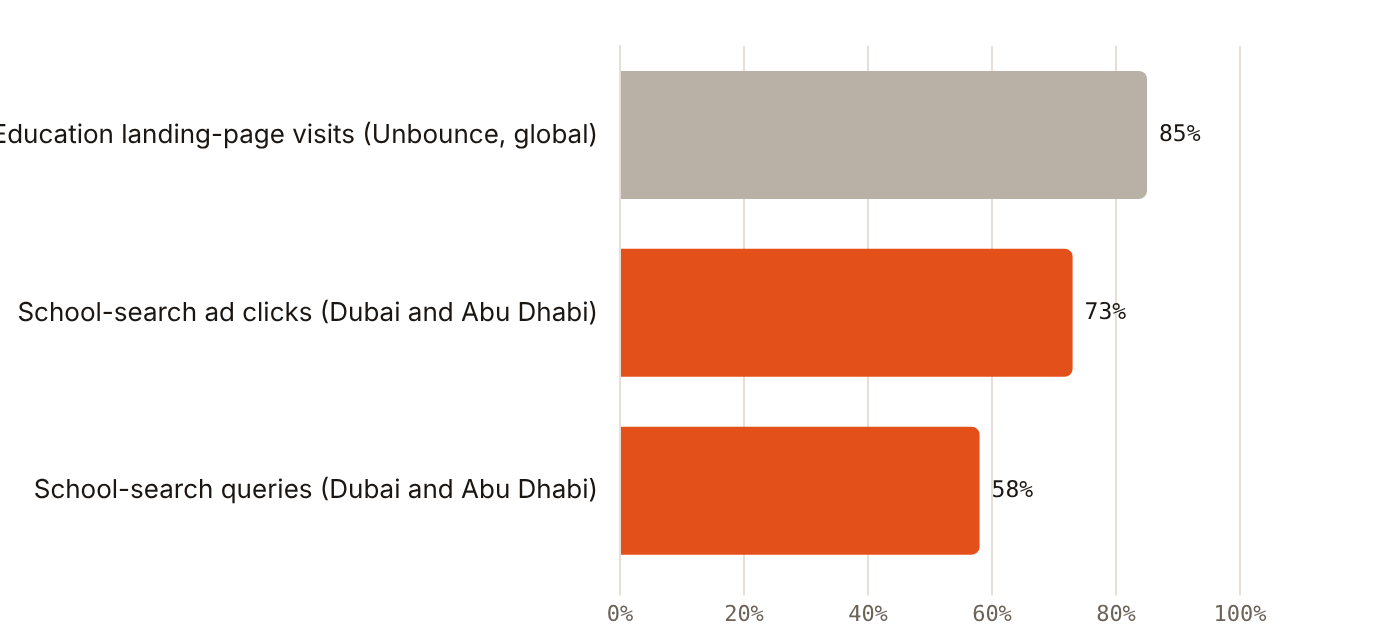
In UAE K-12 school search (Google data, 2018 to 2019), mobile was 58% of queries and 73% of ad clicks, and queries peaked in October (Nexa, Q2 2018). Unbounce found mobile at 85% of education landing-page visits globally.
Google says established SEO foundations still apply to its generative AI features and that no special AI markup or AI text file is required.
Keystone found 67% of prospective students use AI monthly for study research but only 36% rate it very or extremely trustworthy.
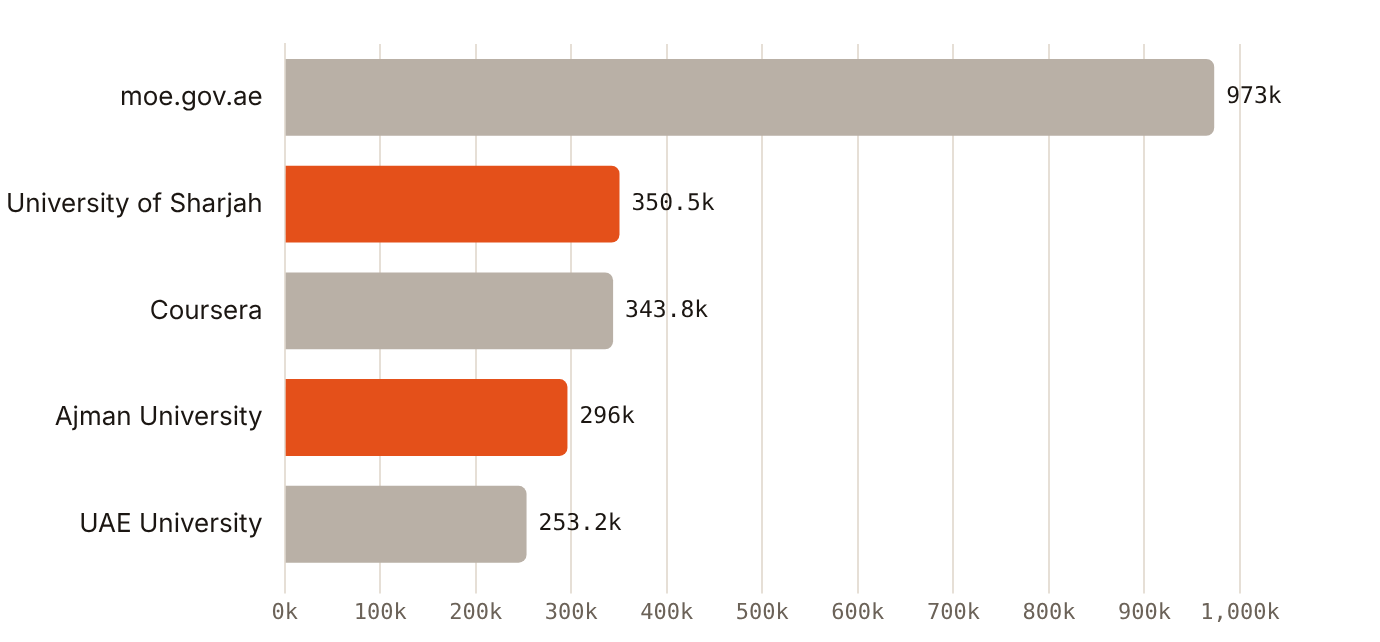
The most-visited UAE education category sites in August 2026 were moe.gov.ae (973k), University of Sharjah (350.5k), Coursera (343.8k), Ajman University (296.0k) and UAE University (253.2k) on Semrush estimates (live page, as at October 2026).
No source in the notes gives Google's share of UAE search, UAE education search volumes, or UAE AI Overview coverage.
| 84% Graduate prospects rating search engines most important US, 2025. Ruffalo Noel Levitz | 46% Higher-ed website users arriving from organic search US, Jul 2023 to Jun 2024. Carnegie | 90% AI Overview coverage of education and healthcare queries is "approaching" this level US-led, 2025. Search clicks fell 30% in last year |
| -58% Position-one organic CTR when an AI Overview appears Dec 2025 vs Dec 2023. PPC Land | 36% Prospective students rating AI study information highly trustworthy Global, Aug 2025. Keystone Education Group |
Search engine share in the UAE
The research for this book did not find a source for Google's share of search in the UAE. No StatCounter, Similarweb or Google figure is held in the notes, and this chapter therefore does not state one. What the notes do show is that Google is the search engine whose behaviour UAE providers are measured against: the only UAE education search data published comes from Google (via an agency), Google's Year in Search 2025 is the only UAE trending-query data, and Google's guidance is the only search-engine documentation on generative AI features in the notes. The UAE's top trending technology searches in 2025 were Gemini, DeepSeek and ChatGPT, in that order, so AI assistants are part of the search landscape that providers need to monitor alongside Google (Gulf News).
No public data. Google's share of UAE search, by device and emirate, was not found. Future editions should fetch StatCounter Global Stats for the UAE and any Google UAE disclosure of search share or education query volumes.
How learners use search
Search is the first stop
The clearest measure of search's role comes from US higher education. RNL's 2025 Graduate Student Recruitment Report (1,390 respondents) found 84% of prospective graduate students rate search engines as their most important information source and 71% began their search with keywords (Ruffalo Noel Levitz). Carnegie's 2024 benchmark of more than 200 US-focused higher education websites, built from Google Search Console and GA4 data for July 2023 to June 2024, found organic search was the first channel for users (46%), generated 53% of engaged sessions with a 61% engagement rate, and that non-branded keywords made up 87.09% of impressions.
The 87.09% non-branded share is the figure that matters most for UAE providers. It means most search impressions come from people who have not yet named an institution: they are searching for a subject, a qualification, a location or a fee. A provider that ranks only for its own name is invisible to most of that demand.
Organic search brought 46% of users to US higher education websites, and 87.09% of search impressions were non-branded
Organic search metrics, %, 200+ US-focused higher education websites, Jul 2023 to Jun 2024 (GSC and GA4)
View chart data
| Label | % (%) |
|---|---|
| Share of users from organic | 46 |
| Share of engaged sessions from organic | 53 |
| Organic engagement rate | 61 |
| Non-branded share of impressions | 87.09 |
What people search for
Keystone's 2025 data on international interest in UAE study names subject availability and tuition fees as the two leading factors in student decisions (The PIE News). Leap Scholar reports cost as the top factor for 75% of Indian study-abroad students, and QS's 2025 Global Student Flows survey of more than 70,000 respondents found 67% concerned about living costs (Careers360, 2020 to 2025; QS). For business school candidates, career outcomes and ROI became the top research priority while interest in rankings declined (GMAC 2026) (Poets&Quants). These are the questions course pages must answer: what the programme is, what it costs, and what it leads to.
The only UAE-specific search pattern in the notes is old and covers K-12 schools. A 2020 agency summary of Google data for school-related searches in Dubai and Abu Dhabi (Q2 2018 against Q2 2019) found mobile accounted for 58% of queries and 73% of ad clicks, queries peaked in October (when CPC was lowest), CPC peaked in August, average ad CTR was about 6.1%, and mobile CPC was USD 0.82 against USD 1.32 on desktop (Nexa). It is an agency citing Google, not Google's own publication, and it predates AI Overviews.
Mobile
Unbounce's 2024 education conversion benchmark found mobile made up 85% of visits to education landing pages, with a median conversion rate of 10.2% on mobile against 12.0% on desktop. The sample is Unbounce's platform users and has no UAE split. Together with the older UAE school-search data, it shows that course pages are mostly read on phones, and that phones convert slightly less well, so mobile form length, fee tables and WhatsApp links need testing on the device most people use (Nexa, Q2 2018).
Mobile was 85% of education landing-page visits globally and 73% of UAE school ad clicks
Mobile share, %. Unbounce: education landing pages, platform sample, 2024 edition, no UAE split. Google via Nexa: Dubai and Abu Dhabi school searches, Q2 2019, K-12, older agency summary.
View chart data
| Label | Mobile share (%) |
|---|---|
| Education landing-page visits (Unbounce, global) | 85 |
| School-search ad clicks (Dubai and Abu Dhabi) | 73 |
| School-search queries (Dubai and Abu Dhabi) | 58 |
Which UAE education sites get the traffic
Semrush traffic estimates for the UAE "education" category in August 2026 put the Ministry of Education site (moe.gov.ae) first at 973k monthly visits, followed by the University of Sharjah (350.5k), Coursera (343.8k), Ajman University (296.0k) and UAE University (253.2k, up 117.7% month on month). These are tool estimates from a live page, read as at October 2026, and August is an admissions month, which may explain UAEU's monthly jump. The list matters for two reasons. Two of the four universities are outside Dubai (Sharjah and Ajman), and the presence of Coursera shows that global course platforms compete for the same UAE search demand as local providers.
University of Sharjah and Ajman University drew more estimated visits than UAE University in August 2026
Estimated monthly visits, thousands, top UAE education-category websites, Aug 2026. Semrush tool estimates.
View chart data
| Label | Visits (thousands) (k) |
|---|---|
| moe.gov.ae | 973 |
| University of Sharjah | 350.5 |
| Coursera | 343.8 |
| Ajman University | 296.0 |
| UAE University | 253.2 |
Match search intent to pages before forecasting keyword demand
Keyword examples identify the questions to serve. Actual demand and auction costs require location-specific planning data. The map below sets each search intent against the page that should answer it and the outcome that page should produce.
| Intent | Illustrative query theme | Best destination | Outcome |
|---|---|---|---|
| Explore a pathway | MBA or professional certification | Balanced comparison guide | Relevant programme exploration |
| Choose a course | PMP preparation Dubai weekend | Exact course page | Eligible consultation |
| Check recognition | Is this programme accredited | Current status explanation with official link | Informed application |
| Check affordability | MBA fees Sharjah | Fee basis and funding page | Financially suitable enquiry |
| Find nearby provision | Nursery near my area | Real branch page | Tour with catchment fit |
| Act on a deadline | IELTS preparation next batch | Current batch page | Suitable paid start |
| Procure training | Corporate safety training Abu Dhabi | Employer service page | Qualified opportunity |
Research workflow
Use the institution's Search Console queries, internal site search, admissions questions and historical campaign search terms as the starting point. Add keyword-planning estimates by serviceable geography, language and date range. Retain the export and assumptions. Search volume is not the number of eligible learners, and the same person can search several variants.
Language and geography
Build English and Arabic journeys where the institution can respond appropriately. Add other languages only where demand and operational support justify them. Translation should preserve the exact qualification, fee basis and entry conditions. Do not create near-identical city pages simply to capture place names; each should contain useful delivery information.
Negative intent
Review job vacancies, current-student portals, exam results, free-only requests, unrelated curricula and patient-service searches according to the offer. Avoid blanket exclusions that remove useful discovery demand without evidence. Separate informational content from paid conversion campaigns so each can be assessed against its purpose.
ONS reading
Before launch, prepare a map linking search queries to pages with geography, language, intent, evidence owner, conversion event and exclusions. No monthly search-volume estimates were available for this book, so any forecast must be built from the institution's own Search Console and keyword-planning exports.
Given India's 43% share of Dubai's international higher education students, ONS would include Indian search locations and Indian English phrasing in the intent map for any Dubai university or certification provider recruiting from that market, and would keep them in separate reporting from UAE-resident searches (Gulf News citing KHDA, 2024).
AI Overviews on education queries
Google's AI Overviews (AIO) place a generated answer above the organic results. Education is one of the categories most affected. BrightEdge's one-year review reported AIO coverage of healthcare and education queries "approaching 90%", with click-through down 30% year on year while impressions rose 49%. The sample and geography are not stated and the data are US-led.
Two independent studies measure the click loss. Ahrefs, analysing 300,000 keywords in desktop Search Console data, found position-one organic CTR was 58% lower when an AI Overview appeared (0.016 against a forecast 0.037) in December 2025, compared with 34.5% lower in its April 2025 study (PPC Land). Seer Interactive, using 3,119 informational and educational search terms across 42 client organisations and 25.1 million organic impressions, found organic CTR on queries with an AIO fell from 1.76% to 0.61% between June 2024 and September 2025 (Seer states -61%); for queries without an AIO it records an organic CTR of 1.62% and a 41% fall; and paid CTR on queries with an AIO fell from 19.70% to 6.34% (-68%). Seer also found that, in Q3 2025, brands cited inside the AI Overview earned 35% higher organic CTR and 91% higher paid CTR than those not cited. The source is not internally consistent: 1.76% to 0.61% implies a fall of about 65% rather than 61% (ONS calculation), the paid decline is given as 65% in one place and 68% in another, and a later section gives different cited-brand CTRs. The figures here are Seer's stated headline figures.
Where AI Overviews appear, studies report click-through falls of 58% to 68%
Reported fall in click-through rate, %. Seer: 3,119 informational and educational terms, Jun 2024 to Sep 2025. Ahrefs: 300,000 keywords, Dec 2025 vs Dec 2023. BrightEdge: all CTR in first year of AIO. Geography not stated; US-led.
View chart data
| Label | Fall in CTR (%) |
|---|---|
| Paid CTR, queries with AIO (Seer) | 68 |
| Organic CTR, queries with AIO (Seer) | 61 |
| Position-one organic CTR with AIO (Ahrefs) | 58 |
| Organic CTR, queries without AIO (Seer) | 41 |
| CTR, first year of AIO (BrightEdge) | 30 |
A compilation by Web Tonic claims that zero-click or AIO results cover about 75% of education queries (attributed to Prose Media) and that position one earns 39.8% CTR on education searches against 31.7% for all industries (attributed to Searchlab). These figures come from a secondary compilation with no stated geography, and the 75% claim conflicts with BrightEdge's "approaching 90%" coverage (Search clicks fell 30% in last year, via Search Engine Land). Both are shown here; neither has been verified against its primary study.
| Study | Finding | Sample, geography, period | Grade | Source |
|---|---|---|---|---|
| BrightEdge | AIO coverage of education and healthcare approaching 90%; CTR -30%, impressions +49% | Sample not stated; US-led; first year of AIO | [Industry] | Search clicks fell 30% in last year |
| Ahrefs | Position-one CTR 58% lower with AIO (34.5% in Apr 2025 study) | 300,000 keywords; desktop; Dec 2025 vs Dec 2023 | [Industry] | PPC Land |
| Seer Interactive | Organic CTR with AIO 1.76% to 0.61%; paid CTR with AIO 19.70% to 6.34% | 3,119 terms; 42 organisations; Jun 2024 to Sep 2025 | [Industry] | Seer Interactive |
| Seer Interactive | Cited brands: +35% organic CTR, +91% paid CTR (Seer's stated figures; source internally inconsistent) | Same sample; Q3 2025 | [Industry] | Seer Interactive |
| Web Tonic (compiling Prose Media) | Zero-click or AIO on about 75% of education queries | Geography not stated; 2026 | [Estimate] | Web Tonic |
| Web Tonic (compiling Searchlab) | Position-one CTR 39.8% on education vs 31.7% all-industry | Geography not stated; 2026 | [Estimate] | Web Tonic |
What it means for marketersOn informational education queries ("what is CME", "IELTS vs PTE", "how to become a CMA"), ranking first no longer delivers the clicks it did. Being cited inside the Overview is now the outcome that carries the click premium, and that depends on clear, verifiable answers on the provider's own pages.
ONS reading
For healthcare training and professional certification, the informational queries that used to feed course enquiries are the ones most exposed to AI Overviews (Search clicks fell 30% in last year, via Search Engine Land). ONS would expect organic traffic to such guides to fall even when rankings hold, and would judge the content by citations and assisted enquiries rather than by sessions. Course-specific and fee queries ("BLS course Dubai price", "PMP batch Abu Dhabi") are closer to a decision and remain the core of organic and paid search work.
AI visibility should be measured as an additional discovery route
The priority is accurate, findable information that prospective learners can verify. In Keystone's August 2025 survey of more than 1,700 prospective students, 67% used AI at least monthly to research study options, while 36% rated the information very or extremely trustworthy. The sample has no UAE breakdown. It supports an AI-discovery workstream, but cannot establish the share of UAE admissions attributable to AI.
Students use AI widely for research but trust it far less: 67% monthly use against 36% high trust
% of respondents. Different surveys and questions; do not add or compare directly. Keystone: global prospective students, Aug 2025. OHO: US-based agency, nationwide online survey of about 530 students, Apr 2025; the page gives the age range as both 17 to 22 and 17 to 24 and does not name the country. EAB: US high-school students, 2025.
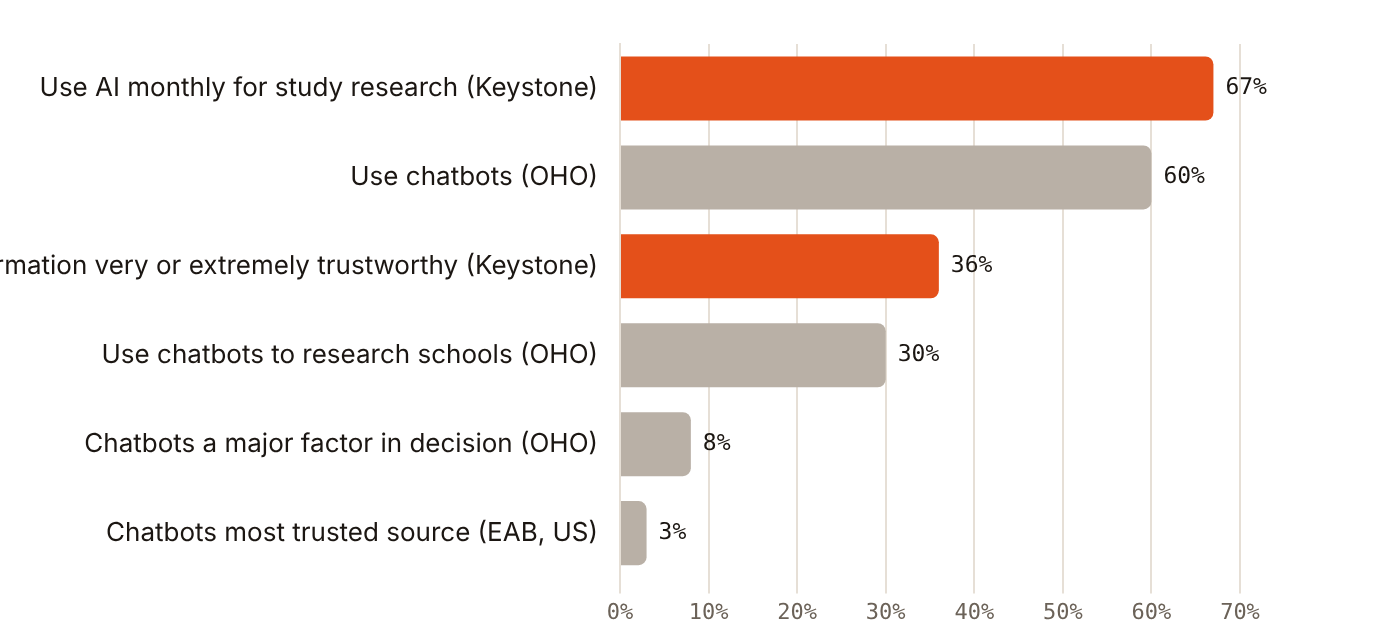
View chart data
| Label | % (%) |
|---|---|
| Use AI monthly for study research (Keystone) | 67 |
| Use chatbots (OHO) | 60 |
| Rate AI information very or extremely trustworthy (Keystone) | 36 |
| Use chatbots to research schools (OHO) | 30 |
| Chatbots a major factor in decision (OHO) | 8 |
| Chatbots most trusted source (EAB, US) | 3 |
Other studies point the same way. IDP found 54% of prospective international students plan to use AI to choose a university, up from 35%, and over half rely on university websites (Insider Guides; ICEF Monitor). EAB found 18% of US high-school students removed a college from consideration because of AI-generated results (EAB, 2025). INTO found 54% of enrolled students from the Middle East and Africa found AI "much more helpful" than traditional sources (ICEF Monitor, 2025). RNL found 73% of US graduate AI users considered the results accurate (Ruffalo Noel Levitz, 2025).
An institution-specific approach
Maintain clear answers to programme, fee, location, recognition and admissions questions. Publish the source of claims and the person or department responsible for them. Use original faculty explanations and useful programme comparisons. Correct inaccuracies on the institution's own pages and legitimate third-party listings where a correction route exists.
Current Google guidance
Google's documentation on optimising for generative AI search keeps established SEO foundations: eligible, indexable content, a Search Console inclusion control and a generative AI performance report. It also says special AI text files or special schema are not required for its generative search features. Feature availability can vary, and technical eligibility and content quality do not guarantee indexing, ranking or inclusion (Google Search Central, 2026). Use the features available in the institution's account and retain their definitions.
A practical monitoring panel
Track a fixed set of relevant questions by programme and location, recording date, model or search surface, account context where known, answer, citation and material factual errors. Treat the panel as a diagnostic sample, not market share. Combine it with available Search Console reporting, referral analytics and the applicant's own reported discovery source.
ONS reading
Do not sell a technical checklist as a guarantee of AI citations; Google's own guidance rules this out. Recommended success criteria are fewer material inaccuracies, more useful cited programme pages and evidence of qualified downstream enquiries. A model mention alone is not an enrolment or a reliable reach metric.
The gap between use and trust is useful (Keystone Education Group, 2025). Students who use AI to build a shortlist then check institution websites and counsellors (Insider Guides). A provider whose own page confirms the AI answer quickly, with a dated fee, a current intake and an official recognition link, is better placed than one whose page contradicts it.
Make the institution easy to understand and verify
Useful programme pages and accurate local information support both search discovery and admissions confidence.
Programme and branch pages
Give each page a clear subject and audience. Include the programme or service name, actual location, delivery mode, duration, prerequisites, timetable, fee basis, credential issuer and next step. Keep substantial information accessible on the page rather than only inside a brochure or a form response. Brochures can remain useful downloadable companions.
UAE providers differ in how much they publish. Some publish full fee schedules: Middlesex University Dubai shows Daytime MBA tuition of AED 84,872 inclusive of VAT with January, April and September intakes; AURAK lists its MBA at 30 credits at AED 2,520 per credit; Ajman University's 2026-27 brochure lists BSc Management at AED 1,531 per credit and its MBA at AED 2,420 per credit; Abu Dhabi University publishes average annual international undergraduate tuition by programme, for example BBA AED 49,745. Others publish only part: Heriot-Watt Dubai publishes its application fee (AED 525) and deposit terms but tuition only per programme, and the MoHESR service card for HBMSU lists application and admission fees but not tuition. Nurseries such as Ladybird (Jumeirah) and Canadian Kids (Business Bay) publish term fees by days and hours.
Fee pages also change. Ajman University states it may raise tuition and other fees by up to 10% a year, and Amity Dubai's fee structure is dated April 2026. A fee that an AI tool or directory copied last year can be wrong this year.
| Institution (emirate) | What the public page shows | Example published value | Grade | Source |
|---|---|---|---|---|
| Middlesex University Dubai (Dubai) | Programme tuition incl. VAT; intakes; full and part-time | AED 84,872 (Daytime MBA) | [Platform] | Middlesex University Dubai |
| Heriot-Watt Dubai (Dubai) | Application fee and deposit; tuition per programme only | AED 525 application fee | [Official] | Heriot-Watt University |
| Abu Dhabi University (Abu Dhabi) | Average annual international UG tuition by programme; VAT note | AED 49,745 (BBA) | [Official] | Abu Dhabi University |
| UAE University (Abu Dhabi, Al Ain) | MBA course fees itemised | AED 5,900 per course | [Official] | UAE University |
| American University of Sharjah (Sharjah) | UG tuition per semester; lab and housing fees; scholarship share | AED 52,510 per semester | [Official] | American University of Sharjah |
| Ajman University (Other markets) | Per-credit fees; up to 10% annual increase notice | AED 2,420 per credit (MBA) | [Platform] | Ajman University |
| AURAK (Other markets) | Per-credit fees; additional charges listed separately | AED 2,520 per credit (MBA) | [Platform] | AURAK |
| Ladybird Nursery, Jumeirah (Dubai) | Term fee by days and hours | AED 14,500 per term (five mornings) | [Platform] | Ladybird Nursery |
Site architecture
| Site layer | Purpose | Maintenance owner |
| Institution | Identity, governance and contact routes | Leadership and communications |
| Programme or course | Offer, eligibility, content and fee | Academic owner and admissions |
| Campus or branch | Location, hours and local service details | Branch management |
| Intake or batch | Dates, availability and enrolment process | Admissions operations |
| Trust and support | Recognition, faculty, policies and outcomes | Relevant accountable department |
Recognition and claims on course pages
Course pages in regulated segments need claims that match the awarding body's own rules. PMI announced changes to PMP live-training eligibility for 1 December 2026, with prior completed training remaining eligible under current rules, so PMP pages need dated eligibility text (PMI). ACCA approves tuition providers at Platinum, Gold and Silver levels, and the level must be checked for the actual provider. CFA Institute forbids participating prep providers from reporting their own customer pass rates in response to the listed question. NEBOSH warns learners about guaranteed passes and runs a Learning Partner directory. IELTS Academic and General Training serve different purposes, and PTE Academic, Core and UKVI routes differ (British Council UAE, 2026; Pearson PTE, 2026). The CAA directory distinguishes institution, programme, emirate, level and active or inactive status, and is the official link to cite on a recognition page (CAA, 2026). KHDA runs advertising approval services for Dubai training institutes, higher education providers and early childhood centres.
What it means for marketersA recognition page that links to the regulator's or awarding body's own directory gives both the applicant and an AI system a verifiable source. A claim the provider cannot link to should not be on the page.
Technical priorities and structured data
Check that important pages are discoverable, indexable and usable on mobile, given that mobile is the majority of education visits (Unbounce, 2024). Fix broken enquiry paths, inconsistent canonical pages, obsolete redirects and duplicate versions that confuse visitors. Maintain clear internal links from programme families to specific offers.
Use structured data only where it accurately represents visible content and is supported by the intended search feature. Google states that no special schema is required for its generative AI features. The notes hold no study measuring the effect of Course, EducationalOrganization or LocalBusiness markup on education rankings, AI Overview citations or enquiries.
ONS reading
ONS treats structured data as a way to state facts that are already on the page (organisation name, branch address and hours, course name and provider, fee where shown) in a form machines can parse, not as a ranking lever. Markup that describes a fee, intake or rating not visible on the page should not be used. The order of work is: accurate visible content first, crawlable and indexable pages second, markup that mirrors them third.
Local SEO for campuses, branches and nurseries
For nurseries, tutoring centres, language schools and training branches, the local result (map pack and Business Profile) is often the first thing a parent or learner sees. The number of local competitors is large and growing. Dubai had 312 early childhood centres in June 2025, with 38 new centres in AY 2024-25, and KHDA announced 17 more for AY 2026-27 with more than 1,700 additional seats. Abu Dhabi had 233 nurseries in October 2025, with seven new nurseries adding 929 seats (ADEK). Sharjah's SPEA oversees more than 201,000 learners across private schools, nurseries and training centres, but publishes no separate nursery count in the notes. Edarabia lists 199 Dubai nurseries with parent reviews.
| Emirate | Local competition data in the notes | Value | Grade | Source |
|---|---|---|---|---|
| Dubai | Early childhood centres, June 2025 | 312 | [Industry] | Khaleej Times reporting KHDA |
| Dubai | New early childhood centres, AY 2026-27 | 17 | [Official] | WAM reporting KHDA |
| Dubai | Nurseries listed with reviews on Edarabia | 199 | [Platform] | Edarabia |
| Dubai | Private higher education institutions, AY 2024-25 | 41 | [Official] | KHDA and Dubai Media Office |
| Abu Dhabi | Nurseries (incl. Al Ain and Al Dhafra), Oct 2025 | 233 | [Official] | ADEK |
| Sharjah | Higher education institutions in SCHESR directory | 11 | [Official] | Sharjah Council for Higher Education and Scientific Research |
| Sharjah | Learners across private schools, nurseries and training centres (mixed) | 201,000+ | [Official] | WAM reporting Sharjah Executive Council and SPEA |
| Other markets | No branch or nursery count in the notes | Not available | Not applicable | None |
Reviews feed local ranking and choice. In BrightLocal's 2025 US survey, 96% of consumers read online reviews at least occasionally and 81% used Google for reviews in 2024. Google's Maps content policy forbids incentivised reviews, selective solicitation of positive reviews and pressure for prescribed content. Because KHDA's ECCE Quality Framework does not yet publish nursery ratings, public reviews are one of the few comparative signals a Dubai parent can find online.
Local discovery practice
Maintain accurate Business Profile details for eligible real locations, with the correct name, address, telephone, hours and website destination. Keep branch information consistent across the institution's website and relevant directories. Use photographs that represent the current site. Do not invent premises or use a location name to imply a campus that does not exist.
ONS reading
For a nursery, the branch page and Business Profile do most of the search work. With 312 centres in Dubai and 233 nurseries in Abu Dhabi, parents search by area, and the profile with accurate hours, current photographs, published fees and a steady flow of genuine reviews is the one that earns the tour (Khaleej Times reporting KHDA, 2025; ADEK, 2025). ONS would ask every nursery client to request reviews from all families at a fixed point (for example, after the settling-in period), never only from satisfied ones, which also keeps the process inside Google's policy.
Content governance
Assign review dates and named owners to fee schedules, accreditation statements, batch dates and admission criteria. Remove or archive expired offers in a way that helps existing applicants. When a course changes, update advertising, landing pages, brochures, counsellor scripts and directory listings together. Dated changes such as the PMP eligibility rule from 1 December 2026 and annual fee increases of up to 10% show why a review calendar is needed (PMI; Ajman University).
ONS reading
Content governance is now an AI-visibility task as much as a compliance one. AI tools and directories copy what they find; if the provider's own page is out of date, the error spreads and the provider has no correction route. ONS would put a "last reviewed" date and an owner on every fee, recognition and intake page, and align the update cycle with KHDA or other advertising approvals where they apply.
Gaps in the evidence
No public data. Google's share of UAE search and UAE education search volumes by emirate were not found. The only UAE education search pattern in the notes covers K-12 school search in Dubai and Abu Dhabi in 2018 and 2019 (Nexa, Q2 2018). Think with Google data pages redirected and could not be read. Future editions should fetch StatCounter UAE, Google Trends exports by emirate for course terms, and Keyword Planner data for a defined query set.
No public data. No study measures AI Overview coverage or click loss on UAE or Arabic-language education queries. All AIO figures are US-led or without stated geography (Seer Interactive; Search clicks fell 30% in last year, via Search Engine Land). Future editions should include an ONS monitoring panel of UAE course queries in English and Arabic.
No public data. No study links structured data types to education rankings, AI citations or enquiries. No Sharjah or Other-markets nursery or branch count was found; Sharjah's SPEA total is mixed across categories. No evidence on Arabic-language course search behaviour was found.
Sources & credits
Abu Dhabi University, "Undergraduate fees for international students", accessed Oct 2026. adu.ac.ae
ACCA, "Approved Learning Partners", Current page accessed 26 Oct 2026. accaglobal.com
ADEK, "Abu Dhabi education landscape expands", 6 Oct 2025. adek.gov.ae
Ajman University, "2026-27 fee brochure", AY 2026-27. ajman.ac.ae
American University of Sharjah, "UG mini prospectus flyer", Sep 2024. aus.edu
Amity University Dubai, "Amity Fee Structure APR2026 PDF", Apr 2026. amityuniversity.ae
AURAK, "Tuition and fees", Updated 1 Sep 2026. aurak.ac.ae
BrightLocal, "Local Consumer Review Survey 2025", 29 Jan 2025. brightlocal.com
British Council UAE, "IELTS test types", Current indexed page accessed 26 Oct 2026. britishcouncil.ae
CAA, "Accredited programmes directory", Current indexed directory accessed 26 Oct 2026. caa.ae
Canadian Kids Nursery, "Business Bay fee schedule", AY 2026-27. canadiankidsnursery.com
Careers360, "75% Indian students use AI to make study-abroad choices", 20 Dec 2025. news.careers360.com
Carnegie, "Higher Ed SEO Benchmarks 2024", 2024. carnegiehighered.com
CFA Institute, "Selecting a prep provider", Current page accessed 26 Oct 2026. cfainstitute.org
EAB, "AI in college search survey press release", 25 Feb 2026. eab.com
Edarabia, "List of Best Nurseries in Dubai, 2026 Fees", Accessed Oct 2026. edarabia.com
Google Maps content policies, "Reviews and fake engagement", Current policy accessed 26 Oct 2026. support.google.com
Google Search Central, "Optimising for generative AI search", Current documentation accessed 26 Oct 2026. developers.google.com
Gulf News citing KHDA, "Indian students top Dubai's global intake at 43%; Pakistanis at 6%", 8 Jul 2025 (updated). gulfnews.com
Gulf News, "UAE Google Trends 2025...", 6 Dec 2025. gulfnews.com
Heriot-Watt University, "Dubai fees", 2026. hw.ac.uk
ICEF Monitor, "same as #42", 16 Oct 2025. monitor.icef.com
ICEF Monitor, "The ChatGPT generation: how AI is quietly rewriting the global student search experience", 8 Jan 2026. monitor.icef.com
Insider Guides, "New research shows how ChatGPT is choosing your next university", 15 Oct 2025. insiderguides.com.au
Keystone Education Group, "AI use in study research", August 2025 survey. keg.com
Khaleej Times reporting KHDA, "Dubai early childhood landscape", 2 Oct 2025; June 2025 snapshot. khaleejtimes.com
KHDA and Dubai Media Office, "Dubai private higher education landscape", 19 May 2025; AY 2024-25. mediaoffice.ae
KHDA, "Quality Framework for ECCE", 14 Nov 2025. web.khda.gov.ae
KHDA, "Training institute advertising approval", Current indexed service accessed 26 Oct 2026. web.khda.gov.ae
Ladybird Nursery, "Jumeirah fee schedule", AY 2026-27. ladybirdnursery.ae
Middlesex University Dubai, "Daytime MBA course page", September 2026 price context; accessed 26 Oct 2026. mdx.ac.ae
MoHESR, "HBMSU service card PDF", n.d.. mohesr.gov.ae
NEBOSH, "Choosing a Learning Partner", Current page accessed 26 Oct 2026. nebosh.org.uk
Nexa, "School Marketing with Google in 2020 - Insights & Data from Google", 19 Jan 2020 (OLDER, K-12). blog.digitalnexa.com
OHO Interactive, "The Influence of AI Chatbots in the College Search Process", 3 Apr 2025. oho.com
Pearson PTE, "Which test is right for me", Current page accessed 26 Oct 2026. pearsonpte.com
PMI, "PMP exam and training eligibility changes", Current page accessed 26 Oct 2026. pmi.org
Poets&Quants, "same", 24 Mar 2026. poetsandquants.com
PPC Land, "Google's AI summaries now swallow 58% of clicks...", 4 Feb 2026. ppc.land
QS, "Global Student Flows 2025", 2025 international student survey. qs.com
Ruffalo Noel Levitz, "2025 Graduate Student Recruitment Report", 2025. learn.ruffalonl.com
Search Engine Land, "New Google AI Overviews data: Search clicks fell 30% in last year", 2025 (approx. May) (data: Search clicks fell 30% in last year). searchengineland.com
Seer Interactive, "AIO impact on Google CTR, Sept 2025 update", 4 Nov 2025. seerinteractive.com
Semrush, "Top Education Websites in the UAE", Aug 2026 data. semrush.com
Sharjah Council for Higher Education and Scientific Research, "Higher education institution directory", Undated directory accessed 26 Oct 2026. schesr.shj.ae
The PIE News, "same", 15 Aug 2025. thepienews.com
UAE University, "MBA tuition and fees", accessed Oct 2026. uaeu.ac.ae
Unbounce, "Education conversion benchmarks", 2024 edition. unbounce.com
WAM reporting KHDA, "New education capacity for 2026-27", 1 Oct 2026; AY 2026-27. wam.ae
WAM reporting Sharjah Executive Council and SPEA, "Sharjah private education strategy", 9 Sep 2025. wam.ae
Web Tonic, "Education & Coaching SEO Statistics 2026", 22 Jul 2026. webtonic.io
PUT THE INSIGHT TO WORK
Your market.
Your next move.
Explore how ONS approaches education marketing.
Explore our expertise ↗