
In this chapter
This chapter asks which platforms reach the people who choose UAE courses (students, parents, working professionals and employers), how they use messaging, reviews and AI assistants while researching, and what the 2025 advertiser permit rules mean for influencer work. The headline finding is that reach is near universal but skewed: 99.0% of UAE residents are online and social media identities equal 110% of the population, yet the adult base is 63.7% male and women are a minority of every platform's ad audience (DataReportal, late 2025; DataReportal / Kepios, end 2025). At the same time 54% of prospective international students now plan to use AI tools to choose a university (Insider Guides; ICEF Monitor).
In brief
The UAE had 11.4 million residents in October 2025, a median age of 31.6, and 25 to 34 year olds made up 28.7% of the population against 10.2% for 18 to 24 year olds (DataReportal / Kepios, end 2025).
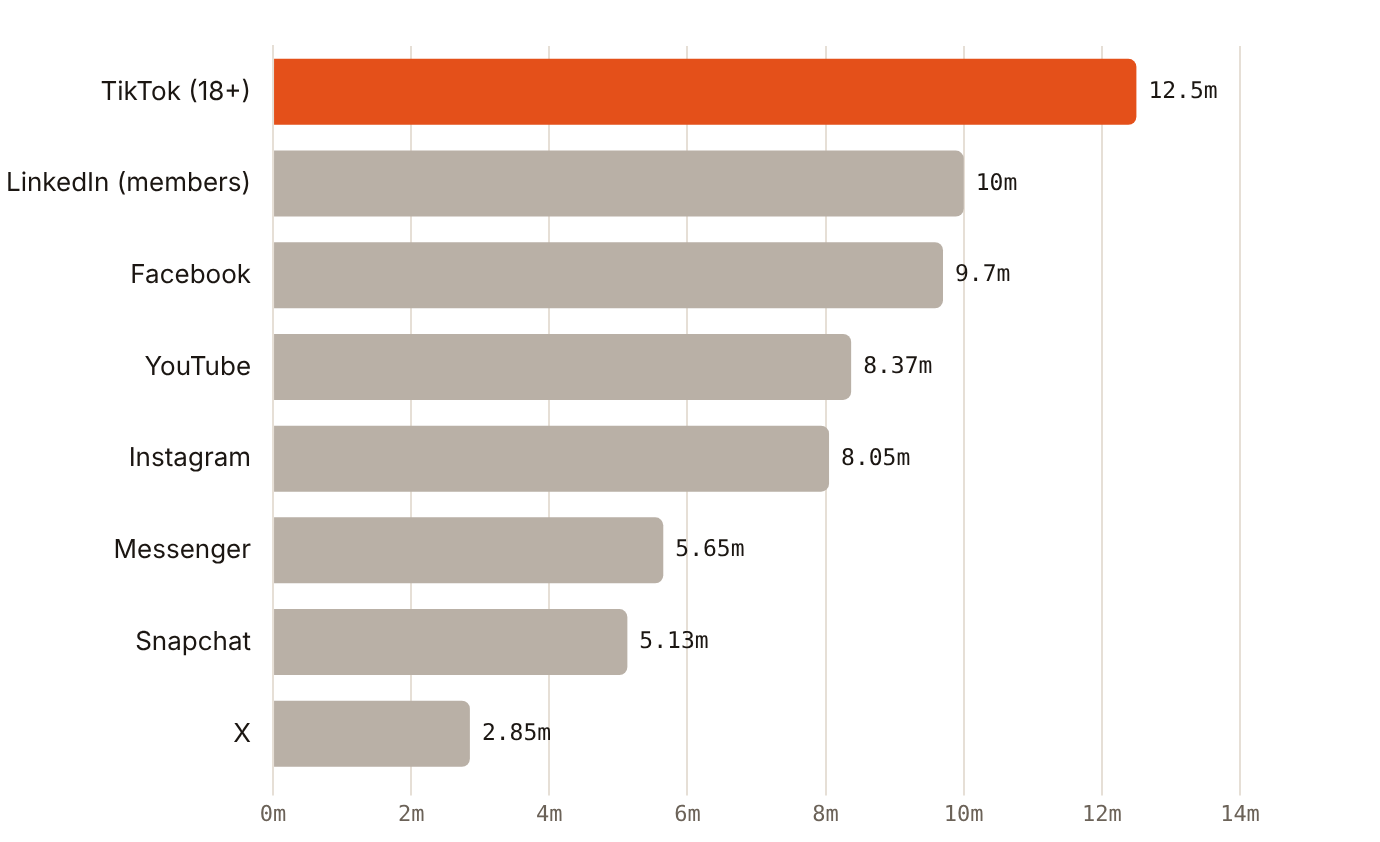
Ad reach in late 2025: TikTok 12.5 million adults, LinkedIn 10.0 million members, Facebook 9.70 million, YouTube 8.37 million, Instagram 8.05 million, Snapchat 5.13 million and X 2.85 million (DataReportal; DataReportal Kepios). These are ad audiences, not unique people, and they cannot be added together.
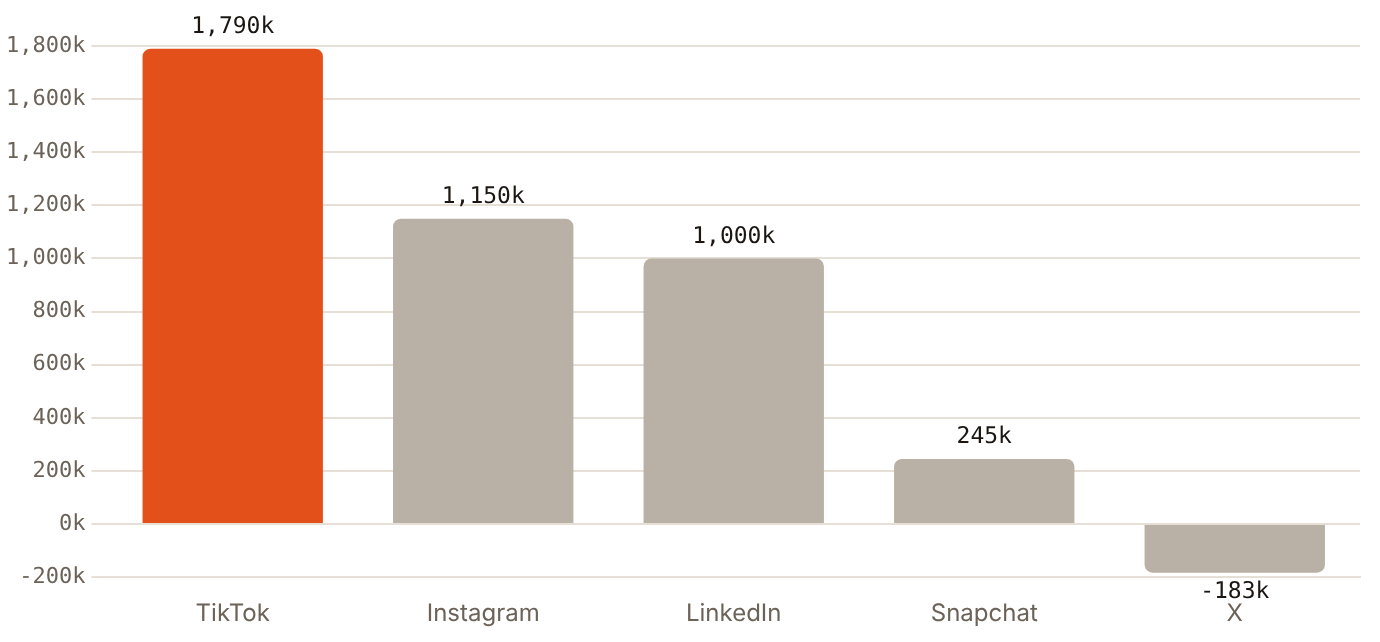
TikTok (+1.79 million) and Instagram (+1.15 million) grew fastest in UAE ad reach in the year to late 2025, while X fell by 183,000 (DataReportal, late 2024).
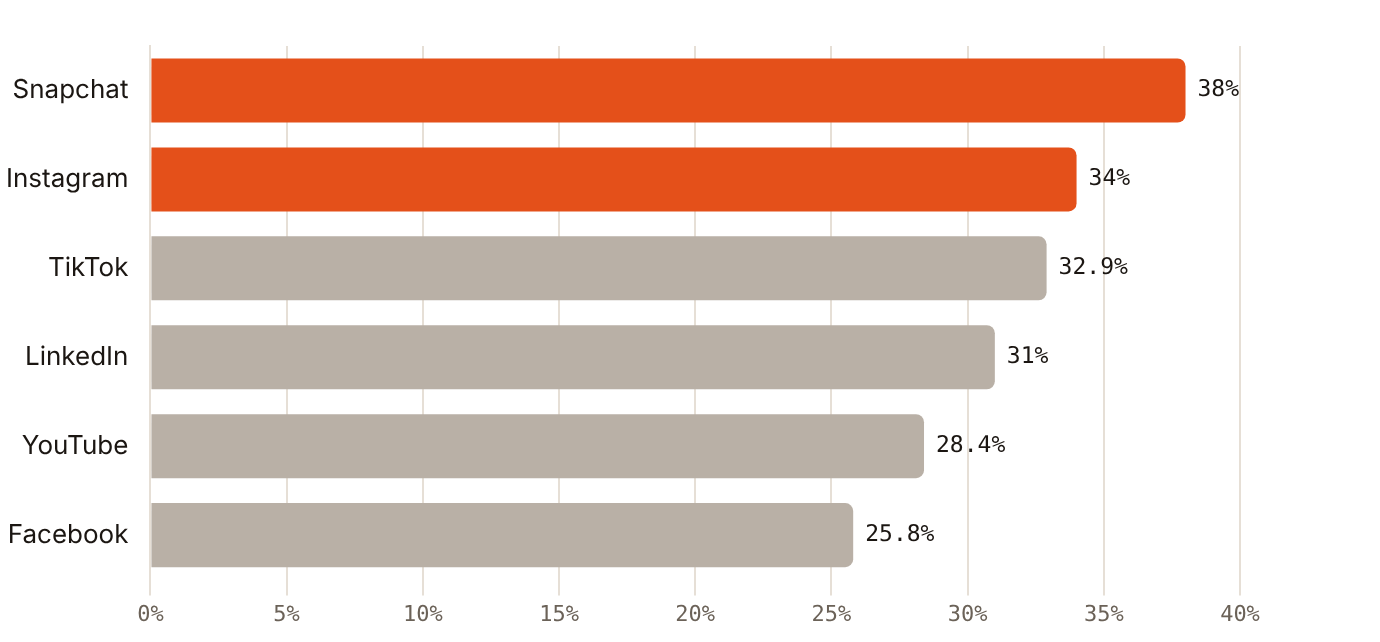
Women are 38.0% of the Snapchat ad audience and 34.0% on Instagram, but only 25.8% on Facebook (DataReportal, late 2025). For nursery marketing aimed at mothers this is the most relevant split in the data.
85% of UAE residents want businesses to offer WhatsApp support and 65% used WhatsApp to contact a business in the past year, against 48% who used email (YouGov for Zbooni, 2024) (Communicate Online).
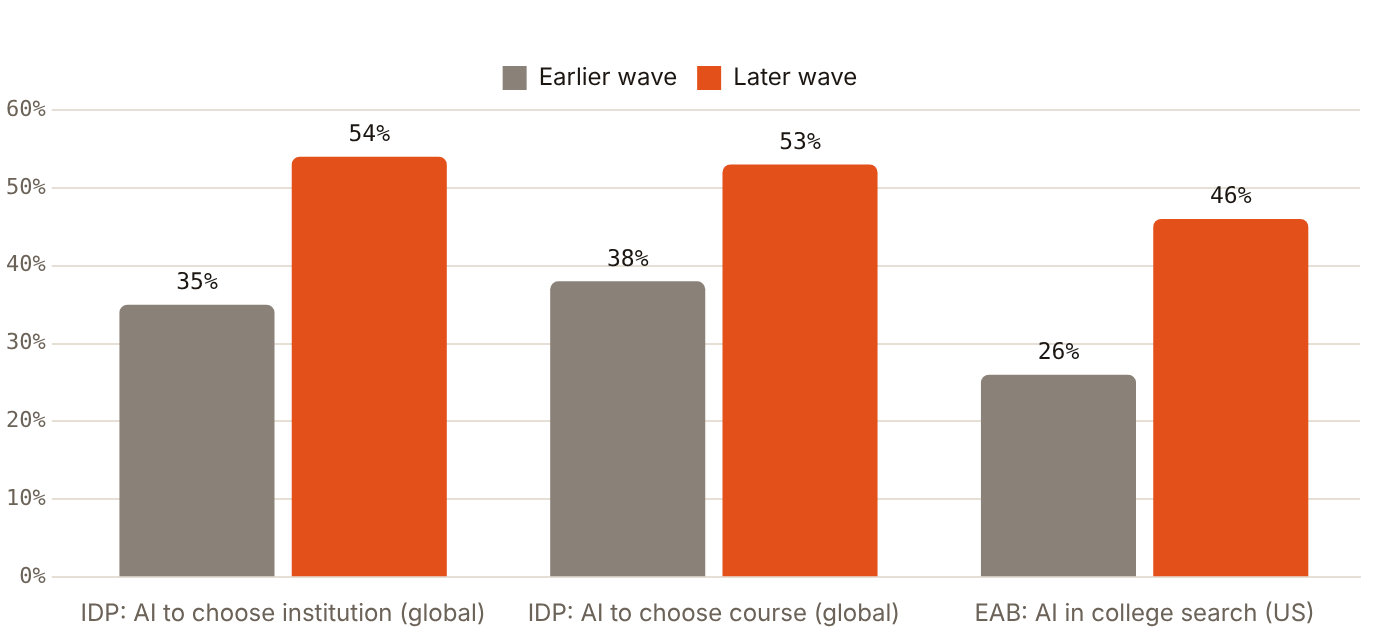
AI in course research is rising fast: IDP's global survey moved from 35% to 54% planning to use AI to choose an institution, and US high-school use in college search moved from 26% to 46% (EAB) (Insider Guides; ICEF Monitor). Trust remains low: 36% rate AI study information very or extremely trustworthy (Keystone Education Group, 2025).
Since late October 2025 individuals who create paid or unpaid promotional content on social media in the UAE need a Media Council Advertiser Permit, free for the first three years, with exemptions for people promoting their own business and for under-18s in educational, sports, cultural or awareness activities; content breaches can carry fines of up to AED 1 million (The National; Gulf News).
Personal recommendation was the most influential source in Dubai school choice in 2020 survey work, with KHDA ratings used to confirm (RS Academics). KHDA does not yet publish nursery ratings.
No UAE study breaks platform use down by emirate, or by student, parent, professional and employer. The segment view in this chapter combines demographic data with ONS judgement.
| 99.0% Internet penetration, 11.3m users UAE, late 2025. DataReportal | 28.7% Share of population aged 25 to 34 UAE, end 2025. DataReportal / Kepios | 8.69 Social platforms used monthly by internet users 16+, highest globally UAE, Digital 2026. Campaign Middle East |
| 85% Residents who want businesses to offer WhatsApp support UAE, Feb 2024. Communicate Online | 54% Prospective international students planning to use AI to choose a university Global, 2025. Insider Guides |
The UAE audience base
Population and age
DataReportal and Kepios put the UAE population at 11.4 million in October 2025, with a median age of 31.6 years. The age structure matters more for education marketers than the total. People aged 25 to 34 are 28.7% of the population and those aged 35 to 44 are 23.8%, while 18 to 24 year olds are only 10.2% (DataReportal / Kepios, end 2025). The resident population is therefore weighted towards working adults, which is the natural audience for professional certification, IT and AI upskilling, language testing and corporate programmes, and towards the age band in which people become parents of nursery-age children. The school-leaver cohort that undergraduate recruitment depends on is comparatively small, which is one reason UAE universities recruit heavily from abroad: in Dubai, 35% of private higher education students were international in AY 2024-25 (KHDA and Dubai Media Office, 2025).
The population is 63.7% male, and the internet and social media user base is 67.1% male (DataReportal / Kepios, end 2025; DataReportal, late 2025). This imbalance reflects the labour force and has a direct effect on ad delivery: an untargeted UAE campaign will reach more men than women on every platform.
Connectivity and platform reach
There were 11.3 million internet users in late 2025, a penetration of 99.0%, and 12.5 million social media user identities, equal to 110% of the population and up 16.7% year on year (DataReportal; DataReportal Kepios). Identities exceed people because one person can hold several accounts. The Digital 2026 Global Overview, reported by Campaign Middle East, found that UAE internet users aged 16 and over use 8.69 social platforms each month, the highest number in the world, and spend 15 hours 8 minutes a week watching video.
Platform ad reach figures from the same DataReportal report are the best available guide to scale. They measure the audience each platform says advertisers can reach, not unique monthly users, and the TikTok figure covers adults aged 18 and over only (DataReportal, late 2025; DataReportal Kepios, late 2025).
TikTok reports the largest UAE adult ad reach at 12.5 million, ahead of LinkedIn's 10.0 million members and Facebook's 9.70 million
Advertising reach (LinkedIn: registered members), millions, UAE, late 2025. TikTok counts adults 18+. Not unique users; figures overlap and cannot be summed.
View chart data
| Label | Millions (m) |
|---|---|
| TikTok (18+) | 12.5 |
| LinkedIn (members) | 10.0 |
| 9.7 | |
| YouTube | 8.37 |
| 8.05 | |
| Messenger | 5.65 |
| Snapchat | 5.13 |
| X | 2.85 |
| Platform | Metric | Reach | Share of base | Year-on-year change | Female share of ad audience | Source |
|---|---|---|---|---|---|---|
| TikTok | Ad reach, adults 18+ | 12.5m | 134.6% of 18+ | +1.79m (+16.7%) | 32.9% | DataReportal [Industry] |
| Registered members | 10.0m | 87.6% | +1.00m (+11.1%) | 31.0% | DataReportal [Industry] | |
| Ad reach | 9.70m | 85.0% | Not stated | 25.8% | DataReportal [Industry] | |
| YouTube | Ad reach | 8.37m | 73.3% | Not stated | 28.4% | DataReportal [Industry] |
| Ad reach | 8.05m | 70.5% | +1.15m (+16.7%) | 34.0% | DataReportal [Industry] | |
| Messenger | Ad reach | 5.65m | Not stated | Not stated | Not stated | DataReportal [Industry] |
| Snapchat | Ad reach | 5.13m | 44.9% | +245k (+5.0%) | 38.0% | DataReportal [Industry] |
| X | Ad reach | 2.85m | 25.0% | -183k (-6.0%) | Not stated | DataReportal [Industry] |
Two sources give different TikTok figures for the UAE. DataReportal's country report (November 2025) gives an ad reach of 12.5 million adults aged 18 and over, while the Digital 2026 Global Overview, as reported in February 2026, gives a TikTok reach of 15.5 million. The reports were published at different times and Campaign Middle East does not state the age base for the 15.5 million figure, so the two numbers conflict and neither should be read as a count of people. Both exceed the adult population, which shows that platform reach estimates include duplicate, inactive or non-resident accounts.
What it means for marketersPlatform reach is not the constraint in the UAE. Every major platform reaches a large share of the population, so channel choice should follow the decision being made and the person making it, not the size of the audience.
Growth and decline by platform
In the year to late 2025, TikTok added 1.79 million to its UAE ad reach and Instagram added 1.15 million, both growth of 16.7%. LinkedIn added 1.00 million (+11.1%) and Snapchat 245,000 (+5.0%), while X lost 183,000 (-6.0%) (DataReportal, late 2024).
TikTok added 1.79 million to its UAE ad reach in a year while X lost 183,000
Change in advertising reach, thousands, UAE, late 2024 to late 2025. Facebook and YouTube changes not stated in the notes.
View chart data
| Label | Change (thousands) (k) |
|---|---|
| TikTok | 1790 |
| 1150 | |
| 1000 | |
| Snapchat | 245 |
| X | -183 |
Gender mix by platform
The female share of each platform's adult ad audience is highest on Snapchat (38.0%), then Instagram (34.0%), TikTok (32.9%), LinkedIn (31.0%), YouTube (28.4%) and Facebook (25.8%) (DataReportal, late 2025). Because the adult base is 63.7% male, women are a minority on every platform (DataReportal / Kepios, end 2025). This is the closest public evidence to a "parent" audience: no source breaks UAE platform use down by parental status.
Women are 38.0% of Snapchat's UAE ad audience but only 25.8% of Facebook's
Female share of adult advertising audience, %, UAE, late 2025
View chart data
| Label | Female share (%) |
|---|---|
| Snapchat | 38.0 |
| 34.0 | |
| TikTok | 32.9 |
| 31.0 | |
| YouTube | 28.4 |
| 25.8 |
Young Arab audiences and Snapchat
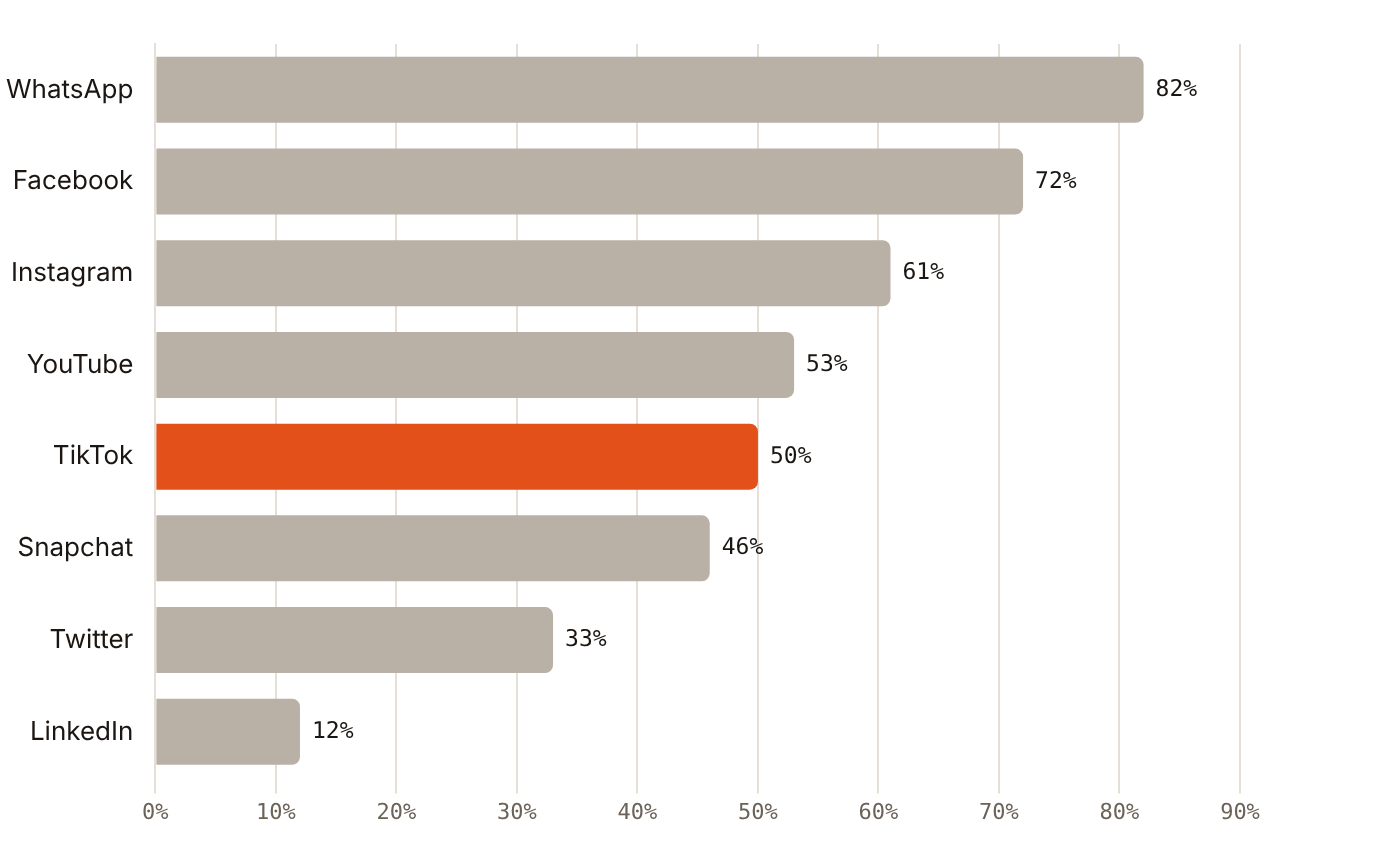
The most recent regional youth data in the notes are the 2022 Arab Youth Survey, covering 18 to 24 year olds in 17 Arab states. Daily use was WhatsApp 82%, Facebook 72%, Instagram 61%, YouTube 53%, TikTok 50% (up from 21% in 2020), Snapchat 46%, Twitter 33% and LinkedIn 12%, and social media was the main news source for 65% (Arab News, 2022). These are regional, not UAE-only, figures and are four years old.
WhatsApp was used daily by 82% of young Arabs in 2022, and TikTok had risen to 50% from 21% in 2020
Daily use by platform, % of 18 to 24 year olds, 17 Arab states, 2022 (14th Arab Youth Survey). Older data; not UAE-only.
View chart data
| Label | Daily use (%) |
|---|---|
| 82 | |
| 72 | |
| 61 | |
| YouTube | 53 |
| TikTok | 50 |
| Snapchat | 46 |
| 33 | |
| 12 |
Snapchat's own claims about Gulf youth are older still. In 2021 a Snap executive told Gulf News that Snapchat reaches more than 60% of 13 to 24 year olds in the UAE and about 90% of 13 to 24 year olds in Saudi Arabia (Gulf News). An undated Arabian Business report gives 60% of UAE 13 to 24s and 90% of Saudi 13 to 34s, with 67 million monthly users across the Middle East. The two reports conflict on the Saudi age band (13 to 24 against 13 to 34). By June 2024 The National reported at least 75 million Middle East users, GCC users opening the app 45 times a day on average, and (from 2021 Kantar work for Snap) 71% of Saudi parents using Snapchat (The National). There is no equivalent published figure for UAE parents.
The UAE also introduced rules on children's access to social media in June 2026: a minimum age of 15 for personal accounts, enhanced protections for 15 to under 16 year olds, and a transition of up to 12 months for platforms. The initial scope is X, Facebook, Instagram, Snapchat and TikTok (Ministry of Family, 2026). Teen reach claims from 2021 therefore describe an audience that providers should not be targeting directly in any case.
What it means for marketersSnapchat's strongest claims are about teenagers, who are not the decision makers for most segments in this book and are now subject to age rules. For tutoring and university recruitment the audience to reach on Snapchat is the parent, and the only parent figure available is from Saudi Arabia.
Who decides, and where they look
Education purchases in this book have four kinds of decision maker. Students choose for themselves in higher education, language testing and most certification. Parents choose nurseries and, largely, tutoring. Working professionals choose and often fund their own upskilling. Employers buy corporate and compliance training for staff. No UAE source reports platform use by these four groups, so the evidence below is assembled from demographic and international studies, with the geography stated each time.
Students and prospective international students
For prospective graduate students in the US, Ruffalo Noel Levitz (RNL) found that 84% rate search engines as their most important source of information and 71% began with a keyword search. 55% had seen graduate programme ads on social media, with Facebook (56%) and YouTube (55%) the most cited platforms, and 37% had used AI in their programme search. IDP's Emerging Futures 8 survey of 7,922 prospective international students in 134 countries found that over half rely on university websites and over a third rank counsellors among their most trusted sources. 85% consider more than one destination (Insider Guides; ICEF Monitor).
For the UAE as a destination, the source market matters more than platform statistics. India supplied 43% of Dubai's international higher education students in AY 2024-25, followed by Russia (6%), Pakistan (6%), China (4%) and Kazakhstan (3%) (Gulf News citing KHDA). Keystone Education Group reported that search interest in UAE study rose nearly 90% in June 2025 against June 2024, that the UAE accounted for 59% of all MENA study-destination searches on its platforms, and that India is "by far" the biggest audience for UAE study. Studyportals reports the UAE as its top MENA destination for five years. A recruitment marketer for a Dubai university is therefore planning for Indian search and social behaviour as much as for UAE behaviour.
Demand from these markets fell after the regional conflict began. Studyportals reported GCC study demand down 43% from its late-December 2025 peak and down 30% since early February 2026, and one recruitment platform said one-third of its Gulf-bound applicants asked about deferral, an alternate intake or another destination (The PIE News; ICEF Monitor).
Agents and fairs remain channels in their own right. 75% of US institutions worked with education agents in 2024 and about half of UK institutions' international students were placed by an agent (ICEF Monitor; The PIE News, 2021); L.E.K. found 65% of Chinese students used agents or pathway providers (L.E.K. Consulting, 2008 to 2018). No UAE agent share is published. IDP's September 2025 Study Abroad Expo brought 105 institutions to Abu Dhabi and 120 to Dubai (Gulf News GN Focus).
Parents
Parents choose nurseries and most tutoring. In a 2020 survey of more than 1,000 families at 14 Dubai schools, RS Academics found personal recommendation was the single most influential source, with KHDA ratings and school visits used to confirm rather than to drive the choice. The survey is about K-12 schools and is now six years old, but it is the only Dubai evidence on how families choose. For nurseries the confirming signal is weaker, because KHDA's Quality Framework for Early Childhood Care and Education, launched in November 2025, is described as a "first step" and does not publish ratings for centres.
On platforms, the female ad audience shares above are the best guide: Snapchat and Instagram have the highest share of women (DataReportal, late 2025). The Saudi figure of 71% of parents using Snapchat is regional and from 2021 (The National).
Working professionals
People aged 25 to 34 (28.7%) and 35 to 44 (23.8%) form the largest age groups in the UAE, and LinkedIn's 10.0 million registered members equal 87.6% of the population (DataReportal / Kepios, end 2025; DataReportal, late 2025). This is a members figure, not active users, and it includes people who have left the country. For professional programmes, the Meta "Career and Employment" category is the closest benchmark proxy: it had a lead campaign CPL of USD 12.30 in the 2026 US-based dataset (see Chapter 14) (LocaliQ). In the GMAC Prospective Students Survey, Central and South Asian candidates planning to apply to Middle East business programmes rose from 2% to 9% during 2025, and career outcomes and ROI became the top research priority for full-time MBA candidates while interest in rankings declined (Poets&Quants, 2026).
Employers
Employers buy corporate, compliance and safety training. LinkedIn's member base is the main paid route to HR and line managers, and its Lead Gen Forms are the format with published education evidence (DataReportal, late 2025). LinkedIn's SDA Bocconi case study reports cost per lead 40% below target after moving from a website form to Lead Gen Forms. No UAE or MENA education case study on LinkedIn was found.
| Decision maker | Evidence on research behaviour | Geography and period | Grade | Source |
|---|---|---|---|---|
| Graduate students | 84% say search engines most important; 55% saw programme ads on social media; 37% used AI | US, 2025, n=1,390 | [Industry] | Ruffalo Noel Levitz |
| Prospective international students | Over half rely on university websites; over a third trust counsellors; 54% plan to use AI to choose a university | Global, 2025, 7,922 students | [Industry] | Insider Guides; ICEF Monitor |
| Indian study-abroad students | About 75% use AI tools to choose programmes; cost the top factor for 75% | India, 2020 to 2025 | [Industry] | Careers360 |
| US high-school students | Most trusted: in-person events 34%, online resources 30%, school resources 26%, AI chatbots 3% | US, 2025, 20,000+ | [Industry] | ICEF Monitor |
| Dubai families (K-12) | Personal recommendation most influential; KHDA ratings confirm | Dubai, Sept 2020, 1,000+ families | [Industry] | RS Academics |
| Professionals (business school) | Middle East application intent among Central and South Asian candidates 2% to 9%; ROI top research priority | Global, 2025 | [Industry] | Poets&Quants |
| Employers | No UAE study found; LinkedIn Lead Gen Form case only | Undated, market not stated | [Platform] | LinkedIn Marketing Solutions |
WhatsApp as the reply channel
A YouGov survey of 1,000 UAE residents for Zbooni, published in February 2024, found that 85% want businesses to offer WhatsApp support, 88% say WhatsApp is the easiest channel for quick, accurate responses and 84% say it is more helpful than email. 65% had used WhatsApp to contact a business in the past year, compared with 55% for call centres, 48% for email and under 30% for social media inboxes. 87% prefer a real person to a chatbot (Communicate Online). In the 2022 Arab Youth Survey, WhatsApp was the most-used daily platform among 18 to 24 year olds at 82% (Arab News).
The preference for a human reply matters for lead handling. In US research, graduate prospects want a fast and personal answer: 37% expect an immediate reply and 49% a personalised reply within 24 hours, and RNL reports that over 60% of graduate students are likely to enrol with the programme that responds first (Ruffalo Noel Levitz, 2025; Ruffalo Noel Levitz). More than half of US high-school students react negatively to messages they believe are written by AI (EAB, 2025).
WhatsApp outreach is subject to UAE marketing rules. The federal telemarketing framework requires prior approval, company-registered local numbers, Do Not Call Register controls, disclosure of identity and purpose, call recording notice and a 09:00 to 18:00 window for marketing calls (Ministry of Economy and Tourism, 2024). TDRA describes prior consent for marketing messages, and the federal personal data framework sets consent obligations with exceptions. None of these sources says that SMS, email, calls and WhatsApp share identical permission rules, so each channel needs its own consent check.
What it means for marketersA WhatsApp reply option on every course page and ad is close to an expectation in the UAE. The survey also says residents want a person on the other end, which limits how far automation can replace admissions staff.
Reviews and directories
The only large review survey in the notes is from the US. BrightLocal's 2025 survey of 1,026 adults found 96% read online reviews at least occasionally, Google was used by 81% for reviews in 2024 (87% in 2023), and 42% trust reviews as much as personal recommendations, down from 79% in 2020. The fall in trust suggests that reviews now sit alongside word of mouth rather than replacing it, which fits the Dubai school-choice finding that personal recommendation leads (RS Academics, 2020).
Google's Maps content policy forbids incentivised reviews, selective solicitation of positive reviews, and pressure for prescribed review content. An enrolment referral offer therefore must not be made conditional on a review.
UAE education directories hold part of the review traffic. Edarabia, launched in 2005 and describing itself as the "Middle East's #1 Education Guide", reports more than 70,000 newsletter subscribers but publishes no visitor figures. It lists 199 Dubai nurseries with parent-review-based ratings; sampled listings carry 6 to 10 reviews each (Edarabia, 2026). With so few reviews per listing, a small number of new reviews can move a nursery's rating. No WhichSchoolAdvisor nursery data was retrieved.
| Review or trust signal | Finding | Geography and period | Grade | Source |
|---|---|---|---|---|
| Online reviews read | 96% read at least occasionally | US, 2025 | [Industry] | BrightLocal |
| Google as review platform | 81% (2024), 87% (2023) | US | [Industry] | BrightLocal |
| Reviews trusted as much as personal recommendations | 42% (79% in 2020) | US | [Industry] | BrightLocal |
| Most influential school-choice source | Personal recommendation | Dubai, K-12, 2020 | [Industry] | RS Academics |
| Nursery ratings by regulator | Not published; ECCE framework is a "first step" | Dubai, Nov 2025 | [Official] | KHDA |
| Directory listings | 199 Dubai nurseries; 6 to 10 reviews per sampled listing | Dubai, 2026 | [Platform] | Edarabia |
AI assistants in course research
Several 2025 and 2026 surveys measure how students use AI tools such as ChatGPT when choosing courses. They ask different questions of different populations, so they indicate a trend rather than a single rate.
IDP Emerging Futures 8 (global, 7,922 students, 134 countries, fielded July to August 2025): 54% plan to use AI tools to choose a university, up from 35% in August 2024, and 53% to select a course, up from 38%. 63% of Chinese respondents would use AI to choose an institution (Insider Guides; ICEF Monitor). The UAE was not in IDP's top five destinations (The Koala News, 2025).
Keystone Education Group (more than 1,700 prospective students, August 2025): 67% use AI at least monthly for study research, but only 36% rate the information very or extremely trustworthy.
INTO University Partnerships (1,622 enrolled international students in the US and UK, September 2025): 17% used AI in their initial search; 96% of AI users rated it as good as or better than traditional sources; among students from the Middle East and Africa, 54% found AI "much more helpful" (ICEF Monitor).
EAB (US, 5,000+ high-school students, October to November 2025): 46% use AI tools in college search, up from 26% in spring 2025, and 18% removed a college from consideration based on AI-generated results. 43% say AI will influence the career they pursue and 39% say AI is pushing them to consider alternatives to college (EAB; eSchool News). In a separate EAB study, AI chatbots were the least trusted of 11 information sources, at 3% (ICEF Monitor, 2025).
OHO Interactive (US-based agency; nationwide online survey of about 530 students, published 3 Apr 2025; the page gives the age range as both 17 to 22 and 17 to 24 and does not name the country): 60% used chatbots, 30% use them to research schools, 60% to compare institutions and 8% said chatbots were a major factor in their decision; 77% use ChatGPT and 31% Gemini.
RNL graduate study (US, 2025): 37% used AI in programme search and 73% of those found it accurate (Ruffalo Noel Levitz).
Leap Scholar (India, application and survey data 2020 to 2025): about 75% of Indian students use AI tools to choose study-abroad programmes, interest in the UAE as a destination rose 5,400% (against 7% in previous years), and cost is the top factor for 75% (Careers360).
QS GenAI Pulse Survey (late 2023, 1,663 respondents): over a third said generative AI influenced their choice of course, university or career (QS). Tyton Partners found 42% of US students use GenAI weekly.
Planned AI use in choosing a university rose from 35% to 54% in a year in IDP's global survey
% of respondents. IDP: global prospective international students, Aug 2024 vs Jul to Aug 2025. EAB: US high-school students, spring 2025 vs Oct to Nov 2025. Different questions and populations.
View chart data
| Label | Earlier wave (%) | Later wave (%) |
|---|---|---|
| IDP: AI to choose institution (global) | 35 | 54 |
| IDP: AI to choose course (global) | 38 | 53 |
| EAB: AI in college search (US) | 26 | 46 |
The UAE's own search data show that AI tools are already part of everyday behaviour. In Google's Year in Search 2025 for the UAE, the top trending technology platforms were Gemini (first), DeepSeek (second) and ChatGPT (third), with Google AI Studio fifth; no education or course queries appeared in the reported lists (Gulf News).
The surveys also show a gap between use and trust. Keystone's 67% monthly use sits beside 36% high trust, and EAB's US high-school students rank chatbots last for trust. Students use AI to build a shortlist and then check it against institution websites and counsellors, which IDP also reports (Insider Guides). The consequence for providers is covered in Chapter 13: the information AI tools draw on needs to be accurate, current and published on the institution's own pages.
What it means for marketersThe EAB finding that 18% of US students dropped a college because of AI-generated results is the commercial risk (EAB, 2025). If an AI answer gives an old fee, a wrong accreditation status or a closed intake, the provider can be excluded before any enquiry is made.
Influencers and the Advertiser Permit
The UAE Media Council announced the Advertiser Permit on 30 July 2025, effective three months later (the end of October 2025). It is mandatory for individuals creating paid or unpaid promotional content on social media, with exemptions for people promoting their own business, and is free for the first three years. Individuals promoting their own product or service, or a company they own, through a personal account are exempt, as are under-18s taking part in educational, cultural, athletic or awareness activities. Companies are told to engage only licensed advertisers, and the permit number must be shown on the account (The National). A Visitor Advertiser Permit lasts three months with one renewal and is obtained through a council-approved licensed agency (Gulf Business; National Media Authority, 2026).
The permit sits under the UAE Media Law in force since 29 May 2025. Operating without a licence carries a fine of AED 10,000 (AED 40,000 for a repeat); advertising content that breaches media standards can be fined up to AED 1 million (AED 2 million for a repeat within a year); and false information carries AED 5,000. Ads must respect UAE culture, follow Media Council age ratings and uphold child protection (Gulf News). Media activities that need a Media Council licence include "social media advertising by individuals" (Khaleej Times).
| Rule | Detail | Penalty or fee | Grade | Source |
|---|---|---|---|---|
| Advertiser Permit | Required for paid or unpaid promotional social content; effective end Oct 2025 | Free for first three years | [Official] | The National; National Media Authority |
| Exemptions | Own product or owned company via personal account; under-18s in educational, cultural, athletic or awareness activities | Not applicable | [Official] | The National |
| Visitor Advertiser Permit | Three months, one renewal, via licensed agency | Not stated | [Official] | Gulf Business |
| Operating without licence | Media Law, from 29 May 2025 | AED 10,000 (repeat AED 40,000) | [Official] | Gulf News |
| Advertising content breaching standards | Culture, age ratings, child protection | Up to AED 1m (AED 2m repeat within a year) | [Official] | Gulf News |
| False information | Media Law | AED 5,000 | [Official] | Gulf News |
For education providers the rules work out as follows. A private tutor promoting their own service from a personal account is exempt from the permit, although private tutoring has its own MOHRE permit route. A paid or gifted creator promoting a tutoring centre, nursery or training institute needs a permit, and the institution should only engage licensed advertisers (The National). Content about children must respect Media Council age ratings and child protection standards (Gulf News). Separately, KHDA operates approval services for advertising by Dubai training institutes, higher education providers and early childhood centres, so a creator post for a Dubai provider may need both a licensed creator and KHDA approval of the material.
TikTok's published education cases show the scale influencer-style content can reach. TikTok lists Educatly (an Egypt-founded study-abroad platform) at 15,000+ leads, Stepful cutting cost per action by 40%+ with 85,500 lead form submissions, Haufe Akademie reaching 1.8 million users, and 24.4 million+ #EduTok posts as of March 2024. Cygnus Education reports 488 new students for an online university, a 48% lower cost per start and a 62% higher lead-to-start ratio than other platforms (TikTok for Business). Neither case states a UAE market. The oldest UAE example is Canadian University Dubai, which in 2015 became the first UAE university to adopt Snapchat and reported enquiries from as far as Africa (CUD).
What it means for marketersBefore any creator campaign, check the creator's permit number, keep it on file with the brief, and route the content through the relevant KHDA or other regulator approval where one applies.
Emirate view
None of the platform, review or AI sources in this chapter reports separate figures for Dubai, Abu Dhabi, Sharjah or the Other markets (Ajman, Ras Al Khaimah, Fujairah, Umm Al Quwain). The evidence that does vary by emirate is about the supply side and the regulator:
Dubai: the international student base is measured (35% international, India 43% of international students) (KHDA and Dubai Media Office, 2025; Gulf News citing KHDA, 2024); KHDA runs advertising approval services for training institutes, higher education and early childhood; Edarabia lists 199 Dubai nurseries with reviews.
Abu Dhabi: ranked 72nd in QS Best Student Cities 2027, up 8 places, the highest UAE city (Khaleej Times). No platform or review data specific to the emirate was found.
Sharjah: ranked 80th in QS Best Student Cities 2027 (Khaleej Times). The University of Sharjah had the second most-visited UAE education website in August 2026 on Semrush estimates (350.5k visits; live page, as at October 2026).
Other markets: Ajman University had 296.0k monthly visits on the same Semrush estimates. No platform data for Ras Al Khaimah, Fujairah or Umm Al Quwain was found.
Platform priority by segment
ONS reading
The table below is ONS judgement, not measured data. It combines who decides in each segment with the platform evidence above: working-age adults dominate the population, LinkedIn reaches 10.0 million members, women's ad share is highest on Snapchat and Instagram, WhatsApp is the preferred contact channel and AI tools are entering course research. "Primary" means the channel should carry most of the effort; "Support" means a defined secondary job; "Test" means run a limited, measured trial before committing budget (DataReportal / Kepios, end 2025; DataReportal, late 2025).
| Segment | Main decision maker | Google Search | Meta (Instagram, Facebook) | TikTok | Snapchat | YouTube | Reviews and AI answers | ||
|---|---|---|---|---|---|---|---|---|---|
| Professional certification | Professional (self-funded or sponsored) | Primary | Support | Test | Low | Primary | Support | Primary reply channel | Support |
| IT, AI and technology training | Professional, career changer | Primary | Primary | Test | Low | Support | Support | Primary reply channel | Support |
| Healthcare and medical training | Licensed professional, employer | Primary | Support | Low | Low | Support | Low | Primary reply channel | Primary (AI answers) |
| Language and exam preparation | Student or professional | Primary | Primary | Support | Test | Low | Support | Primary reply channel | Support |
| Corporate and safety training | Employer (HR, HSE, procurement) | Primary | Low | Low | Low | Primary | Low | Support | Support |
| Universities and colleges | Student, parent, source-market agent | Primary | Primary | Support | Support (parents) | Support (postgraduate) | Primary | Primary reply channel | Primary (AI answers) |
| Nurseries and preschools | Parent, mostly mother | Primary (local) | Primary | Test | Support | Low | Low | Primary reply channel | Primary (reviews) |
| Tutoring and academic coaching | Parent; older students | Primary | Primary | Support | Support (parents) | Low | Support | Primary reply channel | Primary (reviews) |
The table assumes adult targeting throughout. For nurseries, tutoring and undergraduate recruitment, the June 2026 children's social media rules mean the parent, not the child, is the audience (Ministry of Family).
ONS reading
The strongest UAE-specific evidence in this chapter is not about any one ad platform. It is the WhatsApp preference and the weak trust in AI and reviews compared with personal recommendation (Communicate Online; BrightLocal). Together they suggest that the UAE education journey often ends in a personal conversation, whichever platform started it. Providers that spend on reach and then answer slowly, or only by email, lose the benefit of reaching those prospective learners.
The rise in AI-assisted research among Indian students is directly relevant to Dubai, given India's 43% share of international students (Careers360, 2020 to 2025; Gulf News citing KHDA, 2024). ONS would treat AI answer accuracy for fees, recognition and intakes as a recruitment task for UAE universities in 2027, not as a technical SEO add-on.
Gaps in the evidence
No public data. No source breaks UAE platform use down by Dubai, Abu Dhabi, Sharjah or the Other markets, or by students, parents, professionals and employers. DataReportal reports at country level only. Future editions should seek GWI or Meta Audience Insights cuts by emirate and parental status, and the Arab Youth Survey 2024 and 2025 platform data, which were not retrieved (the latest in the notes is 2022) (Arab News).
No public data. No UAE survey measures AI assistant use in course research. All AI figures in this chapter are global, US or Indian. Future editions should look for a UAE cut of IDP Emerging Futures, the QS International Student Survey and any KHDA or MoHESR applicant survey.
No public data. No data was found on Google review influence on UAE nursery choice, or on WhichSchoolAdvisor nursery listings. The Dubai school-choice survey is from 2020 and covers K-12 (RS Academics). Future editions should commission or source a nursery-parent survey.
No public data. The Media Council's primary permit pages did not render; permit details come from press reports and an indexed authority page (The National; Gulf Business). The fee after the first three years is not published. No Snapchat parent figure for the UAE exists in the notes; the 71% parent figure is Saudi and from 2021 (The National).
Sources & credits
Arab News, "A key trend in latest Arab Youth Survey...", 22 Sep 2022 (OLDER). arabnews.com
Arabian Business, "How Snapchat is proving as popular as ever in the Middle East", Undated (OLDER). arabianbusiness.com
BrightLocal, "Local Consumer Review Survey 2025", 29 Jan 2025. brightlocal.com
Campaign Middle East, "Outliers report: TikTok tops UAE social media landscape with 15.5M reach", 18 Feb 2026. campaignme.com
Careers360, "75% Indian students use AI to make study-abroad choices", 20 Dec 2025. news.careers360.com
Communicate Online, "85 percent of UAE residents want businesses to use WhatsApp", 12 Feb 2024. communicateonline.me
CUD, "CUD Leads the Way in Social Engagement", 8 Dec 2015 (OLDER). cud.ac.ae
DataReportal, "Digital 2026: UAE", 5 Nov 2025. datareportal.com
EAB, "AI in college search survey press release", 25 Feb 2026. eab.com
Edarabia, "About Edarabia", Accessed Oct 2026. edarabia.com
Edarabia, "List of Best Nurseries in Dubai, 2026 Fees", Accessed Oct 2026. edarabia.com
eSchool News, "Nearly half of high school students now use AI in college search", 3 Mar 2026. eschoolnews.com
Google Maps content policies, "Reviews and fake engagement", Current policy accessed 26 Oct 2026. support.google.com
GSRA, "As Iran retaliates across the Middle East, schools close, students worry and institutions reassess TNE", 20 Mar 2026. gsra.org.uk
Gulf Business, 30 Jul 2025. gulfbusiness.com
Gulf News citing KHDA, "Indian students top Dubai's global intake at 43%; Pakistanis at 6%", 8 Jul 2025 (updated). gulfnews.com
Gulf News GN Focus, "IDP Study Abroad Expo connects UAE students with 120 global universities", 16 Sep 2025. gulfnews.com
Gulf News, "Up to Dh1 million penalties for violating UAE new media law", 2025. gulfnews.com
Gulf News, "With Gulf's Snapchatters... Hussein Freijeh", 23 Jul 2021 (OLDER). gulfnews.com
ICEF Monitor, "agents and US institutions survey", 10 Jul 2025. monitor.icef.com
ICEF Monitor, "conflict and Gulf education article", 12 Mar 2026. monitor.icef.com
ICEF Monitor, "Growing use of AI for study abroad decisions highlights importance of multi-channel marketing strategies", 16 Oct 2025. monitor.icef.com
ICEF Monitor, "The ChatGPT generation: how AI is quietly rewriting the global student search experience", 8 Jan 2026. monitor.icef.com
Insider Guides, "New research shows how ChatGPT is choosing your next university", 15 Oct 2025. insiderguides.com.au
Keystone Education Group, "Students turn to UAE: international study interest soars 90% in June 2025", 21 Aug 2025. keg.com
Khaleej Times, "Media activities needing licence under new law", 9 Jun 2025. khaleejtimes.com
Khaleej Times, "UAE climbs global student city rankings as Abu Dhabi records biggest rise", 21 Jul 2026. khaleejtimes.com
KHDA and Dubai Media Office, "Dubai private higher education landscape", 19 May 2025; AY 2024-25. mediaoffice.ae
KHDA, "Quality Framework for ECCE", 14 Nov 2025. web.khda.gov.ae
KHDA, "Training institute advertising approval", Current indexed service accessed 26 Oct 2026. web.khda.gov.ae
L.E.K. Consulting, "TNE students UAE PDF", 2019. lek.com
LinkedIn Marketing Solutions, "SDA Bocconi customer story", Undated. business.linkedin.com
LocaliQ, "Facebook advertising benchmarks", Updated 23 Sep 2026. localiq.com
Ministry of Economy and Tourism, "Telemarketing rules briefing", 29 Aug 2024; accessed 26 Oct 2026. moet.gov.ae
Ministry of Family, "Children and social media resolution briefing", 19 Jun 2026; accessed 26 Oct 2026. alusra.gov.ae
MOHRE, "Private tutor licensing service", Current indexed service accessed 26 Oct 2026. mohre.gov.ae
National Media Authority, "Advertiser permit", Current indexed page accessed 26 Oct 2026. nmo.gov.ae
OHO Interactive, "The Influence of AI Chatbots in the College Search Process", 3 Apr 2025. oho.com
Poets&Quants, "GMAC's bluntest survey yet", 24 Mar 2026. poetsandquants.com
QS, "Generative AI influencing student decision-making", 2 Jul 2024 (OLDER fieldwork). qs.com
RS Academics, "How and why families choose schools in Dubai", 28 Jan 2021 (OLDER, K-12). rsacademics.com
Ruffalo Noel Levitz, "2025 Graduate Student Recruitment Report", 2025. learn.ruffalonl.com
Ruffalo Noel Levitz, "Lead to enrollment and the importance of speed to lead for graduate and online students", Jul 2025. ruffalonl.com
Semrush, "Top Education Websites in the UAE", Aug 2026 data. semrush.com
Studyportals, "Exploring international education in the MENA region: growth markets and regional trends", 17 Feb 2025. studyportals.com
TDRA, "Marketing SMS", Current indexed page accessed 26 Oct 2026. tdra.gov.ae
The Koala News, "AI enters the chat: Emerging Futures reveals global students turn to technology", 15 Oct 2025. thekoalanews.com
The National, "Can Snapchat's Middle East momentum continue?", 19 Jun 2024. thenationalnews.com
The National, "UAE launches advertiser permit...", 30 Jul 2025. thenationalnews.com
The PIE News, "Boom in agent commission paid by UK universities in 2021/22", 5 Aug 2022. thepienews.com
The PIE News, "Gulf study interest falls 30% as conflict reshapes student demand", 24 Mar 2026. thepienews.com
The PIE News, "UAE leads MENA surge as international study interest soars by 90%", 15 Aug 2025. thepienews.com
TikTok for Business, "Cygnus Education success story", Undated. ads.tiktok.com
TikTok for Business, "Education industry page, Arabic", Accessed Oct 2026. ads.tiktok.com
Tyton Partners, "Time for Class 2025", 11 Jun 2025. tytonpartners.com
UAE Government portal, "Personal data protection laws", Portal evidence checked 26 Oct 2026 (data: protection laws). u.ae
PUT THE INSIGHT TO WORK
Your market.
Your next move.
Explore how ONS approaches education marketing.
Explore our expertise ↗