
In this chapter
This chapter asks what happens between the first search and the first collected fee: which content resolves the questions that delay enrolment, how reputation and reviews work for UAE providers, and how fast and through which channel an enquiry should be answered. The main finding concerns the enquiries lost at the response stage: in a US secret-shopper study 44% of higher education enquiries received no reply at all, while 85% of UAE residents say they want businesses to offer WhatsApp support (UPCEA, 2025; Communicate Online). No UAE education study of response speed or enquiry-to-enrolment conversion has been published, so this chapter pairs UAE channel evidence with US funnel benchmarks and labels each by geography.
In brief
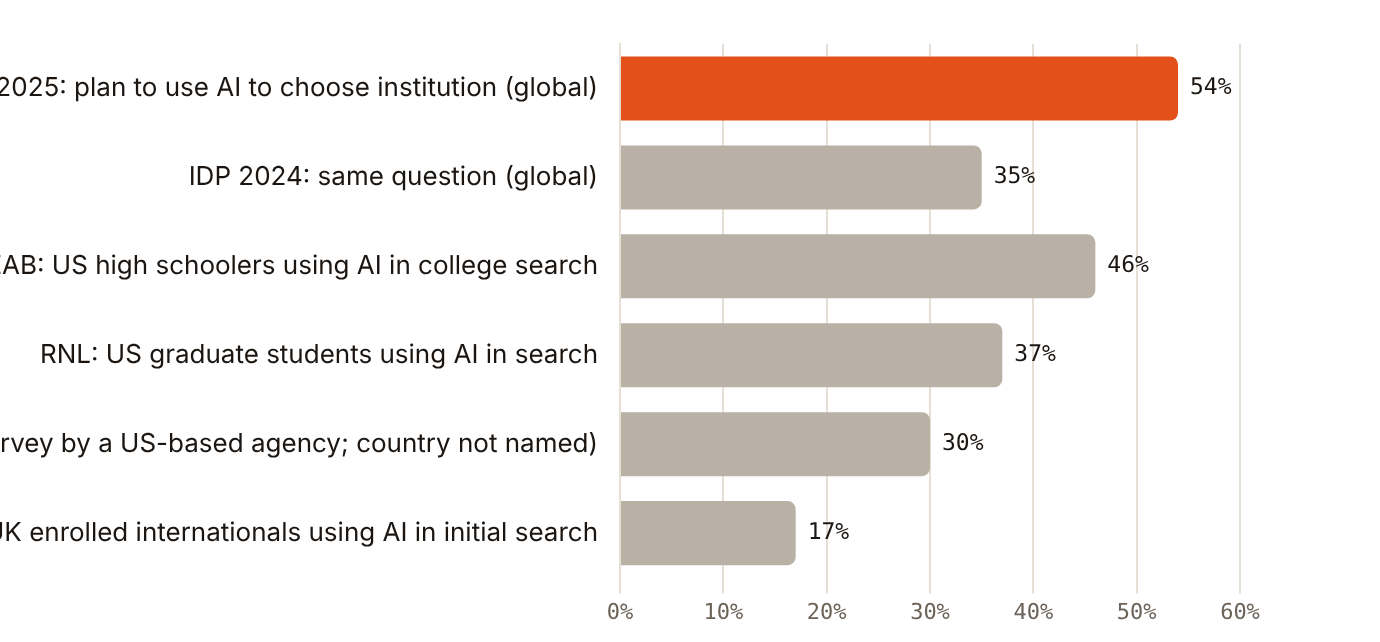
54% of prospective international students plan to use AI tools to choose a university, up from 35% a year earlier (IDP, global, 7,922 students) (ICEF Monitor; Insider Guides). Over half still rely on university websites (Insider Guides).
84% of US graduate applicants name search engines as their most important source, and 55% saw programme ads on social media (RNL 2025, US) (Ruffalo Noel Levitz).
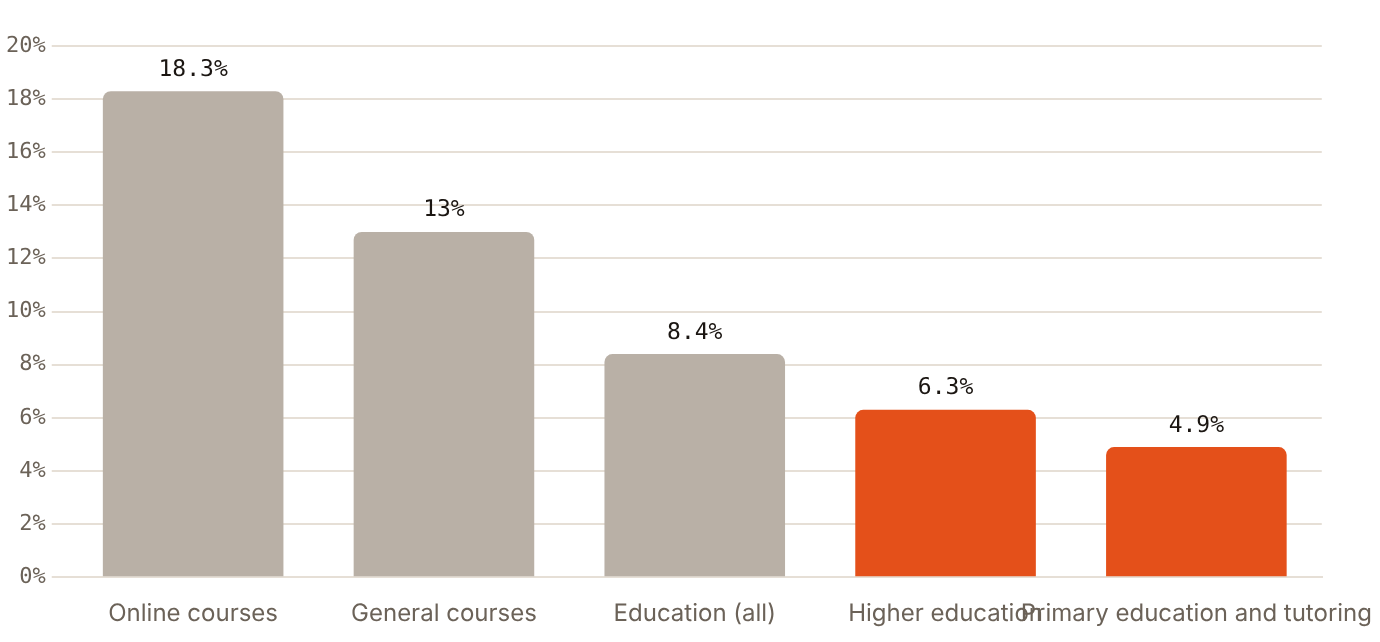
Unbounce's 2024 education sample attributes 85% of visits to mobile; median landing-page conversion was 8.4% for education overall, 6.3% for higher education and 4.9% for primary education and tutoring (platform sample, no UAE split).
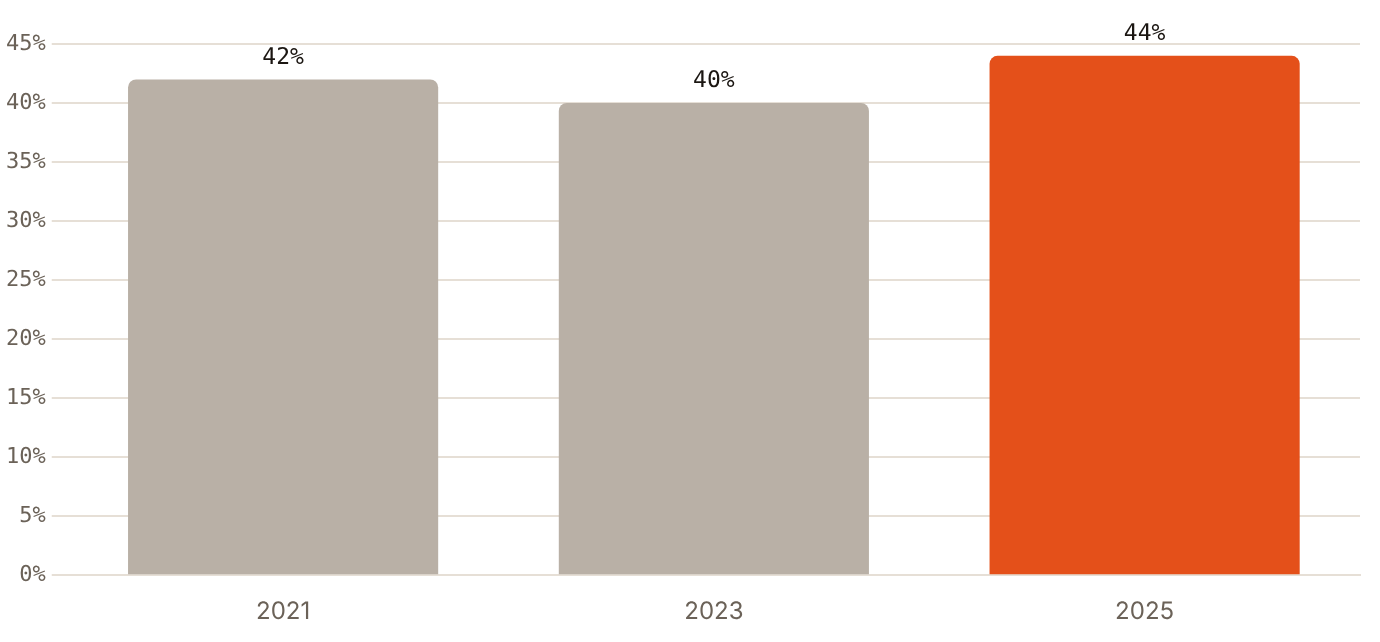
44% of US continuing and online higher education enquiries got no reply in 2025, and the average response took 14 hr 23 min, up from 7 hr 22 min in 2023 (UPCEA).
Firms that contacted a web lead within an hour were 7 times as likely to qualify it as those that waited longer (US, HBR 2011) (CrankWheel blog summarising HBR; authorship confirmed at BYU ScholarsArchive). RNL reports that over 60% of US graduate students are likely to enrol with the programme that responds first (Ruffalo Noel Levitz).
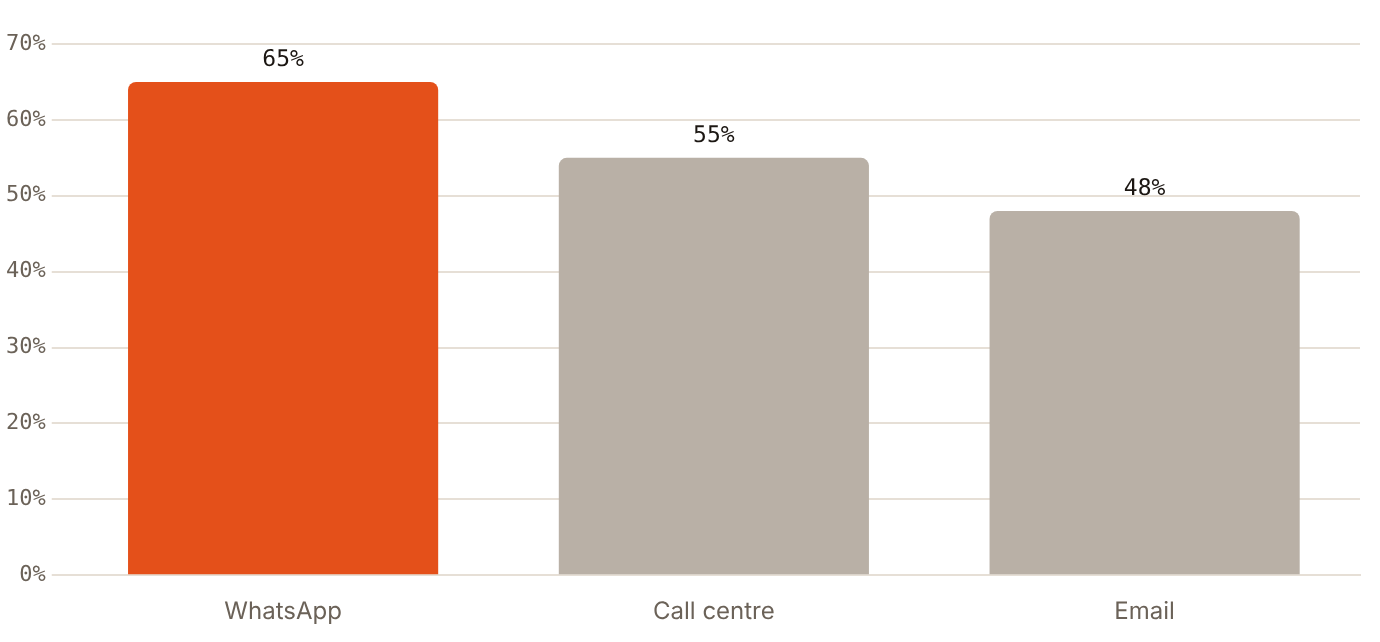
In the UAE, 65% of residents used WhatsApp to contact a business in the past year, against 48% for email, and 87% prefer a real person to a chatbot (YouGov for Zbooni, 1,000 people) (Communicate Online).
Google prohibits incentivised reviews and selective solicitation of positive reviews. KHDA's early childhood quality framework (Nov 2025) does not publish nursery ratings.
Mailchimp's Education and Training senders recorded a 35.64% open rate and a 3.02% click rate, against 2.62% for all users (data to Dec 2023, global platform).
US graduate funnel benchmarks: qualified enquiry to submitted application 45%, admit to register 80%, contact rate 60% (RNL) (Ruffalo Noel Levitz). No UAE equivalent exists.
| 44% US higher education enquiries with no reply US, 2025. UPCEA | 85% UAE residents who want businesses to offer WhatsApp support UAE, Feb 2024. Communicate Online | 7x Likelihood of qualifying a lead contacted within an hour US, HBR 2011. CrankWheel blog summarising HBR; authorship confirmed at BYU ScholarsArchive |
| 54% Prospective international students planning to use AI to choose a university Global, 2025. ICEF Monitor | 85% Share of education landing-page visits on mobile Unbounce sample, 2024. Unbounce |
Content should answer the questions that delay enrolment
Education content should remove the specific uncertainty that stops a suitable person from taking the next step: programme fit, teaching, attendance, total cost, recognition, and other learners' experience.
| Content theme | Example asset | What it resolves |
| Programme fit | Faculty explanation or course comparison | Whether the offer matches the goal |
| Teaching quality | Sample lesson or assessed project | What learning actually looks like |
| Practical attendance | Campus route, timetable and workload | Whether participation is feasible |
| Financial clarity | Fee explainer with inclusions | Total cost and payment uncertainty |
| Trust | Current recognition and staff credentials | Who delivers and who awards |
| Student or parent experience | Consented, specific story | How the journey works in practice |
Published research supports two of these themes directly. Keystone's 2025 platform data names subject availability and tuition fees as the two leading factors in student decisions on UAE study (The PIE News). The QS 2025 international student survey, with more than 70,000 responses in 191 locations, found 67% concerned about living costs and 62% rating a university money advice service as very or extremely important (QS). These are global prospective international students, not a UAE-resident sample (QS, 2025). Among US graduate candidates, career outcomes and return on investment rose to the top research priority for full-time MBA candidates while interest in rankings declined (GMAC, global) (Poets&Quants, 2026). For a UAE marketer, the implication is that fee clarity and programme specificity are content priorities, not compliance afterthoughts.
Where prospective students look
Search remains the main research channel in the data available. RNL's 2025 survey of 1,390 US graduate students found 84% rated search engines as their most important source and 71% began with a keyword search; 55% saw graduate programme ads on social media, with Facebook at 56% and YouTube at 55% of those (Ruffalo Noel Levitz). Across 200+ mainly US higher education websites, organic search generated 46% of users and 53% of engaged sessions, and non-branded keywords made up 87.09% of impressions (Carnegie, Jul 2023 to Jun 2024). In the UAE, the most-visited education category sites in Aug 2026 were moe.gov.ae (973k monthly visits), University of Sharjah (350.5k), Coursera (343.8k), Ajman University (296.0k) and UAE University (253.2k) (Semrush). These are Semrush tool estimates from a live page, read as at October 2026, not audited traffic.
AI assistants are now a second research layer. The surveys below ask different questions of different populations, so they should be read side by side rather than averaged.
Between 17% and 54% of prospective students use AI in course search, depending on the survey
Share of respondents using or planning to use AI tools in institution or programme search; different questions, populations and geographies; 2024 to 2025
View chart data
| Label | Share of respondents (%) |
|---|---|
| IDP 2025: plan to use AI to choose institution (global) | 54 |
| IDP 2024: same question (global) | 35 |
| EAB: US high schoolers using AI in college search | 46 |
| RNL: US graduate students using AI in search | 37 |
| OHO: students using chatbots to research schools (nationwide survey by a US-based agency; country not named) | 30 |
| INTO: US/UK enrolled internationals using AI in initial search | 17 |
The trust picture is mixed. Keystone's August 2025 survey of over 1,700 respondents found 67% use AI at least monthly for study research, but only 36% rate the information very or extremely trustworthy. EAB's 2025 survey of 20,000+ US students ranked AI chatbots last of 11 information sources at 3% for trust, behind in-person events (34%) and online resources such as college websites (30%) (ICEF Monitor). Yet 18% of US high schoolers in a separate EAB survey had removed a college from consideration based on AI-generated results, and more than half reacted negatively to messages they saw as AI-written (EAB, 2025). On the search side, AI Overviews cover a share of education and healthcare queries approaching 90% (BrightEdge, US-led), and position-one organic click-through rate is 58% lower when an AI Overview appears (Ahrefs, 300,000 keywords). Seer Interactive's data on informational queries shows that, in Q3 2025, brands cited in an AI Overview got 35% higher organic and 91% higher paid click-through rate; these are Seer's stated figures, and its page is not fully consistent on them. Google's own guidance says that SEO foundations remain relevant and that no special AI markup is required.
ONS reading We read the AI evidence as a reason to make institutional facts consistent and specific, not as a reason to produce more generic articles. An assistant that summarises a programme can only repeat what it finds; if the fee page, course page and directory listings disagree, the summary will be wrong or vague. Students also distrust content that reads as machine-written. The response is one accurate, plainly worded page per programme, approved by the people who teach it.
Make faculty participation manageable
Turn a subject specialist's approved answer to a real learner question into a course-page section, short video and adviser resource, without widening its scope: a possible career application is not a job guarantee (Chapter 17).
Use content at each stage of the decision
After an enquiry, send the asset that answers the unresolved question rather than a generic brochure bundle, and record whether it helped the applicant complete the next stage. The UPCEA 2025 secret-shopper study found 78% of request-for-information form enquiries received promotional materials, against 2% of enquiries sent by individual email (US). Material that arrives is not the same as material that answers the question asked.
Keep the local detail useful
A Dubai or Abu Dhabi label should add real information about delivery, location or the admissions route. For Sharjah and Other markets, explain the actual site and attendance options. Avoid decorative city references attached to otherwise identical content. Language level also differs by emirate: EF's 2025 English Proficiency Index scores Dubai at 513, Abu Dhabi at 481, Sharjah at 479, Ras Al Khaimah at 459 and Ajman at 454, against a UAE score of 487 (EF Education First). For language providers this is a demand signal; for every provider it is a reminder that plain English and Arabic versions matter outside Dubai.
Keep content and approvals up to date
Publish against the most frequent admissions questions, retire content when the course or rule changes, and keep the evidence and approval date with the asset; in Dubai, a KHDA advertising approval for a training institute is valid for 3 months, so the approval date is an operating field, not an archive note.
ONS reading Content priority in this chapter is an ONS recommendation. No content-production volume or enrolment uplift is guaranteed by this book. We would rank content work by how often a question appears in admissions conversations and how far it sits from the payment step, and we would stop producing an asset type when it no longer changes progression.
Trust requires evidence and a fair feedback process
Reviews, accreditation claims and outcome statements should help people decide without creating a misleading impression. State the exact institution, programme, provider or activity status and link to the relevant authority or awarding-body directory. A commercial licence, an educational permit, a qualification-body partnership and programme accreditation are distinct checks; Chapter 17 lists the regulators for each.
| Claim | Evidence to retain | Wording discipline | Rule or source |
|---|---|---|---|
| Graduate employment | Defined cohort, response rate and observation window | State who was counted and when | ONS recommendation |
| Exam success | Permitted claim and documented denominator | Respect awarding-body restrictions; CFA Institute forbids participating prep providers from reporting their own customer pass rates in response to the listed question | CFA Institute [Platform] |
| Pass guarantees | None can be retained | NEBOSH warns learners about guaranteed passes | NEBOSH [Platform] |
| Student satisfaction | Question, sample and survey date | Avoid presenting selected comments as a census | ONS recommendation |
| Ranking | Publisher, year, category and position | Do not imply all programmes share the ranking; for example QS Best Student Cities 2027 ranks cities (Abu Dhabi 72nd, Dubai 79th, Sharjah 80th), not institutions | Khaleej Times [Industry] |
| Regulator endorsement | Approval letter and scope | ADEK bans false claims of ADEK endorsement; DHA accreditation allows the DHA name only to state CPD hours | ADEK; DHA [Official] |
| Industry partnership | Current agreement and scope | Distinguish project access from job placement | ONS recommendation |
Reviews and ratings
Reviews matter in general consumer research, but the only large dataset is from the US. BrightLocal's 2025 survey of 1,026 US adults found 96% read online reviews at least occasionally, 81% used Google for reviews in 2024 (87% in 2023), and 42% trust reviews as much as personal recommendations, down from 79% in 2020. That last figure matters: trust in reviews is falling, so reviews confirm a choice more than they make it.
The Dubai evidence points the same way. A 2020 survey of more than 1,000 families at 14 Dubai schools found personal recommendation was the single most influential source in school choice, with KHDA ratings and visits used to confirm rather than drive the decision (RS Academics, K-12). That study predates this book by five years and covers schools, not the segments in scope, so it is context only. For nurseries, KHDA's Quality Framework for Early Childhood Care and Education, launched in Nov 2025, is described as a "first step" toward quality assurance and does not publish ratings for early childhood centres. Directory reviews fill part of the gap: Edarabia lists 199 Dubai nurseries with parent-review-based ratings, with sampled listings showing 6 to 10 reviews each.
For nurseries Without a KHDA nursery rating to point to, the visible signals are Google reviews, directory reviews and word of mouth. A nursery with a handful of directory reviews is judged on very few data points, which makes a steady, fair review request process more valuable than for a university with ranking and accreditation evidence (Edarabia, 2026).
Google's Maps content policy prohibits incentivised reviews, selective solicitation of positive reviews and pressure for prescribed review content. Invite honest feedback through a neutral process sent to every completing learner or family. An enrolment referral programme must not require a public rating (Google Maps content policies, 2026). Respond to concerns without revealing student records, payment history or a child's circumstances.
Testimonials and creators
Obtain permission for the actual use and channel, and for children prefer adult staff explanations and anonymised examples. Where a provider pays or gifts a creator, the UAE Media Council advertiser permit applies: companies are told to engage only licensed advertisers, and the permit number must be shown on the account (The National). Chapter 17 covers the permit dates, which sources report differently.
Reputation as an operating signal
Classify recurring feedback about scheduling, fees, communication and teaching, give each issue an operational owner, and report unresolved complaints and response times alongside the review trend. More positive content cannot repair a service problem.
A useful landing page reduces uncertainty before the form
The page should help a suitable person take the next step and help an unsuitable person see why the offer may not fit.
Offer and audience. What it must answer: Which programme, and for whom? Typical failure: Generic headline covers unrelated courses.
Delivery. What it must answer: Where, when and how will I study? Typical failure: Old batch date or missing teaching hours.
Eligibility. What it must answer: Can I take this course or programme? Typical failure: Prerequisites hidden until after payment.
Price. What it must answer: What is the fee basis and what is extra? Typical failure: Starting price lacks schedule or inclusions.
Evidence. What it must answer: Who teaches and what is recognised? Typical failure: Unclear accreditation badge.
Next step. What it must answer: What happens after I enquire? Typical failure: No response expectation or named process.
Published UAE fee pages show how much the fee basis varies. Middlesex University Dubai displays its daytime MBA at AED 84,872 inclusive of VAT; AURAK prices its MBA at AED 2,520 per credit for 30 credits, which is AED 75,600 tuition only; Abu Dhabi University lists international undergraduate tuition and states that 5% VAT applies. Without stated inclusions these cannot be compared. Chapter 17 covers the consumer protection rule that displayed prices must be final.
Mobile usability and conversion benchmarks
Unbounce's 2024 education sample attributes 85% of visits to mobile and reports device conversion medians of 10.2% on mobile and 12.0% on desktop. The full Unbounce benchmark covers more than 41,000 pages and 464 million visitors across all industries. In the UAE, an older agency summary of Google school-search data for Dubai and Abu Dhabi found mobile made up 58% of queries and 73% of ad clicks (Q2 2019, K-12), and 41% of UAE Coursera learners use mobile (Nexa, Q2 2018; Economy Middle East, 2025). These figures justify inspecting the real mobile journey: forms, fee tables, telephone and WhatsApp links, and appointment booking.
Landing-page conversion ranges from 4.9% for tutoring to 18.3% for online courses
Median landing-page conversion rate by education sub-category, Unbounce platform sample, 2024 edition; no UAE split
View chart data
| Label | Median conversion rate (%) |
|---|---|
| Online courses | 18.3 |
| General courses | 13.0 |
| Education (all) | 8.4 |
| Higher education | 6.3 |
| Primary education and tutoring | 4.9 |
The paid-media benchmarks sit in a similar range. LocaliQ's 2026 Education and Instruction search campaigns converted at 13.14%, and Meta Education lead campaigns at 15.87%. Both datasets are US or of unstated geography; the Google sample covers 1 Apr 2025 to 31 Mar 2026 and is described as United States in the ONS draft check, while the LocaliQ page itself does not state geography. Higher education and tutoring pages convert lower than short courses in the Unbounce sample, which fits a larger and slower decision. For a university, a lower form conversion rate is not by itself a problem; the test is whether the enquiries that arrive are suitable.
Forms and friction
Ask only for information needed to route the enquiry. UPCEA's 2025 review of US request-for-information forms found name required on 100%, email on 99%, programme on 61%, phone on 49%, start term on 43% and date of birth on 24%. Platform lead forms reduce friction further: a compilation of 2026 agency and vendor sources puts LinkedIn Lead Gen Form completion at 8% to 13%, against 2% to 4% on external landing pages (Web Tonic, Jan to Jul 2026). SDA Bocconi reported a cost per lead 40% below target after switching from a website form to LinkedIn Lead Gen Forms, but did not report enrolment conversion. Cygnus Education reported a 62% higher lead-to-start ratio and 48% lower cost per start on TikTok lead forms for an online university, market not stated.
Test one hypothesis at a time (visible fee basis, course-level page, bookable appointment) and judge it on downstream quality, not form conversion; Chapter 18 sets out a test sequence.
Speed to lead: response time benchmarks
The strongest published evidence on response speed is from the US. No UAE education response-time study was found (UPCEA, 2025; Ruffalo Noel Levitz). The benchmarks below are therefore directional, and each carries its geography.
| Benchmark | Value | Geography and period | Source |
|---|---|---|---|
| Enquiries with no reply, continuing and online higher education | 44% (40% in 2023, 42% in 2021) | US, 2025 | UPCEA [Industry] |
| Average response time | 14 hr 23 min (7 hr 22 min in 2023) | US, 2025 | UPCEA [Industry] |
| Median response time | 3 hr 18 min | US, 2025 | UPCEA [Industry] |
| No reply by enquiry route | RFI form 37%; individual email 62% | US, 2025 | UPCEA [Industry] |
| Contacted within an hour vs later | 7x as likely to qualify; 60x vs 24 hours+ | US, 1.25M leads, 42 companies, 2011 | CrankWheel blog summarising HBR; authorship confirmed at BYU ScholarsArchive [Industry] |
| Call within 5 minutes | 100x contact odds; 22x pipeline entry | US, sample not stated, older | CrankWheel blog citing Lead Response Management Study [Estimate] |
| Recommended first contact attempt | Within 60 minutes; contact rate benchmark 60% | US graduate and online | Ruffalo Noel Levitz [Industry] |
| Enrol with first programme to respond | Over 60% | US graduate | Ruffalo Noel Levitz [Industry] |
| Applicant expectation | 37% expect immediate reply; 49% a personalised reply within 24h | US graduate, 2025, n=1,390 | Ruffalo Noel Levitz [Industry] |
| Preferred first response channel | Personalised email 56%; phone 14%; text 13% | US graduate, 2025 | Ruffalo Noel Levitz [Industry] |
The share of US higher education enquiries left unanswered rose to 44% in 2025
Share of secret-shopper enquiries receiving no reply, UPCEA member institutions (continuing and online HE), US
View chart data
| Label | No reply (%) |
|---|---|
| 2021 | 42 |
| 2023 | 40 |
| 2025 | 44 |
The US problem is getting worse: the average response time roughly doubled between the 2023 and 2025 studies, from 7 hr 22 min to 14 hr 23 min (UPCEA). The route also matters: 62% of individual emails got no reply against 37% of form enquiries, which suggests that enquiries outside the main system are the ones most often lost (UPCEA, 2025). In the UAE the equivalent unmanaged route is likely to be a counsellor's personal WhatsApp or an Instagram direct message.
ONS reading We recommend a first human response within five minutes during staffed hours, on the channel the enquirer used, and a stated response time outside those hours. The evidence for this is US and global speed-to-lead research combined with UAE channel preference; it is not a UAE education study, and a provider should measure its own response-time curve before treating the target as proven. The cheapest improvement in most admissions teams is not more media; it is closing the gap between when an enquiry arrives and when a person answers it.
WhatsApp is the UAE's default business channel
The only UAE survey on business messaging found is a 2024 YouGov study of 1,000 UAE residents commissioned by Zbooni (Communicate Online). It found 85% want businesses to offer WhatsApp support, 88% say WhatsApp is the easiest channel for quick, accurate responses, and 84% say it is more helpful than email (Communicate Online). In the previous year, 65% had used WhatsApp to contact a business, against 55% for a call centre, 48% for email and under 30% for social media inboxes (Communicate Online). Among Arab youth aged 18 to 24, 82% used WhatsApp daily in 2022, more than any other platform (17 Arab states) (Arab News).
65% of UAE residents contacted a business on WhatsApp in a year, against 48% by email
Share of UAE residents who used each channel to contact a business in the past year; n=1,000; Feb 2024; social media inboxes (under 30%) not plotted as no exact value was published
View chart data
| Label | Used in past year (%) |
|---|---|
| 65 | |
| Call centre | 55 |
| 48 |
This UAE preference conflicts with the US graduate data, where 56% prefer a personalised email as the first response and 13% a text (Ruffalo Noel Levitz, 2025). The two surveys cover different populations and countries, so neither should be applied to the other. For UAE residents, WhatsApp is the expected channel; for international applicants from markets where email is the norm, the preference may differ, and a provider should let the enquirer choose.
The same YouGov study found 87% prefer a real person to a chatbot (Communicate Online). A chatbot can answer approved factual questions and arrange a handoff; it should not invent admissions decisions or eligibility advice. The rules for promotional messaging differ from those for answering a requested enquiry: TDRA describes prior consent for marketing SMS, and the Ministry of Economy's telemarketing briefing sets a 09:00 to 18:00 marketing-call window. No WhatsApp-specific UAE rule was found in the research for this book; Chapter 17 covers what is known.
For admissions teamsPut WhatsApp into the CRM, not beside it. A WhatsApp conversation held on a counsellor's own phone has no timestamp the manager can see, no handover when the counsellor is away, and no consent record. The UPCEA finding that individual emails were the route most often left unanswered is the risk this creates.
Email and CRM benchmarks
Email benchmarks for education are thin and dated. Mailchimp's Education and Training senders recorded an open rate of 35.64%, a click rate of 3.02% and an unsubscribe rate of 0.18%, against 35.63%, 2.62% and 0.22% for all users (global platform, data last updated Dec 2023). A 2025 HubSpot compilation gives an all-industry open rate of 42.35% (MailerLite), click-through rate of 2.3% (Campaign Monitor), click-to-open rate of 5.3% and unsubscribe rate of 0.22%, with no education row, and notes that Apple Mail Privacy Protection inflates opens. University senders on Campaign Monitor recorded an unsubscribe rate of 0.1% and a bounce rate near 0.6% in 2019 to 2020, mostly US.
| Email benchmark | Open | Click | Unsubscribe | Geography and period | Source |
|---|---|---|---|---|---|
| Mailchimp, Education and Training | 35.64% | 3.02% | 0.18% | Global platform, to Dec 2023 | Mailchimp [Platform] |
| Mailchimp, all users | 35.63% | 2.62% | 0.22% | Global platform, to Dec 2023 | Mailchimp [Platform] |
| HubSpot compilation, all industries | 42.35% | 2.3% | 0.22% | Global compilation, 2025 | HubSpot [Estimate] |
| Campaign Monitor, university senders | Chart only | Chart only | 0.1% | Mostly US, 2019 to 2020 | Campaign Monitor [Platform] |
Open rates are now an unreliable measure because of privacy features (HubSpot, 2025). A UAE provider should measure email by replies, booked appointments and stage progression instead. No UAE or GCC education email benchmark was found.
The CRM should track the full admissions process
The institution needs a reliable link from enquiry source to paid start and later outcome. Google documents enhanced conversions for leads, which use first-party data to supplement offline conversions, and recommends qualified or converted lead goals with diagnostics. That feature only works if the CRM records the stages.
| Record | Minimum useful fields | Reason |
| Person or guardian | Contact details, language, channel and permissions | Respond correctly and respect preferences |
| Opportunity | Programme, emirate and branch, intake and owner | Record the offer the enquirer is considering |
| Stage history | Date, stage and reason for change | Measure progression and delay |
| Source history | Campaign and landing page where available | Preserve acquisition context |
| Response log | Time of enquiry, time of first human reply, channel | Measure speed to lead |
| Finance outcome | Deposit, payment, refund, start and collected amount | Reconcile commercial value |
| Capacity | Places or delivery slots by offer | Avoid promoting places or courses that are unavailable |
One person can have several valid opportunities. Deduplicate accidental repeats without erasing a genuine second enquiry, link parents and corporate contacts to the right opportunity, keep an audit trail, and route by programme, language, emirate and service hours with a backup owner.
Distinguish responding to a requested enquiry from later promotional messaging. Record the contact purpose and channel permissions, give a simple way to stop future promotion, and make sure suppression reaches every system. A purchased list or a public professional profile is not permission for a campaign. Admissions documents and sensitive student information belong in a controlled system, with marketing receiving only the status or event it needs. A hashed email remains personal data; hashing does not create consent (Google Ads Help, 2026).
KPI definitions from enquiry to collected revenue
The definitions below are ONS recommendations for a common vocabulary between marketing, admissions and finance. The benchmark column shows the nearest published figure, almost all from the US; none is a UAE target.
| Stage | Definition | Rate to track | Nearest published benchmark | Source |
|---|---|---|---|---|
| Enquiry | A unique person or organisation asking about a named offer through any channel, after removing duplicates and spam | Response time; contact rate | US HE: 44% of enquiries unanswered; median first response 3 hr 18 min | UPCEA [Industry] |
| Qualified lead | An enquiry that has been contacted and meets the stated eligibility, budget, timing and location for an available offer | Qualified lead rate (qualified / valid enquiries) | US graduate: contact rate 60%; qualified enquiry to submitted application 45% | Ruffalo Noel Levitz [Industry] |
| Assessment | The segment's evaluation step: application review, placement or diagnostic test, interview, nursery tour, or B2B needs brief | Assessment completion rate | US graduate: submitted to completed application 70% | Ruffalo Noel Levitz [Industry] |
| Offer | A written admission, place or quotation the person can accept | Offer rate (offers / assessments) | US graduate admit rate 80% to 85%; US first-year application to admit 58% private, 67% public (2018) | Ruffalo Noel Levitz [Industry] |
| Deposit | Money received to secure the place, recorded with its refund terms | Deposit rate (deposits / offers) | Example terms: Heriot-Watt Dubai first instalment of 10% of first-year fee plus AED 1,000 refundable deposit; Amity Dubai security deposit AED 2,000 to 3,000 | Heriot-Watt University; Amity University Dubai [Official] |
| Start | The learner attends the first scheduled session or census date of the intake | Melt (deposits that do not start); lead to start | US graduate admit to register 80%; US first-year yield 25% private, 32% public (2018) | Ruffalo Noel Levitz [Industry] |
| Collected revenue | Fees actually received for the cohort, net of refunds and discounts, by intake | Collected revenue per start; media and fully loaded CAC | US median cost to recruit one undergraduate: USD 2,795 private four-year, USD 494 public four-year (2022); US graduate USD 3,500 to 5,000 (2023) | Ruffalo Noel Levitz; Inside Higher Ed [Industry] |
The US first-year data shows how much the stages differ by institution type. RNL's 2019 report on 89 four-year non-profits found a median enquiry-to-application rate of 14.0% at private and 37.0% at public institutions, with yield of 25% and 32% (Ruffalo Noel Levitz, 2018). For international applicants, enquiry-to-application was 31% private and 48.5% public, with yield of 17% and 36% (Ruffalo Noel Levitz, 2018). The data is from fall 2018 and US only (Ruffalo Noel Levitz).
US first-year funnel: private institutions convert 14.0% of enquiries to applications, public 37.0%
Median stage conversion, US four-year non-profit institutions, first-year students, fall 2018 (n=89)
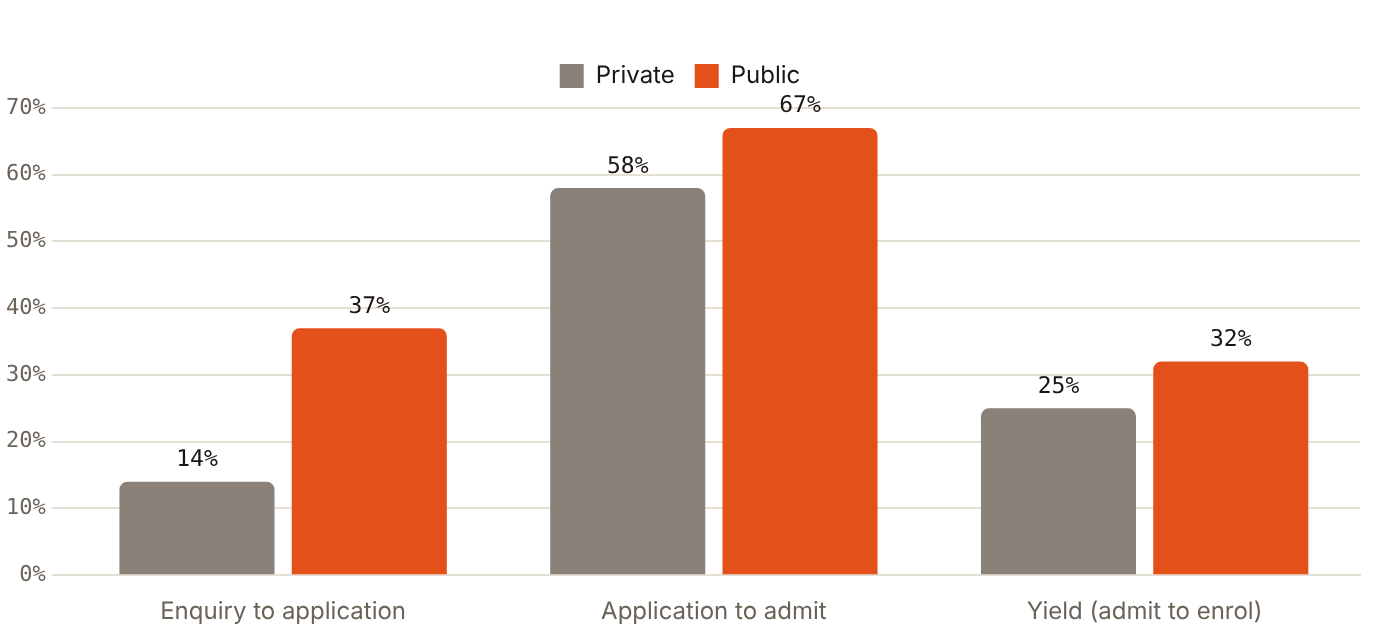
View chart data
| Label | Private (%) | Public (%) |
|---|---|---|
| Enquiry to application | 14.0 | 37.0 |
| Application to admit | 58 | 67 |
| Yield (admit to enrol) | 25 | 32 |
Costs are rising at the top of the funnel. Level Agency and LeadSquared report media costs up 15% to 20% across major platforms in 2024, with enquiry-to-enrolment rates slipping (US, agency data). The median US cost to recruit one private undergraduate rose from USD 2,114 in 2020 to USD 2,795 in 2022 (Ruffalo Noel Levitz). At the lead level, US Education and Instruction search campaigns averaged a CPL of USD 77.48 in 2026, against USD 90.02 in the 2025 edition, and Meta education lead campaigns USD 26.31 (LocaliQ; WordStream, 2024). A cheaper lead is only cheaper if it qualifies at a similar rate, which is why the qualified lead and start stages need definitions before any channel comparison.
Commercial metrics
Qualified lead rate. Definition: Qualified leads divided by valid enquiries. Interpretation: Offer and audience fit.
Cost per qualified lead. Definition: Media spend divided by qualified leads. Interpretation: Quality-adjusted acquisition cost.
Lead to paid start. Definition: Paid starts divided by valid originating enquiries. Interpretation: Full admissions progression.
Media CAC. Definition: Media spend divided by paid starts. Interpretation: Advertising cost only.
Fully loaded CAC. Definition: Media plus acquisition staff, agency and technology costs divided by paid starts. Interpretation: Broader commercial cost.
Collected contribution. Definition: Collected fees less agreed delivery and acquisition costs. Interpretation: Viability after costs.
Cohort retention. Definition: Continuing learners divided by eligible starting cohort. Interpretation: Experience and fit.
Make the reporting period explicit
Show when an enquiry originated, which intake it concerns and how mature the cohort is. Do not divide this month's starts by this month's enquiries when most starts came from earlier campaigns. Keep cancellations, refunds and deferred starts visible. Deferrals were a live issue in 2026: one recruitment platform reported that about one-third of Gulf-bound applicants requested contingency discussions such as deferral or an alternate intake after the conflict began (GSRA; ICEF Monitor).
Attribution and incrementality
Platform, analytics and CRM attribution disagree because of windows, cross-device matching and missing identifiers. Keep each definition visible, test reconciliation before bidding to offline conversions, and do not give branded search full causal credit by default (Google Ads Help, 2026).
ONS reading We would run a weekly review of leading indicators (enquiries, response time, contact rate, qualified lead rate, assessments booked) and an intake review of lagging outcomes (deposits, starts, melt, refunds, collected revenue and retention), always reporting the cohort size with the rate. For a nursery, the assessment stage is the tour and the start is the first attended day; for corporate training, the assessment is the needs brief and the offer is the quotation. The seven stages stay the same across segments, which lets a group compare outcomes across its business lines.
Emirate split
The notes allow only a partial split by emirate. On the content side, Semrush ranks University of Sharjah (Sharjah), Ajman University (Other markets) and UAE University (Abu Dhabi, Al Ain) among the most-visited UAE education sites in Aug 2026. On language, EF scores Dubai highest and Ajman lowest of the emirates reported (EF Education First, 2025). On reviews, the only directory count found is for Dubai nurseries (Edarabia, 2026). No response-time, WhatsApp-use, review or conversion data was found for any single emirate.
No public data by emirate. Response times, review volumes, WhatsApp use, email performance and enquiry-to-enrolment conversion for Dubai, Abu Dhabi, Sharjah and Other markets separately. A later edition should run a structured secret-shopper test across a sample of providers in each emirate, using the UPCEA method adapted to WhatsApp, and request anonymised funnel data from participating providers.
Gaps in the evidence
No public data. A UAE or GCC education speed-to-lead or secret-shopper study; the only evidence is US (UPCEA, RNL, HBR). CRM vendor benchmarks (Salesforce, Element451, Ellucian, Keystone) and EAB lead-to-enrolment data were not retrieved because the search budget ran out. A later edition should fetch them.
No public data. Google review influence on UAE nursery or training-provider choice, WhichSchoolAdvisor nursery data, and any KHDA, ADEK or SPEA published rating for nurseries, training institutes or higher education institutions in scope. The only Dubai choice study found is a 2020 K-12 survey (RS Academics).
No public data. Education email benchmarks newer than Dec 2023, any UAE email benchmark, and any UAE-specific landing-page conversion benchmark (Mailchimp). Unbounce publishes no UAE split.
Sources & credits
Abu Dhabi University, "Undergraduate fees for international students", accessed Oct 2026. adu.ac.ae
ADEK, "School Marketing Policy, Sep 2024", Sep 2024. adek.gov.ae
Amity University Dubai, "Amity Fee Structure APR2026 PDF", Apr 2026. amityuniversity.ae
Arab News, "A key trend in latest Arab Youth Survey...", 22 Sep 2022 (OLDER). arabnews.com
AURAK, "Tuition and fees", Updated 1 Sep 2026. aurak.ac.ae
BrightLocal, "Local Consumer Review Survey 2025", 29 Jan 2025. brightlocal.com
Campaign Monitor, "University email benchmarks", 23 Nov 2020 (OLDER). campaignmonitor.com
Carnegie, "Higher Ed SEO Benchmarks 2024", 2024. carnegiehighered.com
CFA Institute, "Selecting a prep provider", Current page accessed 26 Oct 2026. cfainstitute.org
Communicate Online, "85 percent of UAE residents want businesses to use WhatsApp", 12 Feb 2024. communicateonline.me
CrankWheel blog citing Lead Response Management Study, Undated (OLDER). crankwheel.com
CrankWheel blog summarising HBR; authorship confirmed at BYU ScholarsArchive, HBR 2011 (OLDER). crankwheel.com
DHA, "CPD Accreditation", live page, accessed 27 Oct 2026. dha.gov.ae
EAB, "AI in college search survey press release", 25 Feb 2026. eab.com
Economy Middle East, "UAE advances digital transformation with 344 percent surge in GenAI enrollments", Jun 2025. economymiddleeast.com
Edarabia, "List of Best Nurseries in Dubai, 2026 Fees", Accessed Oct 2026. edarabia.com
EF Education First, "EF EPI: United Arab Emirates", 2025 edition. ef.edu
Google Ads Help, "Enhanced conversions for leads", Current documentation accessed 26 Oct 2026. support.google.com
Google Maps content policies, "Reviews and fake engagement", Current policy accessed 26 Oct 2026. support.google.com
Google Search Central, "Optimising for generative AI search", Current documentation accessed 26 Oct 2026. developers.google.com
GSRA, "As Iran retaliates across the Middle East, schools close, students worry and institutions reassess TNE", 20 Mar 2026. gsra.org.uk
Heriot-Watt University, "Dubai fees", 2026. hw.ac.uk
HubSpot, "Email marketing benchmarks by industry", Updated 4 Nov 2025. blog.hubspot.com
ICEF Monitor, "conflict and Gulf education article", 12 Mar 2026. monitor.icef.com
ICEF Monitor, "Growing use of AI for study abroad decisions highlights importance of multi-channel marketing strategies", 16 Oct 2025. monitor.icef.com
ICEF Monitor, "The ChatGPT generation: how AI is quietly rewriting the global student search experience", 8 Jan 2026. monitor.icef.com
Inside Higher Ed, "column citing RNL", 1 Feb 2024. insidehighered.com
Insider Guides, "New research shows how ChatGPT is choosing your next university", 15 Oct 2025. insiderguides.com.au
Keystone Education Group, "AI use in study research", August 2025 survey. keg.com
Khaleej Times, "UAE climbs global student city rankings as Abu Dhabi records biggest rise", 21 Jul 2026. khaleejtimes.com
KHDA, "Approving Training Institutes Advertisement", live page, accessed 27 Oct 2026. web.khda.gov.ae
KHDA, "Quality Framework for ECCE", 14 Nov 2025. web.khda.gov.ae
Level Agency, "The 2025 Higher Education Performance Benchmarks Report", 2025. info.level.agency
LinkedIn Marketing Solutions, "SDA Bocconi customer story", Undated. business.linkedin.com
LocaliQ, "Facebook advertising benchmarks", Updated 23 Sep 2026. localiq.com
LocaliQ, "Search Advertising Benchmarks", Last updated 1 Jun 2026. localiq.com
Mailchimp, "Email Marketing Benchmarks", 16 Feb 2024 (OLDER data). mailchimp.com
Middlesex University Dubai, "Daytime MBA course page", September 2026 price context; accessed 26 Oct 2026. mdx.ac.ae
Ministry of Economy and Tourism, "Telemarketing rules briefing", 29 Aug 2024; accessed 26 Oct 2026. moet.gov.ae
NEBOSH, "Choosing a Learning Partner", Current page accessed 26 Oct 2026. nebosh.org.uk
Nexa, "School Marketing with Google in 2020 - Insights & Data from Google", 19 Jan 2020 (OLDER, K-12). blog.digitalnexa.com
OHO Interactive, "The Influence of AI Chatbots in the College Search Process", 3 Apr 2025. oho.com
Poets&Quants, "same", 24 Mar 2026. poetsandquants.com
PPC Land, "Google's AI summaries now swallow 58% of clicks...", 4 Feb 2026. ppc.land
QS, "Global Student Flows 2025", 2025 international student survey. qs.com
RS Academics, "How and why families choose schools in Dubai", 28 Jan 2021 (OLDER, K-12). rsacademics.com
Ruffalo Noel Levitz, "2019 Conversion and Yield Report", 2019 (OLDER). learn.ruffalonl.com
Ruffalo Noel Levitz, "2022 Cost of Recruiting an Undergraduate Student Report, hosted by New America", 2022. newamerica.org
Ruffalo Noel Levitz, "2025 Graduate Student Recruitment Report", 2025. learn.ruffalonl.com
Ruffalo Noel Levitz, "Lead to enrollment and the importance of speed to lead for graduate and online students", Jul 2025. ruffalonl.com
Search Engine Land, "New Google AI Overviews data: Search clicks fell 30% in last year", 2025 (approx. May) (data: Search clicks fell 30% in last year). searchengineland.com
Seer Interactive, "AIO impact on Google CTR, Sept 2025 update", 4 Nov 2025. seerinteractive.com
Semrush, "Top Education Websites in the UAE", Aug 2026 data. semrush.com
TDRA, "Marketing SMS", Current indexed page accessed 26 Oct 2026. tdra.gov.ae
The National, "UAE launches advertiser permit...", 30 Jul 2025. thenationalnews.com
The PIE News, "same", 15 Aug 2025. thepienews.com
TikTok for Business, "Cygnus Education success story", Undated. ads.tiktok.com
Unbounce, "Conversion benchmark methodology overview", 2024 edition; exact collection dates not established. unbounce.com
UPCEA, "Enrollment Process Review: Secret Shopper Analysis", Dec 2025. upcea.edu
Web Tonic, "LinkedIn Ads Performance in Education & Coaching: 85+ Stats for 2026", 29 Jul 2026, updated 9 Oct 2026. webtonic.io
WordStream LocaliQ, "2026 search advertising benchmarks", 1 Apr 2025-31 Mar 2026 sample. wordstream.com
WordStream, "2025 Google Ads Benchmarks", 2025. wordstream.com
PUT THE INSIGHT TO WORK
Your market.
Your next move.
Explore how ONS approaches education marketing.
Explore our expertise ↗